
Ameera Haidar
Freelance Architect
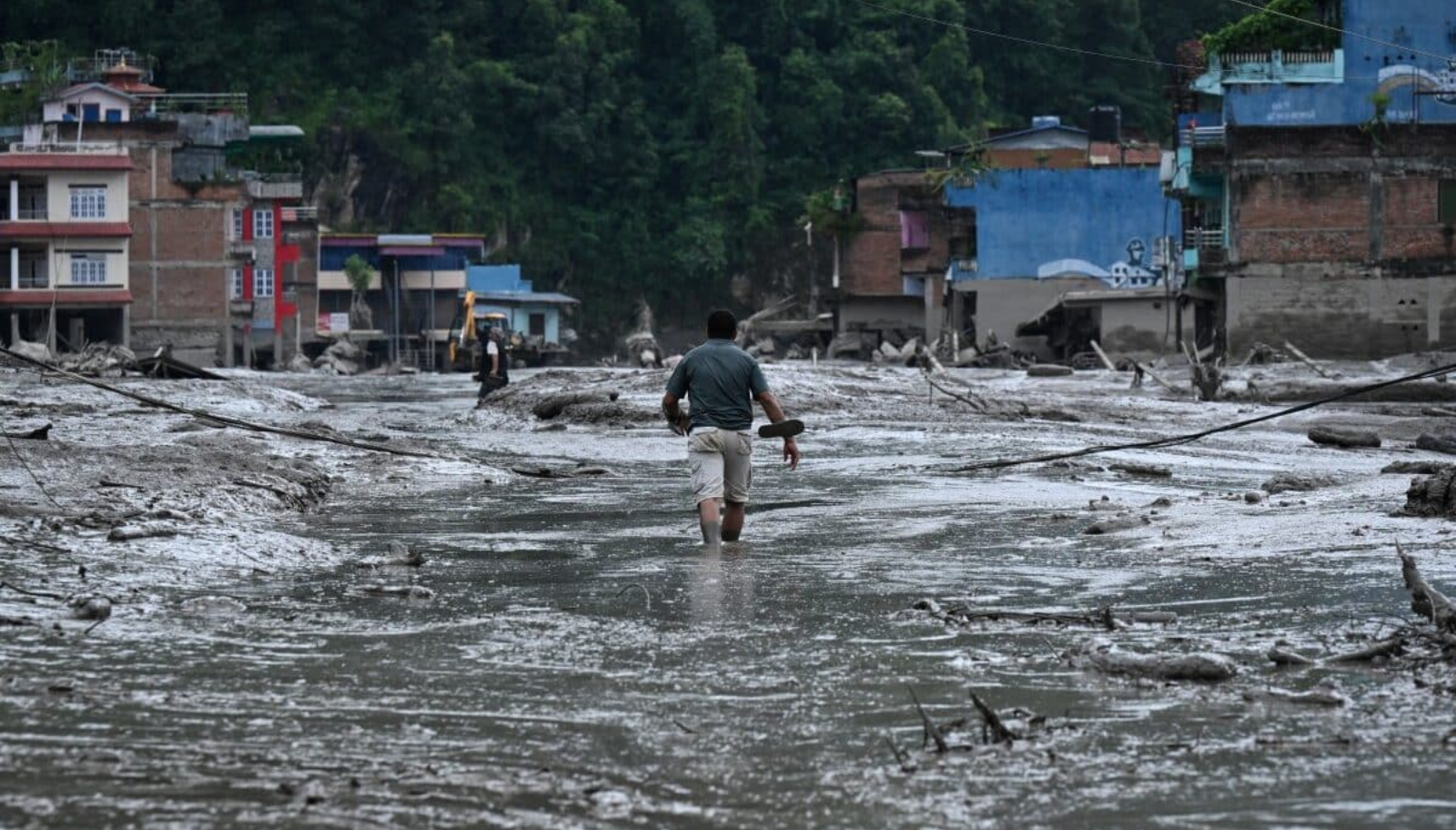
On the morning of August 26, 2026, a ten-meter wall of water swept through Timure and Syabrubesi in Nepal’s Rasuwa district without warning. The Bhotekoshi river, swollen by a high-altitude glacial lake outburst upstream, tore apart trade infrastructure, destroyed bridges, flattened police posts, and consumed hydropower facilities that had taken years to build. Writing in The Daily Star, environmental scientist Sandeep Joshi noted the bitter irony: the Nepalese authorities would call it “unprecedented.” Yet the same landscape had been devastated more than once in a decade. Nothing about it was truly unprecedented. What was absent was honest planning.
Bangladesh should read that diagnosis not as a neighbor’s misfortune, but as a mirror held up to its own future. Sitting at the confluence of the Ganges, the Brahmaputra, and the Meghna, Bangladesh receives the combined drainage of a vast Himalayan watershed. Every extreme event upstream, whether a glacial lake outburst in Nepal, an exceptional monsoon in Bhutan, or cloudbursts over the Meghalaya hills, translates into catastrophic inundation downstream.
In August 2024, the consequences of that geography were on stark display: floods killed at least 71 people, displaced more than 500,000, stranded over five million, and caused estimated damages of 14,421 crore taka. It was described as among the most severe floods in recent history. It almost certainly will not be the last. This article can be considered as a policy warning on this anticipation.
The Statistical Blind Spot Bangladesh Cannot Afford
The central argument of Joshi’s Nepal analysis applies with even greater force to Bangladesh. Planners and engineers across South Asia have long designed public infrastructure around historical averages: the mean annual rainfall, the average monsoon discharge, the typical flood level of a given season. These averages produce predictable numbers that fit neatly into five-year budgets and donor reports. They have almost nothing to say about what actually destroys a country.
Infrastructure does not fail on average days. It fails when a statistical outlier strikes, when the river shows not its mean face but its extreme one. A bridge or an embankment designed to withstand typical monsoon volumes is, by definition, designed to fail the moment variance exceeds that comfortable middle ground. Climate change across the Himalayas is not producing a gentle, linear warming that nudges baseline temperatures upward by fractions of a degree. It is dramatically widening the range of extreme events, stretching the distance between a calm season and a catastrophic one. Glaciers that once regulated seasonal meltwater are now reservoirs of sudden, massive outburst. The tail event is becoming less of a tail, and Bangladesh’s planning assumptions have not kept pace with that shift.
What Bangladesh Has, and What It Lacks
Bangladesh is not without a flood management tradition. The country has developed one of the world’s more extensive early warning systems for cyclones and coastal flooding, and community-based resilience programmes have saved countless lives in coastal areas. Flood shelters, embankments, and the work of the Bangladesh Water Development Board represent real institutional effort over decades. International partners, including the World Bank, have recently committed to supporting flood risk reduction and community preparedness through equipment, training, and drills.
Yet serious structural failures persist. Bangladesh’s flood infrastructure, like Nepal’s roads and bridges, is predominantly designed around historical mean discharge levels rather than variance-based stress tests. Embankments that hold during a typical monsoon are overwhelmed when upstream conditions produce high-sigma events. River dredging and channel maintenance programmes are chronically underfunded and inconsistently implemented, leaving key waterways silted and more prone to overflow.
The country has 64 districts but flood management capacity is heavily concentrated around Dhaka. Rural and haor communities in the northeast, which bear the most acute burden of flash flooding from Indian and Nepali watersheds, remain deeply underserved in terms of early warning infrastructure at the local level.
Perhaps most critically, Bangladesh continues to approach flooding as a disaster to recover from rather than a condition to anticipate and withstand. Post-flood relief absorbs the political energy and budgetary resources that should be directed at pre-flood resilience. Rebuilding the same embankment in the same place to the same specification after every major flood is the South Asian equivalent of what Joshi describes for Nepal: a recurring fiscal drain that delivers the same result each time the river tests it.
The Lessons Bangladesh Must Enact
The first and most urgent lesson is to ban average-based design standards for flood-critical infrastructure. All embankments, bridges, drainage culverts, and river-facing structures must be engineered against high-variance scenarios, not historical medians. The Bangladesh Water Development Board must mandate stress-testing against 100-year or higher variance flood models as a legal requirement for public works approval.
Second, Bangladesh must invest urgently in forecast-triggered action rather than post-disaster cleanup. This means real-time, automated monitoring of upstream river conditions in Nepal, Bhutan, and the Indian states of Assam and Meghalaya, with direct data-sharing agreements and cross-border alert mechanisms. When upstream outburst indicators appear, vulnerable communities must receive warnings and support hours before a flood arrives, not after it has claimed lives. The technology to do this exists. The political will and the bilateral agreements to operationalize it do not yet exist at adequate scale.
Third, the environmental policies underpinning Bangladesh’s river management require fundamental rethinking in line with the country’s own commitments to sustainability. Wetland and floodplain encroachment, driven by unchecked development pressure and weak enforcement of land-use regulations, has reduced the natural buffering capacity that once absorbed floodwaters across haor regions and river margins. Restoring and legally protecting these natural flood sponges is not an environmental luxury. It is critical infrastructure.
Building for the Climate That Exists, Not the One That Did
Joshi’s sharpest observation is that Nepal is building a country for a climate that no longer exists. The same is true of Bangladesh. The planning assumptions embedded in national adaptation plans, infrastructure codes, and disaster risk frameworks were calibrated to a stable climatic baseline that climate change has already dismantled. Every year that Bangladesh delays a fundamental shift from mean-based to variance-based thinking in its flood governance is a year in which the next catastrophic flood is quietly being invited in.
Bangladesh has proven its resilience as a nation through circumstances that would have broken others. But resilience exercised only in the aftermath of preventable disasters is an enormous and unnecessary cost, measured not in taka alone, but in lives, livelihoods, and the cumulative exhaustion of communities required to rebuild over and over again. The lesson from Nepal’s flooded gorges is not that nature is unpredictable. It is that we have chosen to be surprised by events we could see coming. Bangladesh can choose differently.
Reference:
Read also –

