
Farzana Nupur
Stamford University
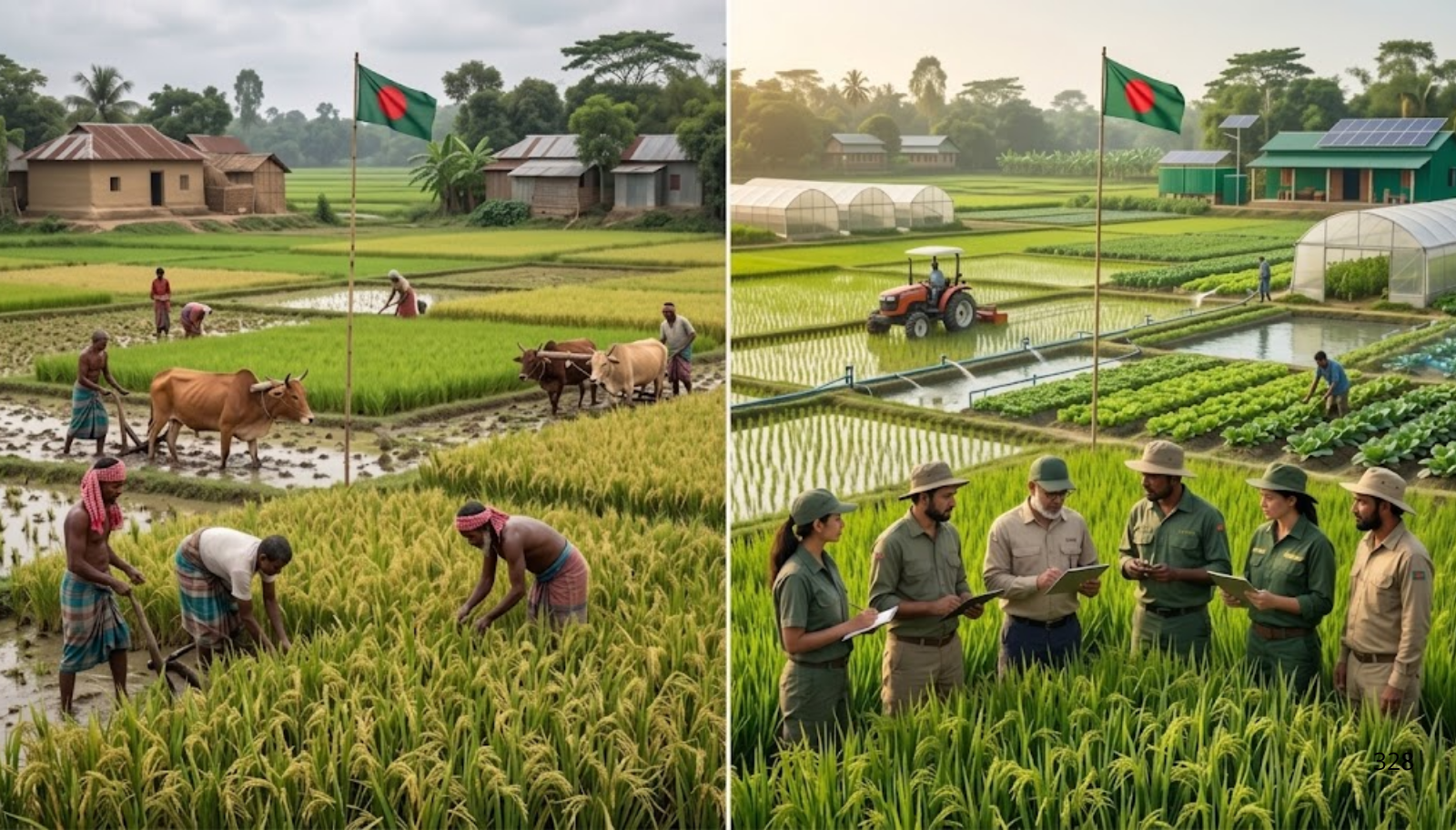
Bangladesh’s current sustainable agriculture roadmap, built around diversification away from rice monoculture, climate smart farming, land tenure reform, and stronger market infrastructure, arrives under a BNP led government. It is worth asking how this vision compares with the party’s own record the last time it held office, under Prime Minister Khaleda Zia between 2001 and 2006.
The comparison is instructive not because the two eras are identical in circumstance, but because it shows how far agricultural policy ambition has evolved within the same party across two decades.
Agricultural Growth: Then and Now
Between 2001 and 2006, Bangladesh’s agricultural economy expanded at an average annual pace hovering around 3 percent, a figure that reflected steady if unspectacular progress rather than any dramatic transformation. That growth rested almost entirely on incremental improvements in rice yields, achieved through the gradual expansion of irrigation infrastructure and the continued adoption of high yielding varieties that had been introduced during earlier waves of agricultural reform.
The gains, while real, were narrow in scope. Cereal production absorbed the overwhelming share of policy attention and investment, leaving comparatively little room for high value crops, aquaculture, or agro processing to develop into meaningful contributors to rural income or export earnings. In effect, the sector’s growth model during this period was one of consolidation rather than diversification, extending the productivity of an existing cereal centered system rather than building new economic pathways within agriculture.
The current plan departs from that model in both ambition and structure. Rather than treating self-sufficiency in cereal production as an end point, it positions productivity growth as something to be achieved through a much wider agricultural base, one that includes pulses, oilseeds, vegetables, fruits, and aquaculture, supported by precision agronomy and integrated pest management practices that were largely absent from the earlier framework. This is not simply a matter of adding new crops to the portfolio. Precision agronomy implies a shift toward data informed input use and site-specific cultivation practices, while integrated pest management signals a move away from blanket chemical application toward more calibrated, ecologically aware interventions. Taken together, and assuming implementation matches design, these elements would mark a structural break from the 2001 to 2006 approach. Where that earlier period pursued more of the same within a single crop category, the current plan aims at a genuinely diversified agricultural economy, a change that is qualitative rather than simply incremental.
| Indicator | 2001 to 2006 (BNP, Khaleda Zia) | Current Plan (Projected) |
|---|---|---|
| Average sector growth | Roughly 3 percent annually | Diversified growth targeted above cereal trend |
| Crop base | Rice dominant | Rice, pulses, oilseeds, fruit, aquaculture |
| Input approach | Subsidy focused on fertilizer supply | Subsidy reform tied to productivity and environment |
| Climate response | Largely reactive | Climate smart agriculture as standard practice |
Input Subsidies and the Fertilizer Crisis
Fertilizer policy shows the sharpest contrast. Between 2001 and 2006, subsidized input distribution buckled under strain by 2006, triggering fatal farmer protests in Kansat, Sherpur, and elsewhere, a warning about unreformed systems facing rising demand.
The current plan proposes redirecting subsidies toward productivity and environmental goals rather than blanket fertilizer provision, while channeling meaningful resources into quality seed systems for non-rice crops. Whether this reform actually materializes will determine whether the sector avoids repeating the supply failures that defined that earlier crisis.
Land, Water, and Climate Resilience
Land fragmentation and water stress were present but not central themes of agricultural policy during the earlier BNP term, when irrigation expansion was treated primarily as a yield lever rather than a resource management challenge. Climate risk received comparatively little structured attention, and adaptation was largely reactive to individual flood or drought events rather than embedded in planning.
The current plan treats land tenure reform, voluntary leasing arrangements, and mechanization through custom hiring centers as core levers for scale economies, and positions climate smart agriculture, including salinity tolerant varieties, alternate wetting and drying methods, and managed aquifer recharge, as standard practice rather than emergency response. This reflects a policy environment shaped by intervening decades of climate science and repeated exposure to flooding and salinity intrusion that the 2001 to 2006 period did not confront with comparable intensity.
Institutional and Market Infrastructure
Post harvest infrastructure, cold chains, and farmer aggregation were underdeveloped throughout the earlier period, with limited public private investment in agro processing or logistics. The current plan places these squarely within its agenda, alongside digital advisory platforms, modernized market information systems, and expanded access to credit and crop insurance for smallholders and women, none of which featured prominently in agricultural policy discussion during the 2001 to 2006 term.
Conclusion
Measured against its own party’s earlier record, the current sustainable agriculture plan represents a considerable widening of ambition, from cereal centered output growth and a subsidy system that ultimately buckled under its own weight, toward diversification, climate resilience, and institutional modernization. The test now is not whether the vision reads more sophisticated on paper, since it plainly does, but whether implementation capacity has grown to match it. The fertilizer crisis of 2006 is a reminder that policy ambition unmatched by delivery systems can produce the opposite of its intended outcome.
Reference: