
Rimsha Seethe
Nottingham Trent University, UK
Bangladesh’s education system has historically defined achievement primarily through examination performance, a metric that, while measurable and administratively convenient, does little to cultivate the disposition that underlies lifelong learning: reading undertaken out of genuine intellectual curiosity rather than in pursuit of grades. This habit remains institutionally underdeveloped across most schools and colleges nationwide, a gap that reflects structural and pedagogical choices rather than any lack of latent interest among students.
Even as policymakers engage in ongoing debate over curriculum reform, comparatively little attention or investment has been directed toward the physical and digital infrastructure, libraries, accessible book collections, digital repositories, and reading spaces, which would be necessary to nurture such a habit at scale. This article creates a foundation to initiate this discussion.
Why Libraries Matter Beyond Exams
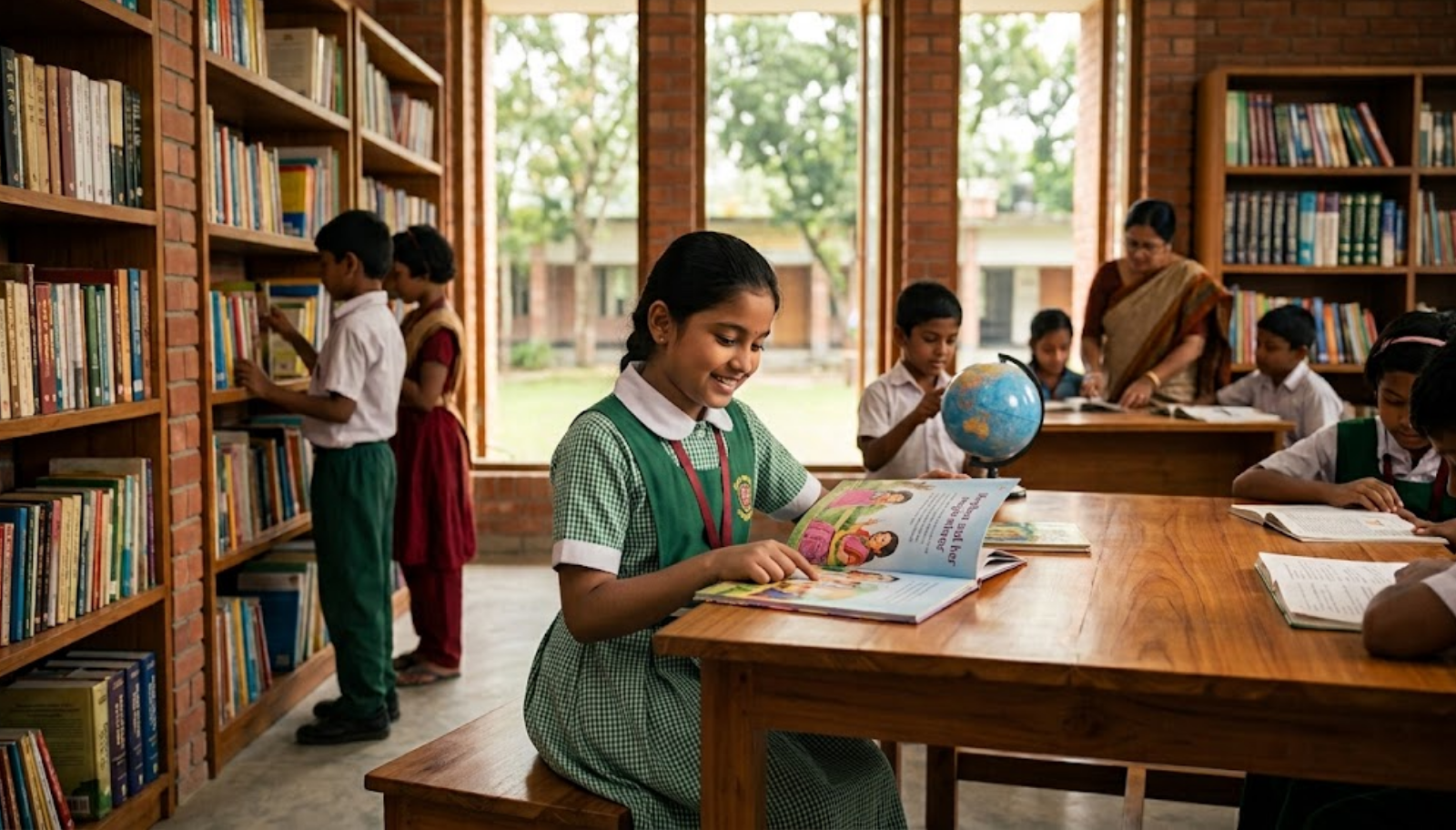
A functioning school library offers more than textbooks, exposing students to fiction, biography, history, and general knowledge that formal syllabi rarely cover, building vocabulary, comprehension, and independent thought beyond what rote memorization achieves. Community organizations already demonstrate impact through affordable book distribution, mobile libraries reaching neighborhoods directly, and storytelling programmes nurturing imagination and language skills outside classrooms. Some schools go further, maintaining separate reading spaces for younger and older students to encourage sustained engagement with books.
The State of School Libraries Today
The reality in most institutions falls well short of this model. Assessments of school and college libraries in Bangladesh have found persistent deficiencies in infrastructural adequacy, reading conditions, the scope of book collections and the competence of library staff, leaving most students dissatisfied with what their library offers. Many schools maintain a library in name only, a locked room with outdated titles rather than a living space for discovery. Recommendations from this research call for sufficient and noise free reading areas, qualified librarians, updated reference collections, and internet connected computers, none of which currently exist as standard provision across the system.
Curriculum Reform Without a Reading Strategy
Since the 2024 student-led uprising, curriculum revision has focused heavily on rewriting historical and political content, adding material on the mass uprisings to Bangla, English and social studies textbooks, with further revisions planned for coming academic years. This is a legitimate and necessary correction, but it illustrates a pattern where curriculum change is driven by political and historical recalibration rather than by a deliberate strategy to embed reading habits beyond the textbook. A curriculum can teach the right history and still fails to teach students how to read for pleasure, critical thought or curiosity, and that second objective has not been given comparable institutional priority.
Signs of Political Attention
Signs suggest the issue has entered public discourse at the highest level, with the current head of government expressing intent to develop children’s reading habits and reduce mobile phone dependence. Such statements reflect genuine awareness, which matters since sustained policy attention typically begins with acknowledgement. Awareness alone, though, has not yet translated into a funded, systemwide programme matching the scale of the challenge.
Judged against documented deficiencies in library assessments, current ministry action falls short of a coherent library development strategy. Textbook distribution remains efficient and curriculum revision proceeds on schedule, but neither addresses the space, staffing, or digital access gaps that keep libraries dysfunctional.
Digital reading platforms and e book access, which could meaningfully reach rural and underserved schools, remain fragmented rather than standard across institutions. Research on rural Bangladesh finds students overwhelmingly use devices for entertainment and social media rather than academic reading, with minimal use of structured educational apps, suggesting that distributing devices or internet access alone, without a deliberate reading programme, will not build the habit policymakers say they want.
What More Should Be Done
Three gaps stand out as priorities. First, every school and college should be required to meet a minimum library standard covering physical space, a trained librarian, and a regularly updated collection, with funding tied to compliance rather than left to individual institutional initiative. Second, curriculum design should formally embed non textbook reading into the school week, through graded reading lists, book review assignments and reading period allocations, rather than treating reading promotion as an extracurricular add on dependent on individual teachers or visiting organizations. Third, a national digital library platform, built specifically for Bangladeshi students and offered in Bangla and English, should be paired with structured teacher guidance on how to use it, since evidence shows that access to digital reading material alone does not translate into better reading habits without deliberate curricular integration.
Conclusion
Bangladesh has the community organizations, the political attention and increasingly the digital infrastructure needed to build a genuine reading culture in its schools. What remains missing is the deliberate policy architecture connecting these pieces, minimum library standards, curriculum time for reading, and a properly integrated digital library, into a single, funded national programme rather than a collection of good intentions and isolated pilot efforts.
Reference:

