
Farah Zahir
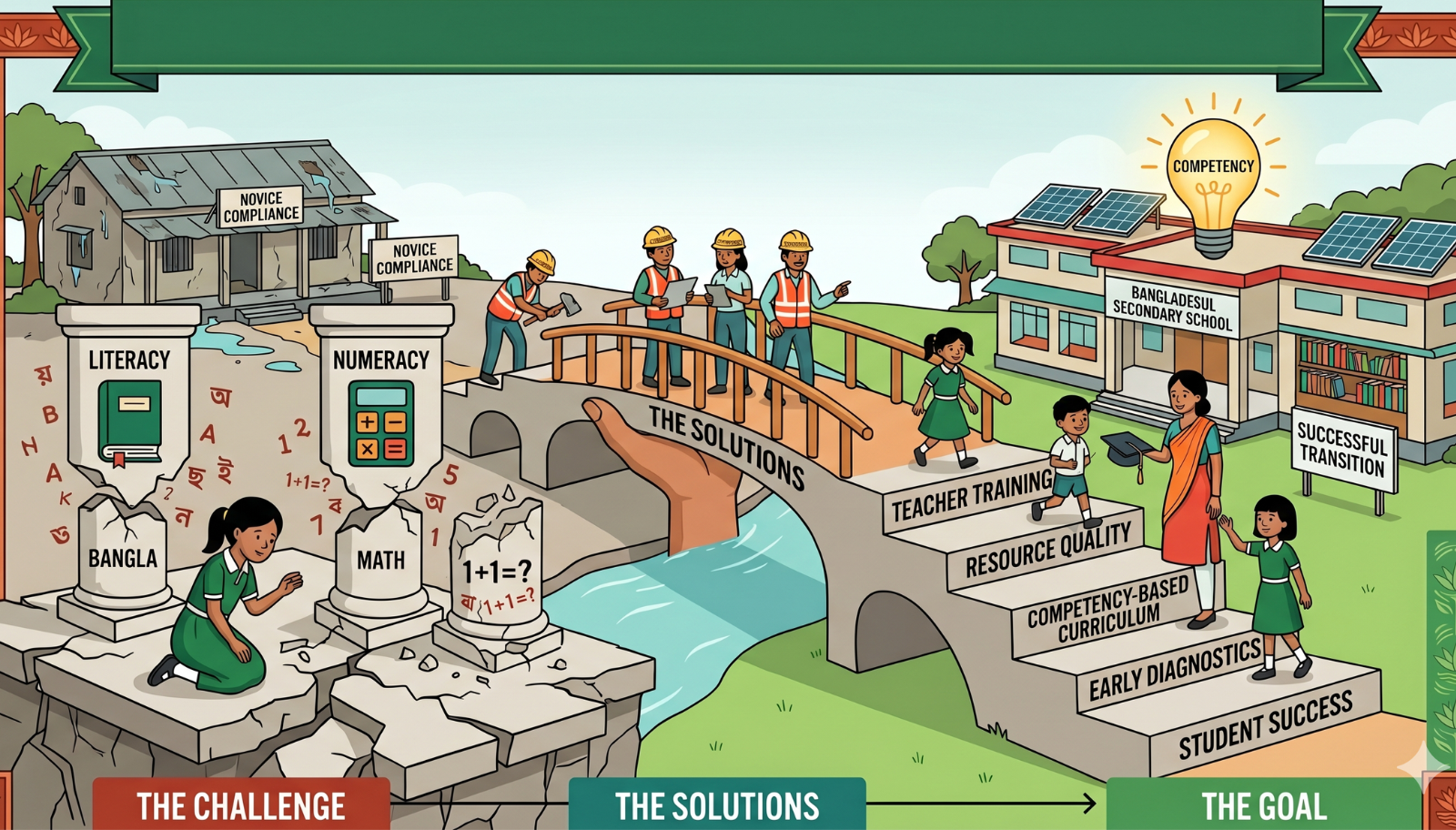
A recent UNICEF-supported assessment of Bangladesh’s primary education sector has exposed a structural learning crisis that extends far beyond conventional concerns over enrolment and school access. According to the findings, approximately 91 percent of Grade 5 students in mathematics and 65 percent in Bangla remain at the “novice” competency level, indicating that most children approaching secondary education are unable to demonstrate even baseline grade-appropriate proficiency. These figures point not merely to weak examination outcomes, but to a deeper institutional failure in ensuring foundational literacy and numeracy during the most formative years of schooling.
While Bangladesh has achieved internationally recognised progress in expanding enrolment, narrowing gender disparities, and extending educational infrastructure into rural regions, the current data underscores a critical policy contradiction: participation in schooling has increased more rapidly than the quality of learning itself. Educational access, although essential, cannot independently serve as a meaningful indicator of human capital development if students’ complete primary education without acquiring core competencies in reading comprehension, written expression, and arithmetic reasoning.
The persistence of weak foundational learning outcomes is not an isolated post-pandemic phenomenon. National Student Assessments conducted over multiple years have consistently revealed deficiencies in primary-level achievement. However, the Covid-19 pandemic significantly intensified pre-existing inequalities by disrupting instruction continuity, limiting access to digital learning resources, and widening disparities between urban and rural institutions, as well as between socioeconomically advantaged and disadvantaged households. Learning loss during prolonged school closures appears to have compounded earlier weaknesses rather than created entirely new ones.
The implications of these deficits are substantial. Research across comparative education systems demonstrates that children who fail to attain foundational literacy and numeracy within the early primary years face sharply reduced probabilities of academic recovery in later grades. As curricula become progressively more abstract and cognitively demanding, unresolved learning gaps accumulate into long-term educational exclusion. Consequently, progression from primary to secondary education increasingly risks becoming administrative rather than competency-based advancement.
Several structural weaknesses continue to reinforce this crisis. Bangladesh’s education system remains heavily examination-oriented, with instructional practices frequently centred on memorisation, textbook reproduction, and procedural recall rather than conceptual understanding. Assessment frameworks often reward short-term retention instead of analytical reasoning or applied problem-solving skills. As a result, students may advance through grade levels without demonstrating genuine mastery of foundational content.
Equally significant is the challenge of classroom capacity. Many teachers operate in overcrowded learning environments with limited pedagogical support, insufficient training in differentiated instruction, and inadequate access to remedial learning tools. The absence of systematic early-grade diagnostic assessments further reduces the system’s ability to identify struggling learners before deficits become entrenched. In many underserved areas, irregular teacher attendance, limited parental literacy, weak school monitoring mechanisms, and insufficient pre-primary preparation also contribute to poor learning continuity.
Addressing this crisis requires policy responses that extend beyond pilot initiatives and short-term recovery programmes. First, public expenditure on education must increase substantially, alongside improved efficiency in budget utilisation. Bangladesh continues to allocate one of the lowest proportions of GDP to education within South Asia. Second, curriculum reform should prioritise competency-based learning, critical thinking, and contextual application rather than content memorisation alone. Third, teacher development programmes must become continuous, practice-oriented, and linked directly to classroom performance. Fourth, targeted interventions are urgently needed for rural and marginalised districts where learning poverty is most concentrated.
Most importantly, education reform must be grounded in evidence-based policymaking rather than administrative expediency. Without sustained institutional commitment to foundational learning recovery, Bangladesh risks producing a generation formally educated in years of schooling yet systematically deprived of the competencies necessary for higher learning, productive employment, and meaningful social participation.