
Sheikh Selim
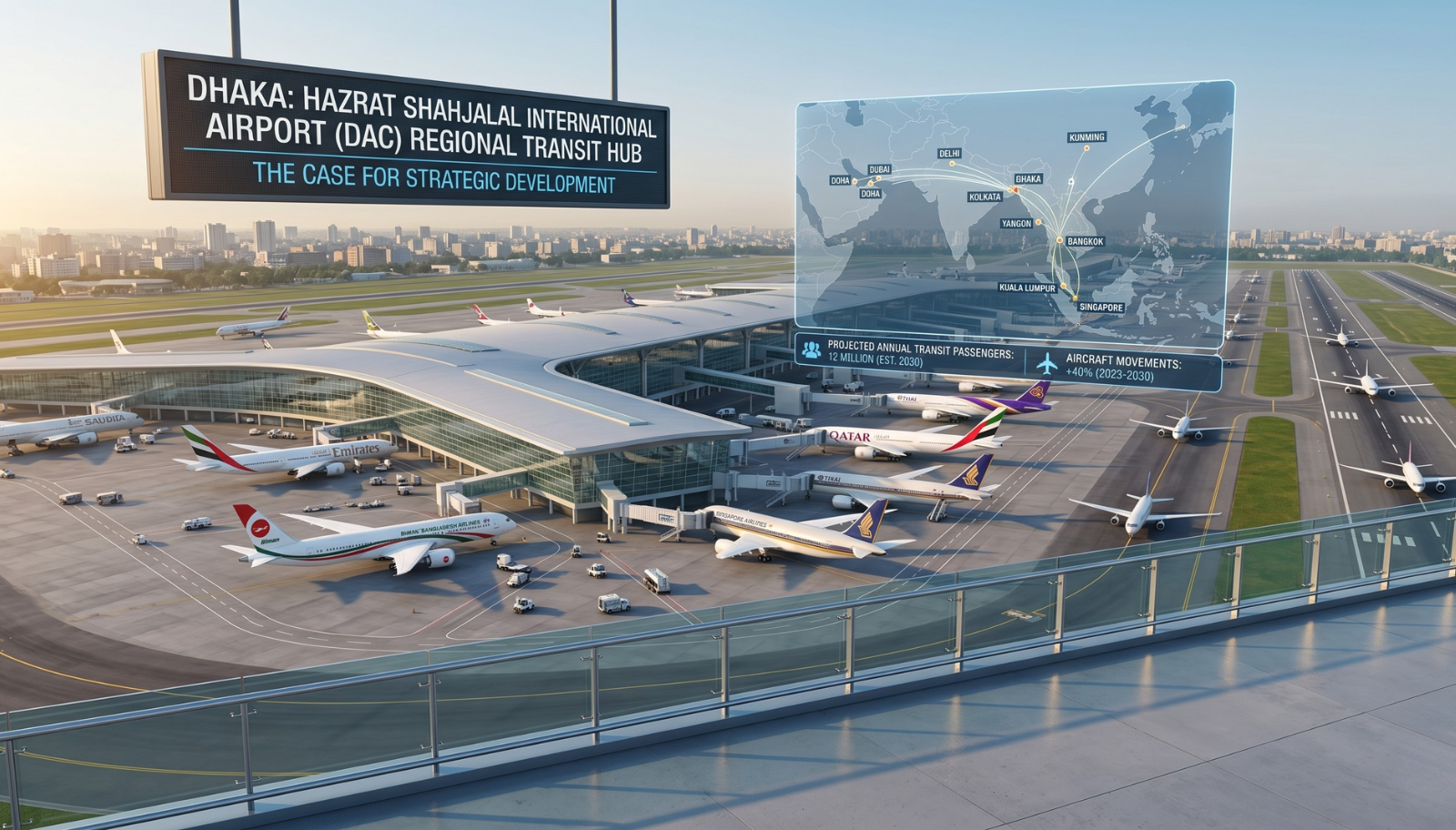
Dhaka is located at the intersection of South and Southeast Asia, a geographical position that naturally lends itself to the development of an advanced aviation infrastructure. However, this potential has remained largely untapped for decades. As global air traffic recovers and regional connectivity become a cornerstone of economic competitiveness, Bangladesh has a unique and time-sensitive opportunity to transform Hazrat Shahjalal International Airport (HSIA) into a premier transit hub for the broader Asian region.
The question is not whether Dhaka can do this. The question is whether it has the will, the policy framework, and the financial strategy to make it happen.
The Significance of Geographical Proximity in Economic Contexts
Dhaka is located within a four-hour flight radius of several of the world’s most populous and economically dynamic cities, including Kolkata, Mumbai, Delhi, Yangon, Bangkok, Kathmandu and Colombo. The island’s position is such that it is proximate to the arc which connects the Middle East to East and Southeast Asia. This route corridor is responsible for the transport of hundreds of millions of passengers and millions of tons of cargo on an annual basis.
In contrast to the deliberate policy based hub status of Singapore and Dubai, which was established despite geographic constraints, Dhaka has an organic positional advantage. It can be posited that airlines operating flights between the Gulf and Southeast Asia, or between South Asia and China, could logically route through Dhaka at minimal deviation. The confluence of this natural catchment, in conjunction with the substantial passenger demand driven by Bangladesh’s diaspora, engenders a dual engine of traffic volume that most aspiring hub cities are simply unable to match.
The present situation: Infrastructure and Institutional Gaps
Despite its geographic promise, HSIA today struggles with chronic congestion, outdated terminals, insufficient runway capacity, and limited ground handling capability. The long-awaited third terminal, currently under phased construction with Japanese financing, represents a significant step forward, i.e expanding annual passenger capacity to approximately 20 million.
The presence of infrastructure does not in itself constitute a hub. The emergence of Dubai as a global aviation powerhouse was not solely attributable to its airport infrastructure. The emirate’s accomplishments are also noteworthy for its role in establishing liberal open-skies agreements, the development of a seamless transit experience, and the integration of aviation with hospitality, logistics, and trade. It is imperative for Dhaka to surmount these challenges and embark on a comparable comprehensive transformation.
Policy and Reforms
The policy architecture required to establish Dhaka as a regional aviation hub must be founded upon multiple pillars. Firstly, it is imperative that Bangladesh adopts a bold open-skies policy. To achieve this, negotiations on bilateral and multilateral air service agreements must be initiated. The objective of these agreements must be to invite foreign carriers to use Dhaka as a connecting point (rather than merely a destination).
The current restrictive air traffic rights regime, which protects Biman Bangladesh Airlines at the expense of competition and passenger growth, must be reformed. It is imperative that Biman undergoes a comprehensive restructuring process to ensure its viability as a commercially competitive airline. This restructuring should focus on the establishment of strategic codeshare partnerships and the expansion of its route network into underserved regional markets.
Secondly, it is imperative to implement a comprehensive overhaul of the transit visa regime. At present, international passengers transiting via Dhaka encounter bureaucratic obstacles that act as a deterrent to layovers, thus diminishing the airport’s appeal to connecting travelers. The introduction of a seamless visa-on-arrival or visa-free transit policy (as implemented in Qatar, the UAE, and Turkey) would serve to immediately enhance Dhaka’s competitiveness.
Thirdly, the Civil Aviation Authority of Bangladesh must be modernised into an independent and professionally managed regulatory body aligned with international standards. This will reduce political interference and improve safety and operational ratings, which in turn will directly influence airline decisions about route planning.
Aviation hubs require collaboration and interconnection to thrive. The establishment of these systems necessitates the presence of surrounding ecosystems that are conducive to hospitality, logistics, cargo, and trade infrastructure. To attract cargo carriers, particularly those specialising in pharmaceuticals, perishables and electronics, Bangladesh must develop airport-adjacent economic zones, hotel corridors and cold chain logistics facilities in a proactive manner. The movement of goods between manufacturing hubs in China, India, and consumer markets in the region can be intricate, but the streamlining of customs clearance processes can enhance the efficiency of value chains, particularly in terms of cost-effective intra-country ground or regional air transit.
For instance, cargo can be cleared in Dhaka and subsequently transported by ground or air to Bhutan, Nepal, or Myanmar, exemplifying the potential benefits of streamlined logistics. The establishment of Special Economic Zones (SEZs) connected to the airport via dedicated road and rail corridors would serve to further enhance the commercial value of the hub.
The tourism infrastructure in Dhaka is currently inadequate for high-volume transit passengers. It is imperative that this infrastructure is upgraded to convert short stopovers into revenue-generating city experiences, definitely within cultural capacities.
The reasons for which the investment merits serious consideration
The economic dividends of a successful aviation hub are substantial and well documented on a global scale. The establishment of a functional regional transportation hub in Dhaka has the potential to generate a significant number of direct and indirect employment opportunities in various sectors, including aviation, hospitality, logistics, and retail. The proposed initiative has the potential to generate substantial increases in foreign exchange earnings, thereby reducing the financial burden on exporters’ reliant on-air freight.
Furthermore, it is anticipated that this initiative will enhance Bangladesh’s global profile, positioning it as a modern, connected economy. For a nation undergoing an economic transition from medium income status and seeking to attract foreign direct investment, the designation of an airport as a hub does not represent a frivolous undertaking; rather, it constitutes a strategic economic multiplier.
The Costs and Risks: Eyes Open
The financial demands are considerable. Full terminal expansion, runway upgrades, ground transport integration, and digital infrastructure could require investment more than five billion US dollars over a decade (IMF estimate, 2025). There are also competitive risks. Kolkata, Yangon and Colombo are also strategically aligning their development plans with the objective of enhancing regional connectivity. Institutional corruption, bureaucratic inefficiency, and political instability persist as structural risks, with the potential to act as deterrents to private investors and airline partners alike. These challenges are addressed with transparency and not solely for the purpose of composing a business proposal.
The most efficient financing model for this ambition is a blended public-private partnership framework. Japan’s JICA, which is already financing the third terminal, should be engaged in the discussion for further infrastructure phases under concessional loan arrangements. The Asian Development Bank and the Islamic Development Bank represent additional multilateral financing sources that are aligned with Bangladesh’s development profile.
Critically, the government should structure terminal operations, duty free retail, and cargo handling as long term private concessions, attracting experienced international airport operators such as Changi Airports International, Fraport, or TAV Airports who bring both capital and operational expertise. Sovereign sukuk bonds and green aviation bonds targeting ESG-focused institutional investors in the Gulf and Europe could supplement these sources, broadening the financing base while reducing over-dependence on any single creditor.
The Window Is Open – But Not Forever
The prospect of Dhaka becoming a regional aviation hub is not merely theoretical; it is a tangible, though not permanent, possibility. This objective is both carefully achievable and dependent on political courage, institutional reform, and strategic investment. Realising such investment requires discipline and transparency in execution. The geographical advantages are already in place, and demand for this service is steadily increasing.
To attain this goal, Bangladesh must demonstrate effective governance along with a clearly defined vision, thereby securing its place among the leading nations of the world.