
Ruksana Akhter
Freelance Architect
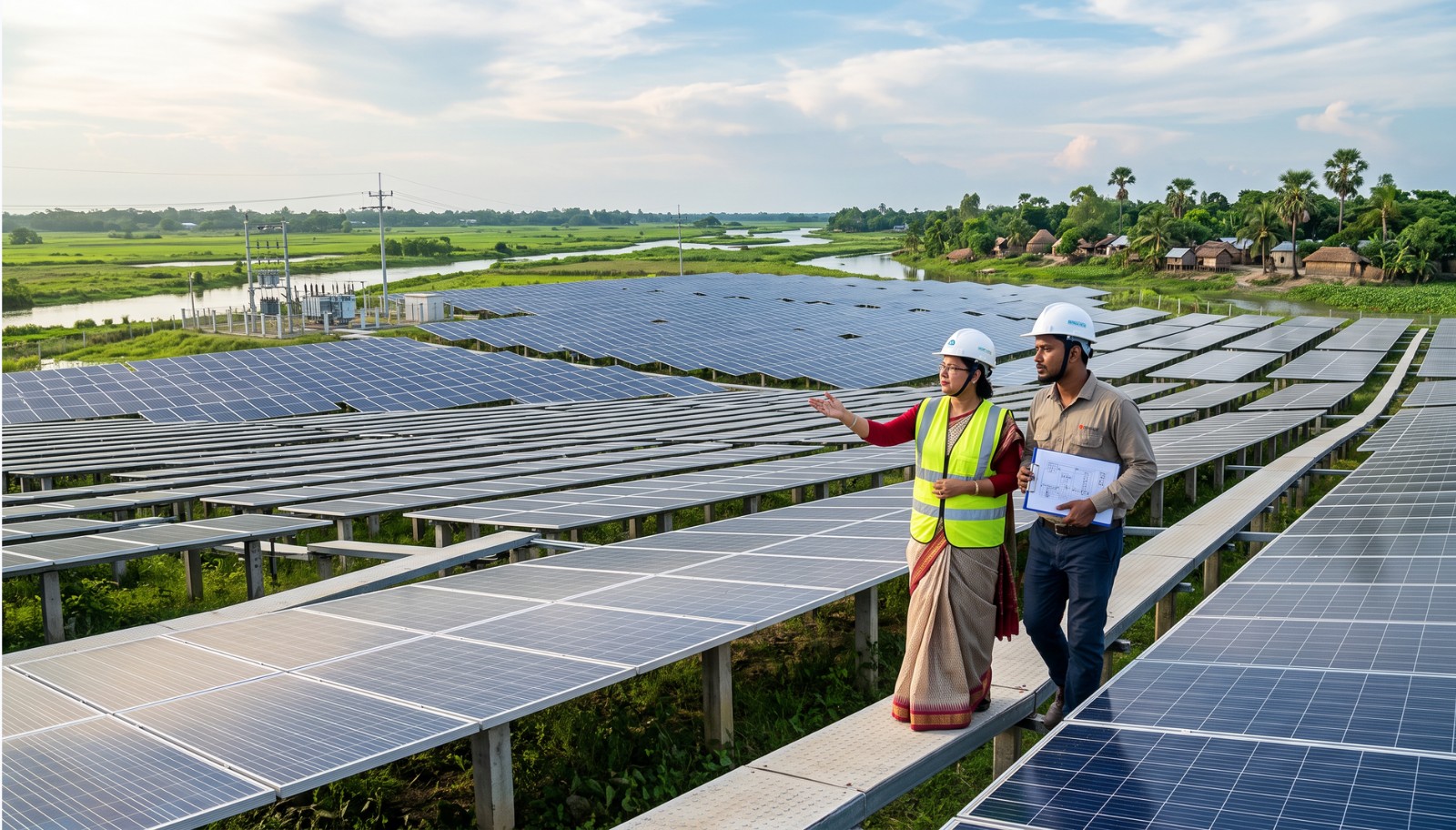
Bangladesh’s leadership has positioned solar power as a key component of the nation’s energy strategy, promoting incentives for both rooftop and utility scale photovoltaic installations as part of a broader effort to strengthen energy security. This ambition is well supported by geographic and economic factors, but turning that potential into lasting, equitable benefit will take more than subsidy programs and the installation of panels alone.
The Case for Solar in Bangladesh
Bangladesh sits within a high irradiance solar belt and receives abundant sunlight for most of the year, while electricity demand keeps rising with urbanization and improving living standards. The falling cost of photovoltaic technology strengthens the argument further, making solar one of the cheapest new sources of generation available to the country.
The nation has already shown that large scale deployment is achievable, since its off grid solar programme has electrified millions of rural households, and several utility scale projects and public private partnerships are now underway. These are genuine achievements that any incentive scheme can build upon.
Where the Momentum Stalls
Despite these gains, progress appears to have reached a ceiling. Private investors remain cautious, held back by financing gaps, high perceived risk, and a regulatory environment marked by inconsistent tariff frameworks, slow approval processes, and unpredictable procurement. The grid itself adds constraint, since limited storage capacity and ageing infrastructure struggle to absorb the variable output that solar generation produces, creating curtailment risk that weakens project economics. Land scarcity compounds the problem, as large scale solar parks compete directly with agriculture and settlement in one of the most densely populated countries in the world. An incentive scheme aimed at panels alone does not resolve any of these underlying constraints.
Sustainability of the Initiative
Sustainability must be judged more than installed capacity. Subsidies that boost panel purchases without matching investment in storage and grid modernization risk generating power that cannot reliably reach consumers, undermining both the environmental and economic case for the programme. Genuine sustainability requires grid upgrades, including smart meters, digital controls, and expanded battery storage, proceeding alongside capacity growth so new solar output becomes dependable electricity rather than wasted generation.
Land smart approaches, such as floating solar on reservoirs, agrivoltaic systems sharing space with crops, rooftop installations, and use of degraded land, allow expansion without displacing food production or communities, essential given Bangladesh’s scarce, contested land.
The Actual Benefit
The real benefit of the initiative depends on who captures it. If gains concentrate among affluent households and large developers able to access financing, the programme risks widening rather than narrowing energy inequality. Extending its reach to lower income households and small businesses requires financing tools that do not yet exist at scale, such as blended finance combining concessional loans, guarantees and equity, along with pay as you go models for rooftop systems and local currency financing that reduces foreign exchange exposure. Only with these tools does the incentive scheme’s benefit move beyond urban rooftops and utility scale projects into households that currently cannot access conventional credit.
Measuring Against the UN Sustainable Development Goals
Against SDG 7, affordable and clean energy, the initiative aligns well in principle, since solar directly expands access to modern energy and can reduce reliance on costly fuel imports. Against SDG 13, climate action, the displacement of fossil generation offers a clear environmental gain, provided end of life panel recycling and site assessment are built into the programme rather than treated as an afterthought. Against SDG 8, decent work and economic growth, and SDG 10, reduced inequality, the picture is far less settled, because these goals are only met if local manufacturing, workforce training, and community ownership models are deliberately built into the incentive structure rather than assumed to follow automatically from capacity growth.
Caveats and Obstacles to Practicality
Several obstacles stand between the initiative and its stated ambition. Financing remains difficult for smaller developers and households, tariff and procurement rules remain inconsistent enough to deter long term investment, permitting and land acquisition processes remain slow and fragmented across agencies, and the grid’s storage and distribution limitations threaten to curtail solar output even where installation succeeds. Without addressing these together, the incentive risks becoming a partial success confined to well-connected developers rather than a national transformation.
Three Reforms for Success
The prime minister’s vision correctly identifies solar as a natural strength for Bangladesh, and the political will behind an incentive programme is a genuinely encouraging signal. Three reforms stand out as essential to sustaining that success. First, long term, technology neutral renewable targets paired with streamlined digital permitting and standardized contracts would give investors needed certainty. Second, stable, transparent tariff mechanisms, including long-term power purchase agreements, competitive auctions, and blended financing, would open the programme to smaller developers and households, not just large players.
Third, a social equity framework covering local manufacturing, workforce training, community ownership, and targeted subsidies would ensure the benefits are as widely shared as the sunlight itself.
Reference: