
Shudev Barua
Freelance Columnist
Over the past few weeks, one headline has been dominating news publications across Bangladesh: “The World Bank has predicted job losses in Bangladesh induced from the war in the Middle East to climb up to 600,000, with 1.2 million fewer people escaping poverty”. While it has primarily been known through newspaper articles, the insights originate from the World Bank’s own Bangladesh Contingent Emergency Response Project (CERP) project paper, dated June 2026. The paper states that Bangladesh was previously expected to have 1.7 million people escape poverty in 2026 but under the Middle East conflict scenario, this falls to only 500,000. That is a reduction of 1.2 million people in the expected number escaping poverty.
Alongside that, nearly 600,000 jobs are expected to be lost, even as Bangladesh’s poverty count had already increased by approximately 1.4 million people in 2025. Rising prices are estimated to account for about 10% of the increase in poverty in 2026, while partial energy-price pass-through could raise inflation by more than 0.5 percentage points.
After seeing the forecasts, one may question the credibility of the World Bank’s forecast at such a scale. Bangladesh’s total labor force was approximately 74.7 million in 2025, meaning 600,000 projected job losses equal roughly 0.80%, or 8 out of every 1,000 people. It is also equivalent to roughly 53% of the 1.13 million Bangladeshis who went abroad for work in 2025, with roughly 67% going to Saudi Arabia.
The importance of the Middle East to Bangladesh is substantial. According to Bangladesh Bank data for 2025, approximately 81% of Bangladesh’s overseas workers were employed in Gulf countries, while Gulf employment generated approximately 46% of Bangladesh’s remittance inflows. In FY2025-26, Bangladesh received total remittances of $35.59 billion, with Saudi Arabia, the UAE and Oman contributing $5.85bn, $4.58bn and $2.05bn, respectively. As remittances have remained extremely strong despite the conflict, the risk is not that they collapse overnight, but that the conflict eventually pivots a shipping/energy shock towards a Gulf-employment and economic-growth shock.
Bangladesh’s exposure to the Middle East’s energy market is equally significant. Prior to the disruptions in the Strait of Hormuz, Bangladesh got more than 50% of its primary energy supply from gas, had seen domestic gas production decline by 15% from its 2016 peak, obtained approximately 60–65% of its crude oil from the Middle East and approximately 55–60% of its LNG from the Middle East. After the conflict hit, 5 of Petrobangla’s 6 LNG supply contracts were declared force majeure, LNG spot prices reached approximately $24–28/MMBtu—more than twice the pre-shock level—and total energy subsidy costs were estimated at $2.5–4.8 billion, compared with approximately $1.5–2.5 billion in recent years.
The transmission mechanism is simple yet unignorable: Middle East conflict → Oil/LNG supply disruption → Higher international energy prices → Higher fuel, electricity and industrial energy costs → Higher production costs → Lower profit margins → Businesses reduce production/investment/hiring → Employment losses. At the same time, higher energy prices raise transport, fertilizer and food costs, increasing inflation and reducing real household income and consumption.
Private-sector conditions add to the concern. In FY25, overall investment growth was only 0.8%, private investment growth approximately 0.1%, private-sector credit growth fell to 6.5%, its lowest level in 22 years, capital-goods machinery imports fell 10.2% and development expenditure contracted 25.5%. Industry grew only 4.0%, compared with an approximately 8.9% average over the previous decade.
Inflationary pressures validate the concern further. World Bank records show inflation rising from 6.1% in FY22 to 9.0% in FY23, 9.7% in FY24 and 10.0% in FY25. Food inflation reached 13.8% in November 2024, while Bangladesh Bank reported point-to-point inflation of 8.32% in July 2026.
Past labor-market shocks also demonstrate Bangladesh’s vulnerability. During COVID-19, a World Bank business survey found that approximately 37% of Bangladesh’s workers had lost their jobs, temporarily or permanently, while 58% of firms reduced working hours. Another World Bank-supported survey found that roughly 68% of respondents in Dhaka and Chattogram who had stopped working reported job loss.
Bangladesh had also experienced three consecutive years of slowing growth by FY25: 7.1% in FY22, 5.8% in FY23, 4.2% in FY24 and 4.0% in FY25. This can be illustrated using the chart below.
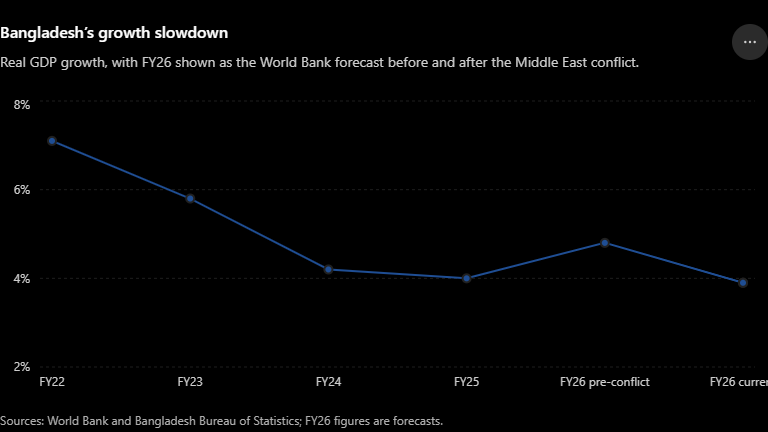
Before the Middle East conflict became a major additional shock, the World Bank had projected FY26 growth at 4.8%, but its April 2026 Bangladesh Development Update downgraded this to 3.9%- approximately a 19% deterioration.
The labor market’s starting point is already poor: youth unemployment was around 8% in 2023, youth unemployment among university graduates around 14%, and approximately 16% of young people were NEET. Meanwhile, microenterprises alone contribute up to approximately 25% of GDP and provide around 56% of jobs, making the economy particularly exposed to higher fuel, transport and working-capital costs.
As of early September 2026, the energy disruption remains relevant. Reuters reported Asian spot LNG prices around $23.20/MMBtu, more than twice pre-conflict levels, while Brent crude ended September 4 at approximately $96.28/barrel after rising 7.6% during the week. August 2026 Hormuz exports were only approximately 2.3 million barrels/day, versus 15.82 million barrels/day before the conflict.
However, historical data necessitates awareness of the nuances of World Bank forecasts. In June 2020, the Bank projected Bangladesh’s FY20 growth at only 1.6%; actual growth subsequently came in at around 3.4%. For FY2024, it projected 5.6%, whereas subsequent estimates put actual growth at about 4.2%.
The resilience of remittance deserves equal attention. Bangladesh recorded $3.75 billion in remittances in March 2026. Therefore, the question is whether the conflict remains sufficiently prolonged to move from an energy-market shock to a Gulf economic slowdown, migrant employment shock and weaker domestic investment.
In conclusion, Bangladesh does not risk losing 600,000 jobs because the World Bank is infallible. For an economy already suffering from weak investment, elevated inflation, slowing growth and extraordinary dependence on Gulf labor markets and Middle Eastern energy, the insulation left for another external shock may indeed be negligible. If the conflict de-escalates and Gulf employment remains resilient, Bangladesh could avoid the worst-case scenario. If the energy disruption and Gulf slowdown persist, however, the 600,000 figure may prove less a sensational headline than an early warning.

