
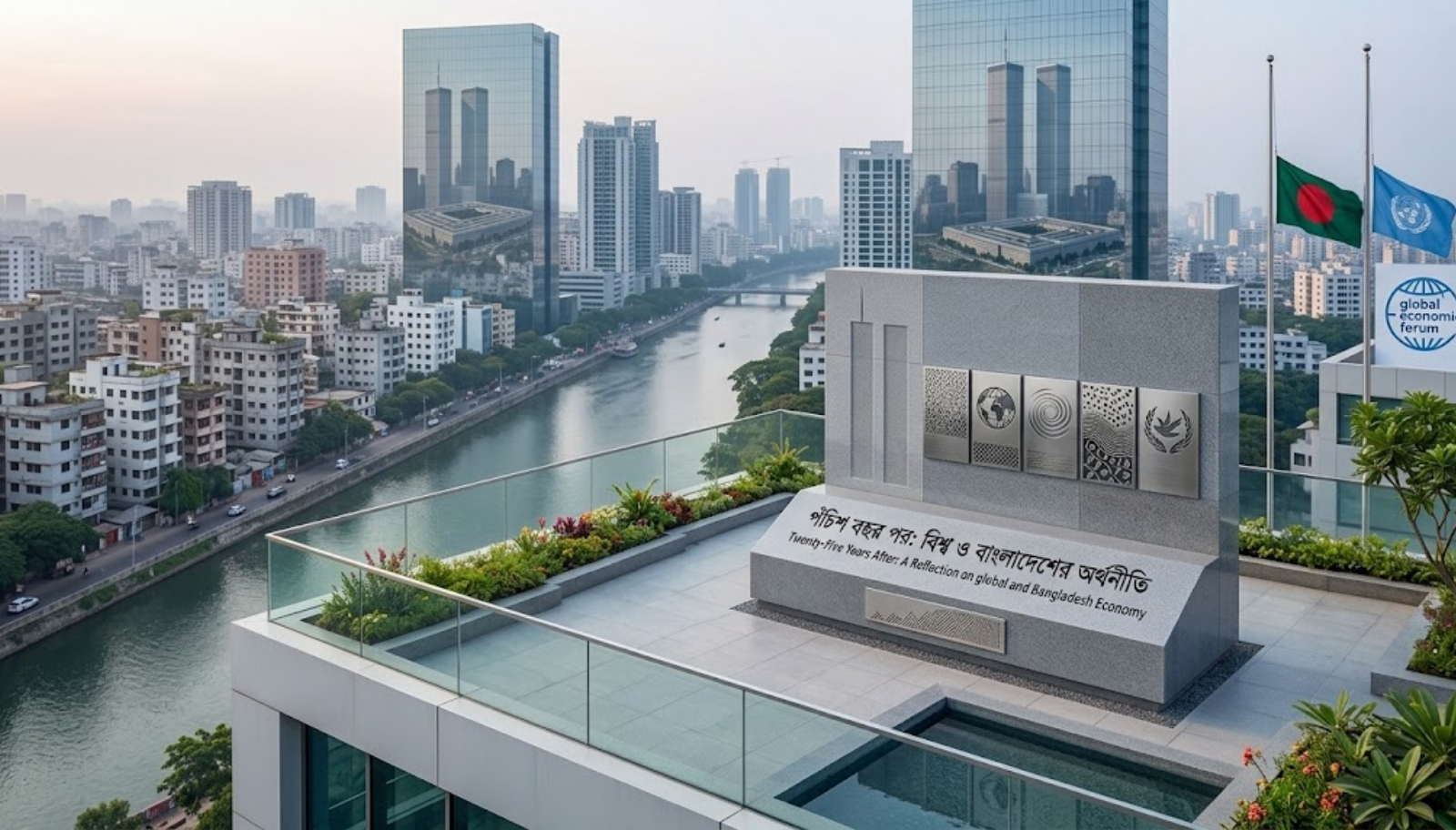
Sheikh Selim
I was a young researcher assembling a PhD proposal for American universities when the towers came down in September 2001. Twenty-five years later, I can still feel the weight of that week, and it is heavier now in memory than it was in the moment.
What I watched on television was an attack on a city I had dreamed of joining, and by any serious reading of international law, a crime against humanity: the deliberate mass murder of civilians. In the days after, I felt grief for the thousands killed, and a quiet, mounting dread that people like me would now be counted, in some unspoken ledger, alongside the men who did it.
My anxieties that week were narrow and personal: whether a Muslim name on an application would carry a cost I hadn’t priced in. I was in my twenties, and I remember fear settling into ordinary routines: the pause before mailing an envelope, rehearsing answers no one had asked, learning that innocence was something I might be asked to prove.
Twenty-five years later, with a career built substantially inside a Western university, I find that the question I asked as a student was both too small and, in its own way, prescient. It was too small because 9/11 did not just reshape admissions decisions, it reshaped the entire architecture of how Bangladesh and the West exchange people, money and ideas. It was prescient because the distrust I feared as an individual turned out to be a measurable, documented, and lasting feature of the system.
From Personal Grief to a Larger Understanding
An economist trained today would not describe 9/11 primarily as a security event. We would describe it as a shock that altered the relative price of trust between two populations and then trace how that repriced trust moved through education, labor markets, remittance channels and diplomacy. And yet the language of economics can feel thin against the moral fact of what happened that morning.
When civilians are targeted precisely because they are civilians, the world has long had a name for it, and that name is crimes against humanity. Naming it this way matters to me for two reasons, and both have shaped my scholarship. It honors the victims, and it reminds us that the correct answer to such a crime is the rule of law applied to the guilty, not suspicion distributed across the innocent. My own shift over twenty-five years has been from a young man worrying about his visa file to an academic who sees that file as one observation in a much larger dataset of policy induced friction, and from a frightened witness to someone who believes that collective punishment, wherever it appears, is itself a cousin of the crime it claims to answer.
Bangladesh and the West: A Relationship Reshaped, Not Severed
In the years after 2001, the United States, the United Kingdom and continental Europe reallocated budgets toward security and military spending, at the expense of research funding, overseas development assistance and the academic exchange that had drawn my generation toward Western doctoral programmes. Bangladesh, a Muslim majority country with no role in the attacks, absorbed reputational fallout without gaining the strategic attention given to Pakistan and Afghanistan, which became major recipients of security linked aid. Bangladesh remained a secondary partner, valued for garment exports and labor, not strategic priority.
Over the following decades, the relationship grew more transactional and securitized. Trade preferences, financing and education partnerships continued, but increasingly filtered through risk assessment that hadn’t existed before. Universities that once recruited Bangladeshi students on merit alone added visa scrutiny, background checks, and at times suspicion.
Remittance and Migration: The Long Shadow of NSEERS
The most concrete evidence of this shift lies in migration data. After 9/11, the United States introduced the National Security Entry Exit Registration System (NSEERS), a mandatory registration regime applied to nonimmigrants from twenty-five countries, Bangladesh among them. Embassy figures show 7,238 Bangladeshi nationals registered, of whom 855 were placed into removal proceedings, while community estimates suggest more than five thousand Bangladeshis left the United States rather than risk the process.
This was not abstract policy; it was thousands of individual decisions to abandon jobs, studies and family ties out of fear that engaging with the immigration system had itself become dangerous.
The chilling effect extended well beyond those directly registered. Community leaders reported that Muslim, Arab and South Asian residents, including many with legal status, grew reluctant to report crimes or engage with authorities at all. That is a textbook trust externality, where punitive treatment of a small number imposes a behavioral tax on an entire population that had done nothing wrong. There is something morally uncomfortable, I would say more gently now, about a state answering a crime against humanity with tools that quietly punish populations by ancestry or faith, however unintended.
The longer run data tells a more complicated story. Legal permanent residency grants to Bangladeshis stood at 14,890 in fiscal year 2019, fell to 9,010 in 2020 and 6,180 in 2021 amid pandemic disruptions, then recovered to 10,140 in 2022 and 18,240 in 2023. Family sponsorship has remained the dominant channel of migration for decades, a pattern predating 9/11 that proved resilient to security driven shifts, even as employment based and diversity pathways stayed comparatively narrow. What changed after 2001 was not the structural shape of migration but its emotional and administrative cost, every application now carrying an implicit tax of suspicion absent for the generation before mine.
Remittances tell a story of resilience rather than rupture. Bangladesh recorded its highest ever remittance inflow last year at 32.82 billion US dollars, with the United States ranking fourth among sending countries at eleven per cent of the total. Those who endured post 2001 scrutiny kept sending money home, simply under a heavier administrative and psychological burden, perhaps the clearest lesson of the period: security policy can raise the cost of mobility without eliminating the economic logic driving it.
Trust, Distrust and the Migration Bridge
The distrust 9/11 created between American security institutions and Bangladeshi Muslims did not stay frozen in 2002. It evolved. Second generation Bangladeshi Americans increasingly describe their identity in broader South Asian or simply American terms rather than the narrow religious lens imposed on their parents, yet the underlying suspicion has not disappeared so much as changed its trigger. More recently, visa restrictions have been justified by democratic governance and electoral conduct rather than terrorism, proof that the machinery built after 2001 found new justifications instead of being dismantled.
For ordinary families, this has meant persistent friction reconnecting with relatives who migrated earlier. Visa delays, reunification backlogs and policy suspensions have stretched routine visits into multiyear uncertainties, eroding the ties that once made diaspora communities effective conduits for capital and knowledge.
A Position to Propose Reform
As a young economist I could offer no answer to mass terror, only fear. The fear of a twenty-something applicant in a distant country is not trivial. It is one of the small human costs that, aggregated across millions of lives, forms the true bill of a great crime. With twenty-five years of research behind me, I can at least outline the direction reform must take.
The method of nationality-based profiling functions as a crude form of statistical discrimination (using group identity as a proxy for risk because individual screening is costly). Governments should instead invest in better information systems, particularly the tracing of financial architecture that enables conflict and proxy warfare, allowing institutions to substitute genuine risk assessment for that proxy and reduce the deadweight loss imposed on innocent populations. Alongside this, mobility and education policy should be decoupled from short term security anxiety. Human capital investment requires a long-time horizon and cannot be priced efficiently under constant policy uncertainty, so multiyear, renewable visa frameworks for students and skilled workers should replace ad hoc, executive level suspensions, giving families, universities and employers the predictability of such investment demands.
Remittance and migrant community channels also deserve recognition as development infrastructure in their own right. These flows function as a public good and merit protection from abrupt disruption, much as trade agreements shield commercial supply chains from arbitrary tariffs. Treating them incidental rather than structural has left them vulnerable to policy shifts that bear no relation to their actual economic function.
Development assistance to countries such as Bangladesh should be rebalanced away from security weighted allocation criteria and toward genuine investment in education and institutional capacity. This would correct the structural inequality that leaves such countries strategically peripheral even as their expatriate communities make a real and measurable contribution to Western economies.
None of this guarantees that terror will not happen again. But a system that responds to a crime against humanity by doling out suspicion to the innocent only breeds the very resentment that violent movements feed on, a quieter injury in its own right. That must end. This is the key reform I would propose.

