
Sumaiya Hasi
Oniket Research Group
Background
On August 31, the Centre for Policy Dialogue (CPD) convened a national dialogue titled “e-Governance in Local Government Institutions: Present Status and the Way Forward.” The event brought together researchers, civil society representatives, government officials, and young citizens to examine how digital tools are reshaping local governance in Bangladesh, and to what extent they are delivering on their core promise: bringing services closer to citizens as a matter of right rather than administrative convenience.
Current State of Digital Services at the Local Level
The keynote research paper presented in the dialogue outlined the present reach of e-governance across union parishads, municipalities, and upazila parishads. Basic services, including birth and death registration, citizen certificates, social safety net allowance disbursement, and trade licensing, are gradually moving onto digital platforms. However, the paper noted that institutional weaknesses, a shortage of skilled personnel, and persistent technological divides continue to leave ordinary citizens facing considerable difficulty when trying to access these services.
Civil Society: Digitization Must Reduce, Not Recreate, Barriers
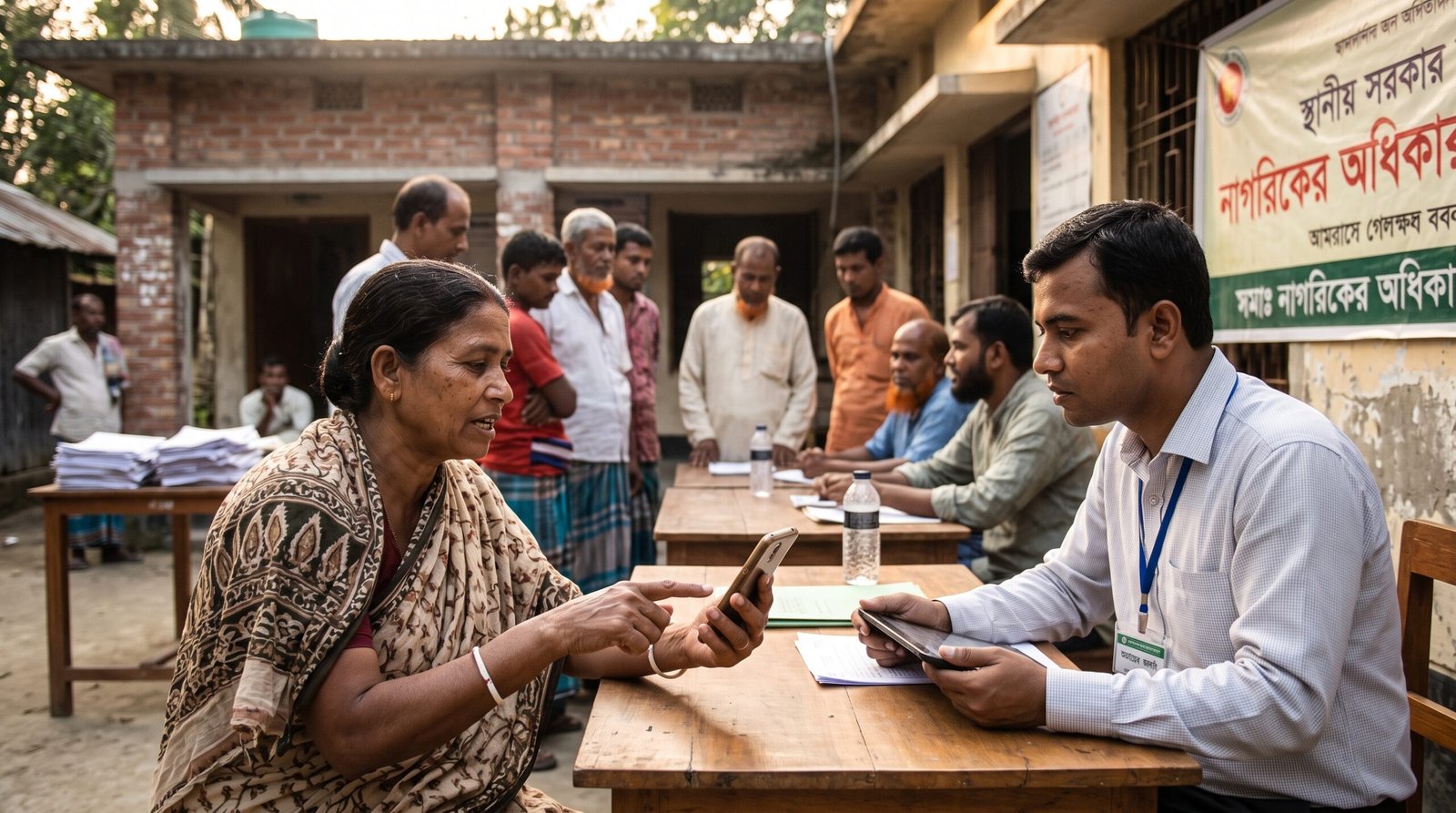
Civil society representatives and citizen rights researchers argued that local government represents the first and most important point of contact between the state and marginalized populations. They stressed that the central purpose of digital services at this level should be to cut down bureaucratic complexity and corruption, not merely to modernize existing procedures. Particular emphasis was placed on ensuring that rural women, disadvantaged communities, older citizens, and young people can access government benefits directly, without discrimination or exploitation by intermediaries. Speakers cautioned that technology, if poorly designed, risks introducing new forms of digital inequality rather than resolving old ones.
Government Perspective: Acknowledging Ground-Level Constraints
Representatives from the administrative and government side acknowledged significant implementation challenges in the field, including slow internet connectivity, frequent power outages, technical disruptions at central servers, and inadequate training for union parishad secretaries and digital center entrepreneurs. They described the core task of e-governance as achieving effective coordination between government policy and citizen demand and pointed to the need for greater infrastructure investment and budget allocation to bring services closer to the public.
Citizens’ Concerns: Transparency and Genuine Service Quality
The open discussion session gave local representatives, academics, and young participants a direct platform to raise citizen level concerns, most centered on service quality and transparency. Participants questioned the real value of a digital certificate application if citizens still had to make repeated in person visits to government offices or pay unofficial charges despite applying online.
This exchange helped crystallize a central message of the dialogue: the true measure of e-governance should not be the extent of procedural modernization, but the degree to which citizen rights are genuinely strengthened.
Reframing the Government’s Role
A recurring theme throughout the dialogue was a shift in how government responsibility should be framed relative to citizen entitlement. Rather than treating the number of online portals launched or digital services introduced as measures of success, participants argued that success should be judged by whether ordinary citizens can access these services as a right, without obstruction, and with dignity. In this framing, government spending on digital infrastructure is not a discretionary favor but a constitutional obligation, and government performance should ultimately be evaluated through citizen satisfaction and the actual rate of rights fulfilled.
A Roadmap for the Way Forward
Drawing on the dialogue’s recommendations, four priority areas emerged for consolidating citizen rights through local e-governance.
Closing the digital divide. Digital platforms and mobile applications need simple, inclusive interfaces available in Bangla, supported by free assistance desks at local offices for those unable to navigate technology independently, alongside dependable, high speed internet access in rural and remote areas.
Institutional transparency and safeguards against corruption. A unified service tracking system would let citizens monitor their application status at any time, with automatic justification required for delays. This should be paired with robust data protection and cybersecurity measures, and mandatory cashless payment gateways to eliminate opportunities for informal or illegal transactions.
Workforce development and institutional capacity. New software alone cannot deliver results without structural change. Local government officials, union parishad secretaries, and digital center entrepreneurs require regular training in modern information technology, cybersecurity, and citizen focused service behavior, backed by adequate budgets and quality IT infrastructure.
Citizen participation and accountability mechanisms. Citizens should be recognized not merely as service recipients but as overseers of the system itself. This calls for online feedback and grievance redress systems allowing citizens to rate service quality and report irregularities, complemented by periodic public hearings and social audits involving citizens, civil society, and government representatives.
Conclusion
The August 31 dialogue offered a clarifying moment for Bangladesh’s local government reform agenda. Its central message was unambiguous: the state’s driving force is its people, and technology should serve as a tool for delivering rights, dignity, and accountable service to every citizen at the margins as swiftly as possible, rather than as an instrument for projecting government authority.