
Reza Mahmud
Cardiff Metropolitan University, UK
The Theory of Optimal Pollution
Microeconomic theory frames pollution as a negative externality: a firm generates emissions alongside its output but bears only its private marginal cost while society absorbs an additional external cost. The socially optimal level of pollution isn’t zero, it’s the point where the marginal social benefit of extra economic activity equals the marginal social cost of the pollution it produces. From that point, abatement costs more than the damage it prevents; before it, further abatement saves more than it costs.
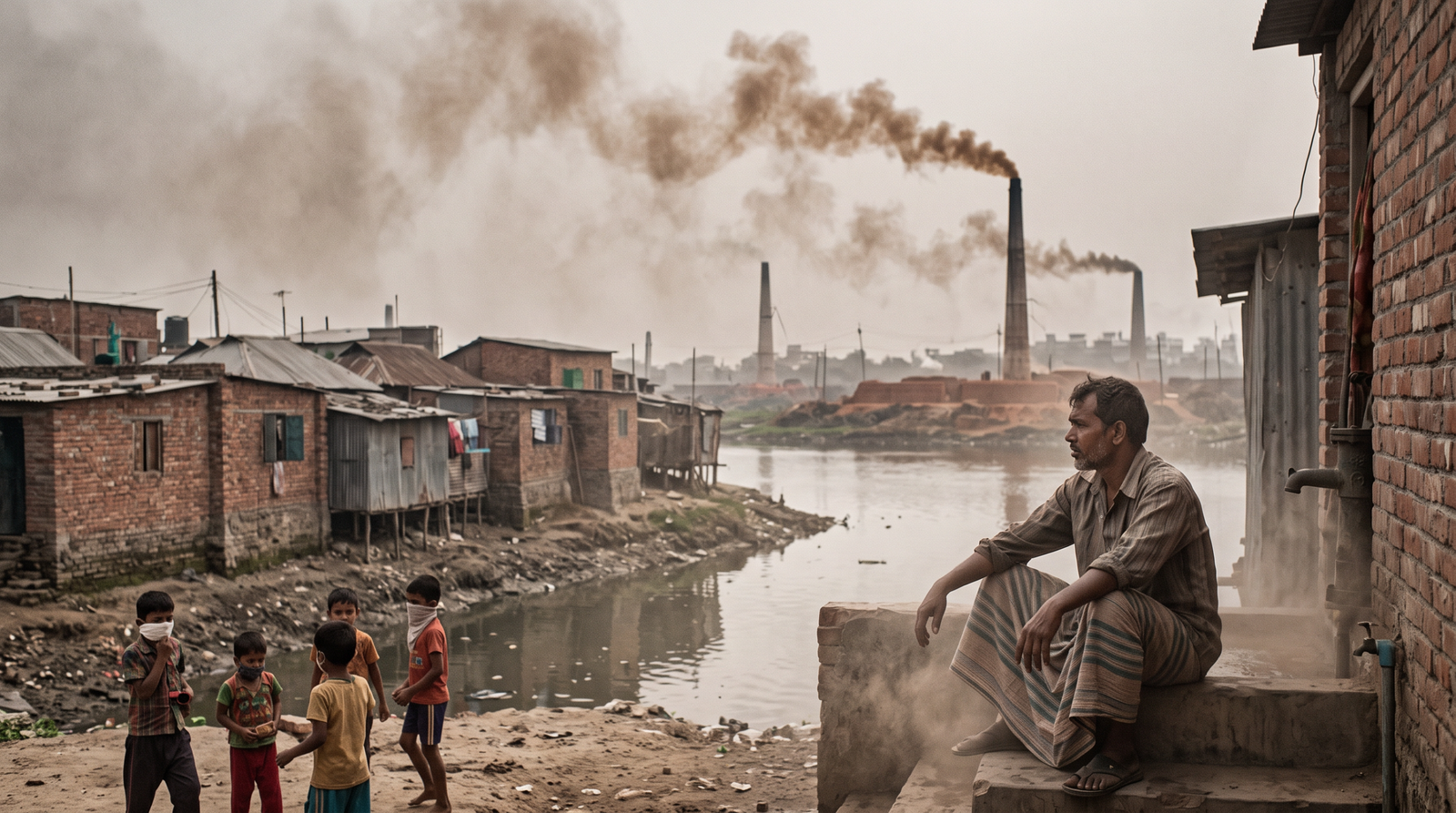
Left uncorrected, markets ignore this external cost entirely, pushing pollution well above the socially optimal level. That gap is exactly what Bangladesh demonstrates today. Dhaka regularly ranks among the world’s most polluted cities, with fine particulate matter often several times above WHO guidelines, driven mainly by brick kilns, vehicle emissions, industrial discharge, and construction dust.
The theoretical fix is well established. A Pigouvian tax, set equal to the marginal external cost, forces polluters to internalize the damage and shifts output toward the social optimum. Alternatively, a cap-and-trade system fixes total allowable emissions through permits, letting the market set an efficient abatement price: firms that can cut emissions cheaply do so, while others simply purchase permits.
Bangladesh’s Current Policy Approach
Bangladesh has experimented with both instruments in a limited way. There are effluent charges under environmental conservation rules, and periodic bans or seasonal restrictions on the operation of older, fixed chimney brick kilns, which function as a rough quantity restriction. In principle these tools mirror the tax and permit models from the textbook. In practice, the gap between the normative optimum and the positive, actual outcome remains wide, and it is largely an implementation and institutional problem rather than a conceptual one.
Gaps in Implementation
Several gaps stand out. The tax rates and penalties currently imposed fall well short of the true marginal external cost of pollution, so they fail to shift behavior at the margin, firms simply absorb fines as a minor cost of doing business rather than treating them as a real price signal. Monitoring capacity compounds the problem: efficient Pigouvian taxation or a functioning permit market depends on continuous, credible measurement of actual emissions, yet enforcement agencies lack the staffing, equipment, and legal authority to track thousands of dispersed, often informal sources like brick kilns and small factories.
Permits and quotas that aren’t properly priced or traded end up functioning as a blunt administrative restriction rather than an efficient market mechanism, since informal kilns frequently keep operating despite bans, given weak enforcement and local political entanglements. On top of this, there’s no coherent, sequenced national strategy tying together transport policy, industrial policy, urban planning, and energy policy, so progress in one sector gets offset by rising emissions elsewhere. This lack of a strategic, cross-sectoral approach to environmental sustainability is arguably the single biggest reason for the gap between market outcomes and social optimum persistence.
Bangladesh Against the COP Framework
Set against the Conference of the Parties framework, Bangladesh has submitted updated nationally determined contributions and adopted a Mujib Climate Prosperity Plan, signalling intent consistent with global commitments. Yet its targets are heavily conditional on international finance and technology transfer, and near-term domestic action on air quality, as distinct from climate mitigation, remains under resourced.
Compared with countries that have credible carbon pricing or well enforced cap and trade systems, Bangladesh is still at an early stage, closer to declarations of intent than to binding, monitored, and consistently enforced instruments.
What Is Needed for Recovery
Closing the gap between optimal and actual pollution levels calls for several concrete steps grounded in the same theory. Pollution taxes need recalibrating toward actual marginal damage, using updated health and environmental cost estimates, and should be indexed so inflation doesn’t quietly erode their impact. Monitoring needs modernizing through continuous emissions sensors and satellite-based particulate tracking, since any tax or permit system is only as effective as the measurement underpinning it.
Permit systems for major industrial sources, including brick kilns and power generation, should be redesigned as genuinely tradable instruments with a binding cap, rather than fixed administrative quotas, so abatement happens wherever it’s cheapest to achieve. Institutional capacity at the Department of Environment needs real investment, paired with clearer legal authority to enforce closures and penalties without being overridden by local political pressure. Finally, what’s needed is a strategic national framework that sequences investment in cleaner brick technology, public transport, and industrial relocation, backed by transitional financing for smaller firms unable to absorb abatement costs immediately.
Conclusion
None of this is theoretically novel, the tools of Pigouvian taxation and tradable permits are well understood. What Bangladesh lacks is not the concept, but the institutional strength, pricing accuracy, and strategic coherence needed to make those tools bind in practice, which is precisely why the gap between the normative optimum and the polluted reality of its cities has proven so persistent.