
Naima Onamika
Oniket Research Group
Over the past decade, the expansion of digital services in Bangladesh has brought significant changes to the country’s public service system. Government information, applications, registration, education, healthcare, social protection and financial transactions are increasingly moving online. There is no doubt that this is an important achievement in Bangladesh’s development. But alongside this progress, a fundamental question has emerged: are digital services truly accessible to everyone?
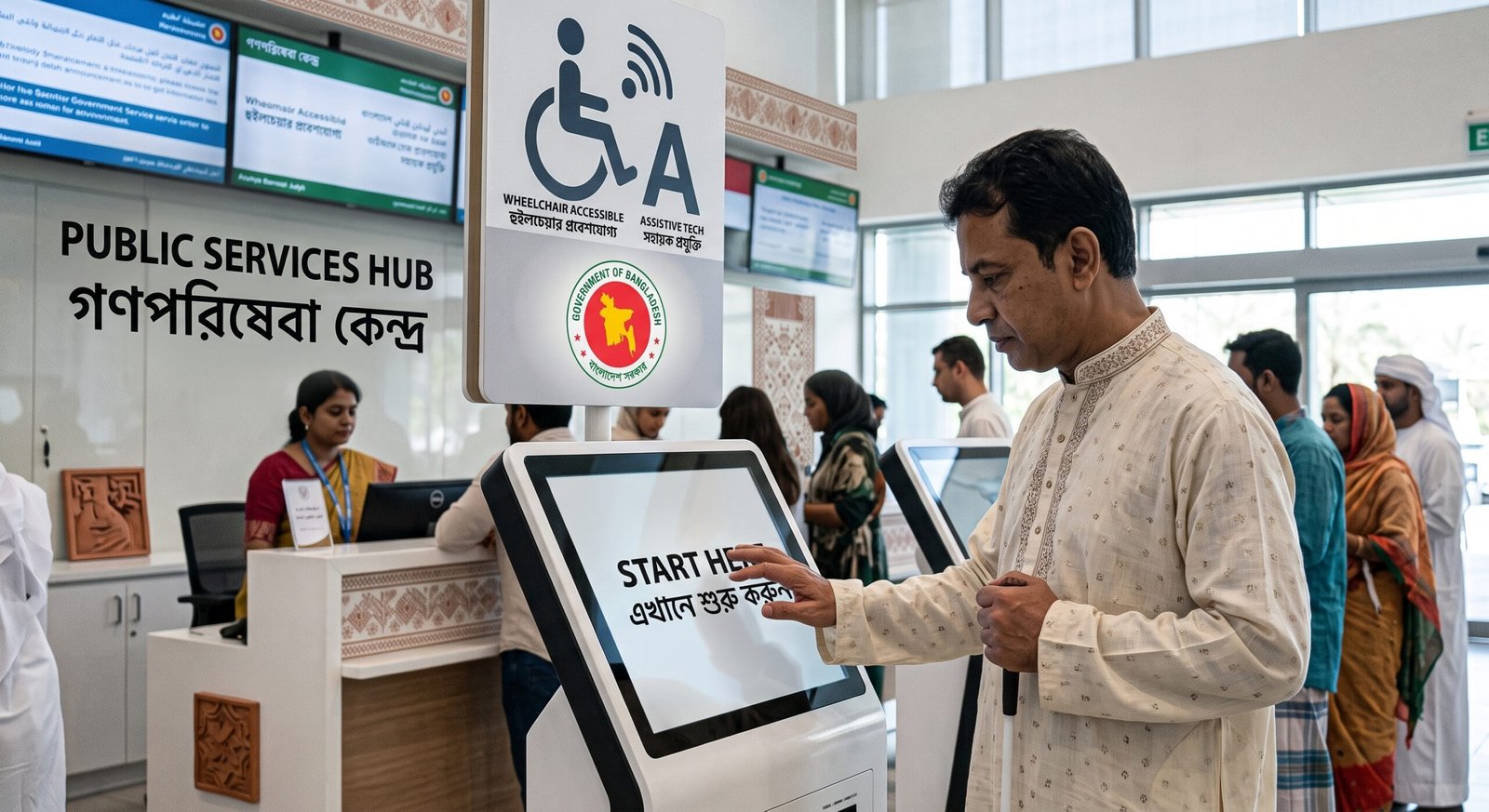
The question is particularly important for people with disabilities, older citizens and people who face limitations in using technology. If a government website cannot be accessed by a visually impaired person through a screen reader, if a video does not provide captions for people with hearing impairments, or if an online form cannot be completed using assistive technology, then the service may be online in a technical sense, but it is not equally accessible to all citizens from the perspective of their rights.
The issue is even more significant in Bangladesh because the country already has laws, policies and guidelines aimed at making digital services accessible to everyone. The central question, therefore, is no longer simply whether policies exist. The more important question is how effectively these existing laws and policies are being implemented.
This is where Bangladesh faces one of its major weaknesses. If we begin by examining the laws and guidelines already in place, the relevance, necessity and importance of the issues discussed in the rest of this report become much clearer.
Constitutional Foundation: The Right to Equality
To understand digital accessibility, we must first look at the Constitution of Bangladesh. Article 27 states that all citizens are equal before the law and are entitled to equal protection of the law. Article 28 establishes the principle of nondiscrimination, while Article 29 guarantees equality of opportunity in public employment.
In the digital age, the meaning of these rights cannot be confined to the physical sphere. As the state increasingly delivers public services through digital platforms, equal access to those services must also fall within the principle of equality. In other words, when a citizen is required to use a digital platform to access a government service, their physical abilities or limitations should not become a reason for exclusion. Ensuring that this does not happen is also part of the state’s responsibility.
Rights and Protection of Persons with Disabilities Act, 2013
One of Bangladesh’s key laws protecting the rights of persons with disabilities is the Rights and Protection of Persons with Disabilities Act, 2013. The law was enacted on 9 October 2013. It established a clear legal foundation for protecting the rights, dignity and safety of people with disabilities and ensuring their equal participation in society.
The importance of this law lies in its recognition of people with disabilities not simply as recipients of assistance or financial support, but as citizens with rights. The Rights and Protection of Persons with Disabilities Rules, 2015 were subsequently introduced. These rules play an important role in establishing the administrative and institutional arrangements required to implement the law.
However, one issue deserves particular attention. When the law was enacted in 2013, digital public services were not as widespread as they are today. As public services are now rapidly shifting to digital platforms, there is a need to align the existing law and rules more clearly with the realities of the digital age.
UN Convention and Bangladesh’s International Commitments
Bangladesh signed and ratified the United Nations Convention on the Rights of Persons with Disabilities, or CRPD, in 2007. Article 9 of the Convention places importance on ensuring accessibility to information and communication technologies, along with various services and facilities, for people with disabilities. Article 21 also recognises the rights of people with disabilities to access information and exercise freedom of expression. This means that ensuring equal opportunities in digital technology is not only a matter of domestic policy. It is also part of Bangladesh’s international commitment.
National Information and Communication Technology Policy, 2018
The National Information and Communication Technology Policy, 2018 is an important policy document in Bangladesh’s digital transformation. The policy emphasises the expansion of information and communication technology, the development of digital services, the creation of skilled human resources and the development of an inclusive, technology driven society. It also outlines various institutional mechanisms for monitoring implementation of the policy. But this brings us to an important question: targets have been set in the policy, but how effective are the mechanisms for measuring whether those targets are being achieved? The real success of a policy should not be measured by the goals written on its pages, but by its actual impact on people’s lives.
Digital Service and Web Designing Guideline for Inclusive Accessibility, 2022
One of the most important developments in Bangladesh’s digital accessibility landscape is the Digital Service and Web Designing Guideline for Inclusive Accessibility, 2022.
The purpose of the guideline is to ensure that government digital services and websites are designed in a way that allows people from different sections of society, including people with disabilities, to use them with ease. The guidelines have been developed in line with the internationally recognised Web Content Accessibility Guidelines, or WCAG 2.1.
In 2023, the Information and Communication Technology Division also issued government instructions regarding compliance with the guideline. In other words, Bangladesh now has more than general policy commitments. It also has a specific technical guideline explaining how digital services should be designed to make them inclusive and accessible.
This brings us to the most important question: is having a guideline the same as implementing it effectively? Real world experience suggests otherwise. The core challenge lies in the gap between policy and implementation. The biggest problem with digital accessibility in Bangladesh may not be the complete absence of laws or policies. Rather, the problem lies in the long distance between policy formulation and implementation.
When a government website is developed, factors such as the accuracy of information, security, technical capacity and the number of users is considered. But whether a visually impaired person can use the website with a screen reader, whether a person with a hearing impairment can understand the content of a video, or whether an older citizen can navigate the platform easily often does not receive the same level of attention. As a result, technology is being developed and services are moving online, but the right to access those services is not being ensured equally for everyone.