
Jamil Shahed
Freelance Journalist
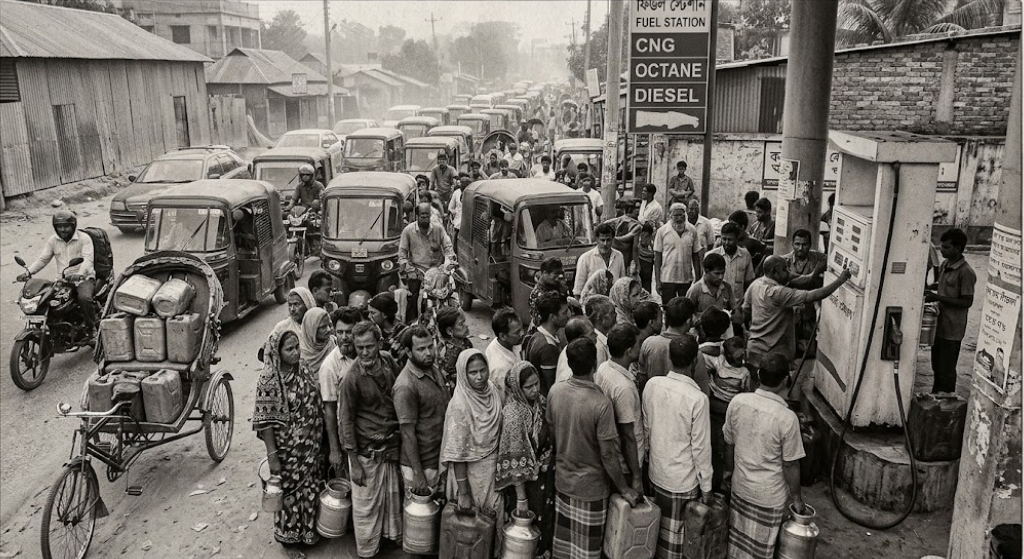
Bangladesh’s decision to raise diesel, petrol, octane, and kerosene prices by Tk 20 per litre from September 21 has triggered one of the year’s sharpest political confrontations. Diesel now costs Tk 135, up from Tk 115, while kerosene has jumped nearly 15 percent to Tk 155.
The government, in office since February, frames the increase as an unavoidable response to global energy shock. Opposition parties call it a political failure landing on ordinary citizens. This article examines the debate, competing party stances, its cost-of-living impact, and policy steps that could ease both the burden and the standoff.
The Government’s Case for the Increase
Officials point to numbers that are difficult to dismiss outright. The Energy and Mineral Resources Division has said Bangladesh Petroleum Corporation lost roughly Tk 22,875 crore between March and August this year. Prices were kept frozen even as international crude and freight costs surged following disruption in the Middle East and reduced throughput through the Strait of Hormuz.
Government advisers have argued that BPC was losing close to Tk 89 per litre on diesel alone before the adjustment, with daily losses reportedly exceeding Tk 100 crore. From this vantage point, the hike is less a political choice than a fiscal correction the government could no longer defer without deepening state losses further.
The Opposition’s Counter Narrative
Jamaat e Islami, the National Citizen Party, and a cluster of smaller parties including Bangladesh Khelafat Majlis, AB Party, and Bangladesh Labour Party have rejected this framing entirely. Jamaat’s leadership has argued that repeated price increases are compounding an already unbearable cost of living crisis. The party has demanded the government publish a transparent, itemized breakdown of import costs, taxes, and margins behind the new prices.
NCP activists have staged processions in Chattogram and elsewhere demanding immediate withdrawal. NCP figures have pointedly asked where profits BPC earned during earlier periods of low global prices went, suggesting the corporation’s current losses reflect years of poor financial management rather than an unavoidable external shock alone.
A Debate That Outpaces the Policy Itself
What makes this dispute distinctly political, rather than simply economic, is the timing argument running through much of the criticism. Critics note that the automatic fuel pricing formula introduced in 2024 is meant to adjust monthly. Yet adjustments were suspended for roughly six months while global prices moved sharply, only to be released in one large jump in September.
That decision to freeze and then release the burden all at once has become the central point of contention. Opposition figures argue that the volatility citizens are now absorbing was manufactured by delay rather than dictated by market forces beyond anyone’s control.
The Toll on Everyday Life
For ordinary households, the political argument matters less than the arithmetic. Diesel powers roughly seventy percent of the country’s irrigation pumps. With irrigation already accounting for a fifth to a quarter of total input costs for Boro rice cultivation, the hike threatens to raise food prices well beyond the fuel pumps themselves.
Transport fares, already adjusted upward on several bus routes, compound the burden for commuters and small traders alike. Economists have warned that industries will face higher logistics and generator costs, weakening profitability and export competitiveness, with small businesses least able to absorb the shock. At the macroeconomic level, the risk is a familiar cycle. Higher input costs feed into broader inflation, squeezed household consumption follows, and growth slows, all layered onto an economy already managing elevated prices for basic commodities.
The Cost of Political Delay
Perhaps the most damaging element of this episode is not the price increase itself but the uncertainty surrounding how and when such adjustments happen. When price changes are deferred for political convenience and then imposed abruptly, citizens lose the ability to plan household budgets. Businesses lose the ability to price contracts with any confidence. That unpredictability, more than the tk 20 figure itself, is what turns a necessary economic adjustment into a source of social distress and public anger.
What Government Action Could Ease the Standoff
A more constructive path forward exists. The government should commit to publishing a detailed, transparent breakdown of fuel pricing components, covering import cost, freight, taxes, and distribution margins, as opposition parties have specifically requested. Transparency would blunt accusations that the increase conceals mismanagement rather than reflects genuine cost pressure.
Restoring the monthly automatic adjustment mechanism, rather than allowing politically timed freezes followed by large corrections, would smooth the burden on households and reduce the shock value that fuels political mobilization. Targeted relief for the agricultural sector, given diesel’s outsized role in irrigation, alongside monitored transport fare caps to prevent opportunistic fare hikes beyond the actual cost pass through, would protect the most exposed segments of the population.
Finally, genuine cross-party consultation before major pricing decisions, rather than unilateral announcements met with street protest, would reduce the political theater currently surrounding a problem that is, at its core, a shared national challenge rather than a partisan one.