
Hasan Hamid
CUET
This article examines the everyday, largely unexamined secularism that persists beneath Bangladesh’s constitutional declaration of Islam as the state religion, distinguishing it from secularism as a formal legal doctrine. It traces where interfaith coexistence has functioned in practice, identifies the specific junctures, communal, political, and institutional, where that coexistence has visibly fractured, and assesses what concrete legal, social, and administrative measures could reinforce it going forward.
A Constitutional Paradox
Bangladesh’s Constitution names Islam as the state religion while also listing secularism among the four foundational pillars of the republic. On paper this looks contradictory. In practice, it reflects a country whose social life has long been more pluralistic than its legal language suggests.
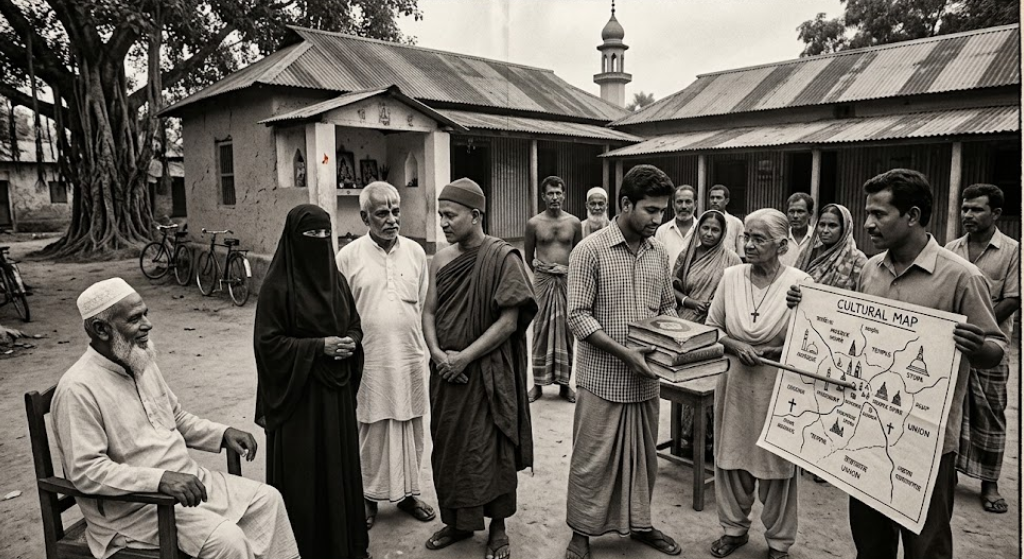
Bangladesh is overwhelmingly Muslim, yet home to one of the largest Hindu populations of any Muslim majority nation, alongside significant Buddhist communities in the Chittagong Hill Tracts and smaller Christian populations in Dhaka, Mymensingh, and the northern districts. Understanding this hidden secularism means looking past the constitutional text and into the lived habits of ordinary people.
Festivals as Shared Civic Life
The clearest evidence of this coexistence appears during major religious festivals. Durga Puja, the largest Hindu celebration, transforms into something closer to a citywide event each year, with elaborate pandals drawing Muslim visitors who come to admire the artistry, and local administrations treating the festival as a matter of public order and civic pride rather than a purely minority affair. Christmas, though celebrated by a small population, is marked by public decorations in urban centers and remains a national holiday, giving interfaith friend groups a shared occasion to celebrate together. Eid, the largest celebration by scale, is frequently an occasion where non-Muslim neighbors are invited to share meals, reinforcing a cycle of reciprocal goodwill that repeats throughout the year. These festivals function less as isolated religious observances and more as recurring moments of social bonding across faith lines.
When Harmony Breaks Down
This balance, however, is neither automatic nor permanent. The 2012 Ramu incident, in which Buddhist temples and homes were attacked following a fabricated allegation of a desecrated Quran circulated on social media, remains a painful reminder of how quickly trust can collapse. A similar pattern unfolded in 2021, when an accusation involving a Quran placed at a Puja pandal in Cumilla triggered attacks on Hindu communities during a period of political instability. In both cases, the violence traced back not to organic religious hatred among ordinary citizens but to orchestrated rumors, land disputes, or political actors exploiting religious identity as a convenient fault line. These episodes reveal that Bangladesh’s harmony, while real, remains vulnerable to manipulation.
Indigenous Communities and a Different Kind of Pressure
A separate and often overlooked dimension of this story involves the indigenous communities of the Chittagong Hill Tracts, including the Chakma, Marma, and Tripura peoples, who practice Buddhism, Christianity, and animist traditions that predate the arrival of both Islam and organized missionary religion in the region.
Their challenges are less about doctrinal conflict and more about land rights, demographic pressure from settlement programs, and cultural erosion. Religious preaching by outside groups, whether Islamic dawah organizations or Christian evangelical missions, has at times created friction with indigenous spiritual practices, raising concerns about the loss of local customs and languages rather than outright religious violence. Their social habitat problems are rooted in representation and recognition within a state structure still adjusting to non-mainstream identities.
The Quiet Work of Social Welfare
Underneath these tensions, social welfare mechanisms have helped sustain a baseline of trust. Government stipends for minority religious institutions, joint disaster relief after cyclones and floods that ignore religious lines, and community policing during major festivals all contribute to stability. Civil society organizations and interfaith youth groups, along with local imams and priests who publicly condemn violence after incidents like Ramu, have proven effective in the escalating tension and restoring confidence when it is tested.
What Governments and Societies Can Do
Strengthening this hidden secularism into something more durable will require deliberate effort. Faster judicial response to communal violence would signal that impunity is not an option. Curriculum reform that teaches the shared cultural history of Bengali civilization across religious lines could reduce the ignorance that fuels suspicion in moments of crisis. Formal recognition and land rights protections for indigenous communities in the Hill Tracts would address root causes rather than symptoms. Finally, clearer public discourse distinguishing the symbolic designation of a state religion from secularism as a governing principle of equal treatment would help citizens see that the two are not mutually exclusive.
Conclusion
Bangladesh does not need to resolve the philosophical tension in its constitution overnight. It needs continued investment in the everyday practices of coexistence that already define much of its social life, protection of those practices from those who would exploit religious identity for political gain, and genuine inclusion of indigenous communities whose spiritual traditions remain underrepresented in the national conversation about religious pluralism.