
Farah Zahir
Managing Editor, The Oniket Bulletin
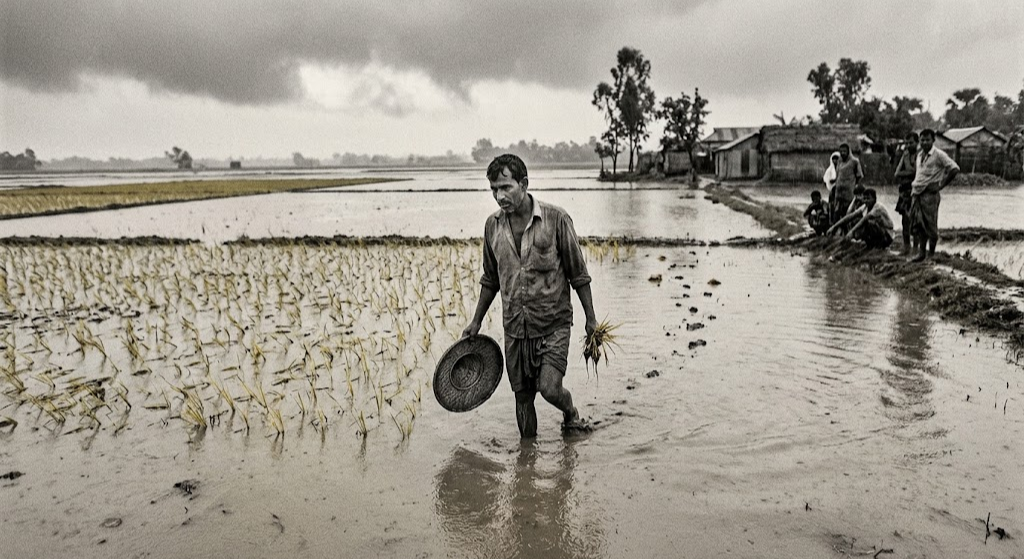
In Shahapur village of Ishwardi upazila, farmer Md Mehedi Hasan watched two bighas of banana he had planted this season go under when the Padma rose sharply earlier this month. He is not alone. This article examines the immediate government response needed to salvage what remains of this season’s harvest in Pabna, and the longer-term policy reforms that could reduce the recurring toll monsoon flooding takes on regional agriculture, viewed alongside Bangladesh’s commitments under the United Nations Sustainable Development Goals.
Across Pabna Sadar and Ishwardi, the district’s Department of Agricultural Extension recorded 187 hectares of farmland submerged along the Padma, with 41.4 hectares of crops destroyed and an estimated loss of Tk 3.46 crore. Mashkalai, chilli, vegetables, banana, and paddy were all hit.
The damage extends beyond what is already lost. Continued rain is now delaying the planting of Kondo, or early onion, a crop farmer in Sujanagar and surrounding areas typically begin sowing by mid-September. With soil still too wet and the ideal planting window running only from September 15 to October 15, the district’s target of cultivating more than 9,000 hectares of early onion this year is now in genuine jeopardy, with no planting yet underway as the window narrows.
Immediate Steps Needed to Salvage What Remains
The most urgent task is triage. Fields where water has receded, but crops were destroyed need rapid assessment so farmers know which plots can be replanted this season. The district agriculture office should quickly distribute short duration seed varieties for vegetables and pulses still sowable before the season closes.
For onion, the government should weigh extending the effective planting window through supplementary guidance and seedling support, since a two-to-three-week delay can decide whether the early crop survives. Coordination with the Water Development Board on real-time water levels should be formalized, giving farmers earlier warnings before rivers approach danger thresholds.
Financial relief cannot wait either. Farmers who lost banana and mashkalai investments need emergency credit or input subsidies, ideally disbursed locally rather than requiring travel to distant banking centers.
Compensation and Verification
Any relief program depends on accurate, fast verification of losses. The 41.4 hectares of destroyed crops already identified by the district office provide a starting baseline, but assessment teams need to move field by field before damage assumptions harden into disputes over eligibility. A transparent, published list of affected farmers and estimated losses, updated as conditions change, would reduce the informal favoritism that often creeps into disaster relief distribution at the union level.
Why This Keeps Happening
What makes the Pabna case worth attention beyond this season is how familiar the pattern is. Riverbank and shoal areas along the Padma flood on a recurring basis when upstream runoff from the Ganges basin swells the river, and farmers in these zones plant crops each year knowing the risk without much structural change in how that risk is managed. Reactive relief after each flood event treats the symptom without addressing why the same low-lying farmland keeps absorbing damage year after year.
Anticipatory Reforms Rather Than Reactive Relief
A more resilient approach starts with crop zoning informed by flood risk mapping for the Padma’s shoal areas. Riverbank plots that flood predictably are poorly suited to flood sensitive crops like banana, and extension strategy should steer high risk zone farmers toward flood tolerant rice and vegetable varieties already developed domestically.
Early warning infrastructure deserves investment too. A river level alert system reaching farmers directly through mobile messaging would give shoal area growers days rather than hours to protect livestock or delay plantings. Weather indexed crop insurance, tied to rainfall or river level thresholds rather than lengthy damage assessment, would let compensation reach farmers faster. Similar pilots already exist in South Asia and could be adapted here.
An anticipatory action framework, releasing relief funding and seed stock before a forecast flood rather than after, would shift government posture from responding to losses to prevent them, triggered automatically once upstream runoff forecasts cross defined thresholds.
Finally, adjusting the planting calendar jointly with meteorological services could help farmers build in a buffer, rather than treating fixed dates as unmovable as monsoon patterns shift.
Building Foresight into the Planning Process
Beyond individual reforms, the district could benefit from a more structured foresight exercise: scenario planning. Rather than preparing for a single expected outcome, agriculture officials and Water Development Board staff would sketch out a small set of plausible flood seasons, a mild one, an average one, and a severe one modeled on years like this, and work out in advance what each would require in terms of seed stock, credit disbursement, and evacuation support for livestock.
The value is not in predicting which scenario will occur, but in stress testing existing plans against more than one future, so decisions made in a calm planning session, rather than during an active flood, determine how relief is distributed. Applied to Pabna, this might mean union level officers already having a pre-approved seed and credit package ready for each scenario, rather than improvising once damage assessments come in. Paired with the river level alert system and anticipatory action framework already proposed, scenario planning would give the district a repeatable process for turning uncertainty about Padma’s behavior into a manageable set of prepared responses, strengthening the same SDG 13 resilience goals the broader reform agenda is already working toward.
Measuring Progress Against Global Commitments
These reforms are not merely domestic administrative fixes. They map directly onto Bangladesh’s stated commitments under the United Nations Sustainable Development Goals. Reducing crop loss and stabilizing farmer income after climate shocks speaks to SDG 2 on ending hunger and achieving food security, since a missed onion season in Pabna ultimately affects consumer prices and availability well beyond the district.
Strengthening early warning systems and shifting toward anticipatory rather than reactive disaster response aligns with SDG 13 on climate action, which explicitly calls for strengthening resilience and adaptive capacity to climate related hazards. And ensuring that smallholder farmers in flood prone shoal areas are not left to absorb losses alone speaks to SDG 1’s target of building resilience among the poor and vulnerable to climate-related extreme events.
Bangladesh has made genuine progress on several of these fronts nationally, but recurring, poorly buffered losses like those seen in Pabna this month suggest that implementation at the district and union level still lags well behind the ambitions set at the national policy level. Closing that gap, through the concrete steps outlined above rather than through policy documents alone, is what will determine whether Bangladesh’s SDG commitments translate into fewer ruined harvests the next time the Padma rises.