
Sheikh Selim
Oniket Research Group
This article analyses the recent move by National Board of Revenue field offices to collect a 10 percent tax on interest paid to microsavers. It explains how the move could affect employment, inflation and short-term growth in a slowing economy, and discusses fiscal alternatives that could soften the business cycle. It also highlights governance concerns, particularly the uneven tax burden and tax evasion.
Policy and Its Size
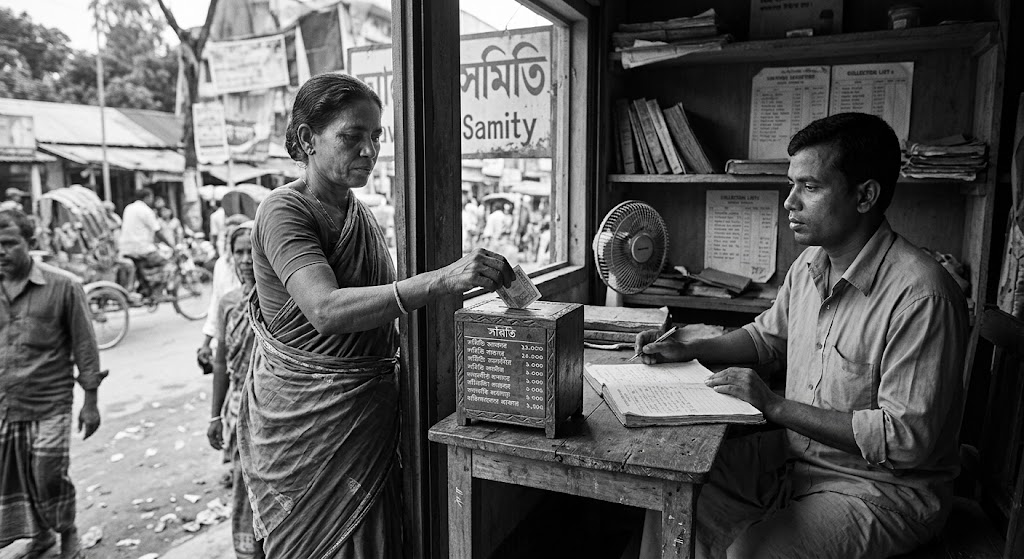
Tax offices have directed microfinance institutions to deduct 10 percent withholding tax on member savings interest, with a 2 percent penalty for noncompliance. Nearly 700 institutions serve 4.40 crore members, 90 percent women, holding Tk 79,932 crore in savings, and interest paid totals Tk 4,795 crore, so the tax would raise just Tk 479.5 crore, under 1 percent of savings, a negligible gain against real macroeconomic risk.
Bangladesh is already in a soft patch; inflation eased to 8.26 percent in August though nonfood inflation held at 9.32 percent, FY26 growth of 4.14 percent masked a 2.2 percent third quarter slowdown, private credit grew only 4.75 percent, and nonperforming loans sit at 32.78 percent, conditions where a poorly designed tax does outsized damage.
Business Cycle Effects
Savings and credit: Member savings equal about 46 percent of outstanding microloans, so they are a core funding source. A lower after tax return pushes poor households toward cash, gold, livestock or informal savings groups. Formal savings shrink, institutions face higher funding costs, and lending either becomes dearer or contracts. This weakens monetary transmission just as the central bank tries to revive lending through its Tk 60,000 crore package.
Employment: Microcredit supports small traders, farmers and home-based producers, often women, who account for a large share of informal jobs. Less credit means fewer new enterprises and less working capital for existing ones, which offsets the 25 lakh jobs the central bank hopes to create. Households also use savings to cope with illness, floods and crop failure, so taxing them weakens private insurance and deepens vulnerability in a downturn.
Inflation: The effects pull in opposite directions. The tax trims disposable income and cools demand slightly, but higher funding costs can feed into loan pricing and small business costs. Since current inflation risks come mainly from the supply side, the tax brings no useful disinflation. It adds cost pressure while eroding real incomes.
Short term growth: Low-income households spend a high share of any income, so losing income or a savings buffer reduces demand almost immediately. The negative multiplier of taxing them is large relative to a revenue yield under Tk 500 crore. The policy is therefore procyclical: it tightens fiscal stance on those least able to adjust, as forecasts are being cut, with the IMF at 3.5 percent and the World Bank at 4.6 percent for FY27.
Governance Issues
This episode reveals a deeper structural bias in tax administration. Withholding at source is administratively easy, needing no investigation or cooperation from the taxpayer, so enforcement gravitates toward whoever is easiest to reach rather than whoever owes most. Microfinance institutions are centralized and already report member data, making them convenient collection points. Yet, the people behind those accounts are overwhelmingly low income, rural, and female, least equipped to dispute an unexpected deduction. Undeclared wealth hidden in cash businesses or opaque structures, by contrast, demands investigative capacity agencies have long underfunded.
The legal ambiguity compounds this. If the law protecting microfinance income conflicts with the Income Tax Act 2023, field offices acting before headquarters clarified matters let interpretation happen at collection rather than policy, disadvantageous to those least able to contest it. Since most micro savers earn below the taxable threshold, the usual refund safety valve does not apply, as claiming refunds requires filing capacity most do not have. What is nominally provisional becomes, in effect, a final tax on the poor.
More broadly, a narrow tax base pushes agencies toward easy, visible targets rather than expanding real coverage. Nearly a third of bank loans remain uncollected, dwarfing the entire projected yield from taxing micro savers, yet draws far less urgency. The system finds it easier to extract small certain sums from compliant savers than pursue large, contested ones from powerful defaulters, an asymmetry that steadily corrodes fairness and credibility.
Fiscal Alternatives
The most immediate fix is a clear exemption for interest in microsavings below a defined threshold, with larger deposits remaining subject to progressive withholding backed by a proper refund facility, so the burden tracks capacity rather than convenience.
Beyond that single correction, the government has a genuine alternative to squeezing small savers: base broadening through third party data matching, electronic invoicing, property and wealth audits, and the gradual phasing out of exemptions could raise multiples of the Tk 479.5 crore at stake here without touching anyone near the poverty line. These are slower, more demanding reforms than issuing a circular, but they are the ones that address where revenue is being lost.
On the expenditure side, the moment calls for tools that support rather than strain the economy: rural public works and targeted cash transfers to lift demand quickly, partial credit guarantees for microfinance and small business lending to share risk alongside the central bank’s package, and temporary investment allowances for reopened factories. A medium-term framework building reserves in good years would end the reliance on taxing the vulnerable during bad ones.
Conclusion
Taxing microsavings offers little revenue but real macroeconomic cost: less saving, tighter credit, weaker household resilience and slower growth. In a stagnant economy with persistent inflation, fiscal policy should protect demand and employment rather than tax the smallest savers. Closing the gaps among large evaders and clarifying the law would serve the budget and the business cycle far better.