
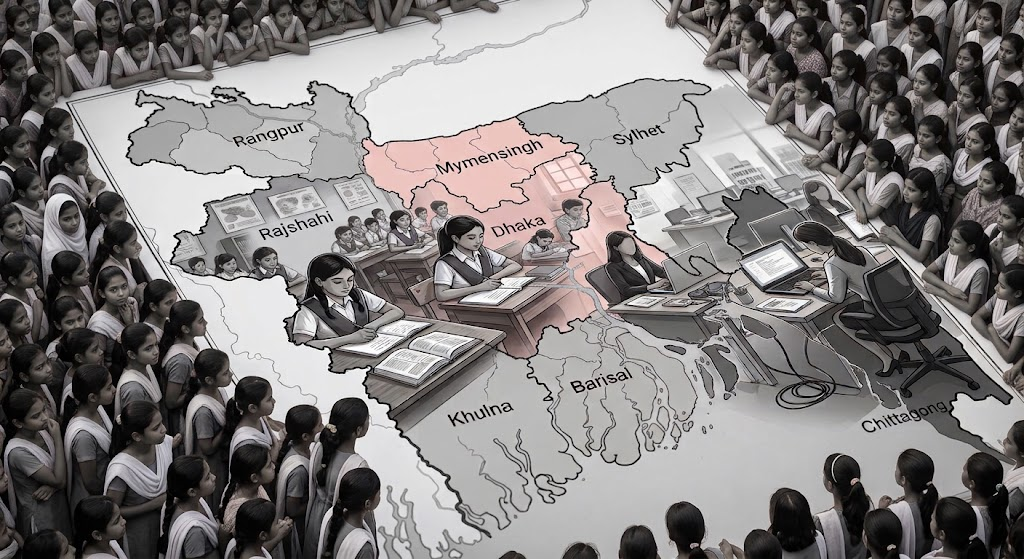
After the promise of free education through undergraduate level, Bangladesh needs a division-by-division picture
Farah Zahir
Managing Editor, The Oniket Bulletin
Scholarships Opened the Door
One of the biggest changes in girls’ education in Bangladesh came with the introduction of free secondary education and scholarships for girls. Making secondary education free in the early 1990s and introducing stipends for rural girls in 1994 brought more girls into classrooms. The support was later extended to the higher secondary level.
Two decades on, the change is clear. Girls are no longer on the margins of primary and secondary classrooms. At the secondary level, their participation is equal to, and in some cases higher than, that of boys. Their presence in medical education is also significant. The policy drive to bring girls into school has produced a major shift.
The government has now announced plans to make that effort further. On April 30, the Prime Minister told Parliament that education for girls would be made free through the undergraduate or degree level. Scholarships would also be provided for students who achieve good results. The announcement matters. But it also raises the central question. Will free education turn into real opportunities in girls’ lives?
One Policy, Eight Divisions, Very Different Realities
Education policy is set nationally in Bangladesh, but its impact varies from one region to another. According to the 2022 Population and Housing Census, the country’s overall literacy rate was 74.66 percent. Female literacy was somewhat lower. There were also clear differences between divisions. Dhaka was ahead, while Mymensingh lagged.
These differences cannot be explained by the number of educational institutions alone. In some places, family income is the main reason girls leave school. In others, it is child marriage. River erosion, floods and displacement interrupt education in some areas. In others, girls who complete school find few suitable opportunities in the local economy.
Recent child marriage data tells a similar story. According to the 2025 Bangladesh Multiple Indicator Cluster Survey, almost half of women aged 20 to 24 were married before the age of 18. The divisions also show wide differences. The rates are highest in Rajshahi and Khulna and lowest in Sylhet.
The next phase of policy for girls’ education therefore cannot be built around the national average alone. Policymakers need to know why girls leave school in one region, why they fail to reach higher education in another, and where girls complete their education but struggle to find work.
A Scholarship Is More Than the Amount of Money
Scholarships have played an important role in keeping girls in education. But the cost of living has changed, as have the costs families face in educating their children. After remaining unchanged for years, monthly support under the primary merit scholarship programme was increased in 2026. The monthly amount for the talent pool scholarship was raised from Tk 300 to Tk 600, while the general scholarship increased from Tk 225 to Tk 450.
Increasing the amount, however, is only one part of the issue. When does the money reach students? Who receives it? How does a girl in a remote area apply? Can a family get the support in time to meet the costs of admission? These questions matter just as much.
The same applies to the new plan for free education through the undergraduate level. Waiving tuition fees alone will not remove the barriers many students face. Transport, books, accommodation, access to technology and financial pressure on families can all stand between a girl and higher education.
The Real Test Begins Outside the Classroom
Girls in Bangladesh have entered the education system in large numbers. The bigger question now is how open the path is from education to work. The 2022 Labour Force Survey showed that women’s participation in the labour force had increased compared with the previous decade. The gap with men remained wide, and women continued to depend heavily on informal work.
The connection between education and employment needs closer attention. A university degree does not automatically lead to economic independence. If a woman does not have safe transport, access to childcare, suitable jobs in her area or a work environment that her family accepts, her education may not translate into a livelihood.
The World Economic Forum’s 2026 report shows clear progress in gender parity in education in Bangladesh, while economic participation remains a major area of weakness. The report also points to a gap in higher education. Bangladesh’s next task is therefore not simply to educate more girls, but to turn education into opportunities for income, skills, leadership and decision making.
Higher Education Still Raises Questions
The progress girls have made in school is more visible than their progress into university. According to the Bangladesh Bureau of Educational Information and Statistics, girls made up a little more than one third of university students in 2023. The World Economic Forum’s 2026 index, meanwhile, gave Bangladesh a score of 77.1 for gender parity in higher education. The two measures are not based on the same methodology, but both point to the same gap: progress at the secondary level has not carried through at the same pace into higher education.
This is where the new policy will face its most important test. If free education through undergraduate level is introduced, the important questions will be how many girls reach university, how many complete their studies, and how many are able to use their education to gain greater control over their own lives.
Education Is Not the Whole Story
Opportunities outside the classroom also matter. Sport, culture, technology, debate, leadership and creative activities are all part of a broader education. For girls in rural areas, the lack of playing fields, trained coaches, safe spaces and regular programmes can limit their chance to develop their abilities.
Scholarships should not be based only on examination results. There should be ways to identify talented students in remote areas, girls who continue their studies despite difficult circumstances, and those with talent in sport or culture. A girl’s potential cannot be measured by her examination paper alone.
From Education to Equality
Girls’ education is not only about building a country’s human resources. It is also closely connected to the Sustainable Development Goals. Sustainable Development Goal 4 calls for inclusive and equitable quality education, while Sustainable Development Goal 5 focuses on gender equality and the empowerment of women and girls. Bangladesh’s experience over the past two decades shows that access to education for girls can be expanded. The question now is how lasting that progress will be and how far it will carry into the next stages of their lives.
According to UNESCO’s 2026 Global Education Monitoring Report, around 38 percent of students in Bangladesh completed upper secondary education in 2024, compared with 57 percent across South Asia. Reaching school and completing education are two different things.
The same distinction matters when looking at employment and economic independence. More girls are entering education, but a significant gap remains in their access to work and economic opportunity. SDG 4 cannot be met simply by putting more girls in classrooms. Education must also give them skills, access to work and greater capacity to make decisions about their own lives. That is where education connects with the broader goals of SDG 5.
For Bangladesh, the next challenge is therefore not simply to bring more girls into school. It is to help them complete their education, reach higher education and turn what they learn into greater economic and social opportunity. This is where the success of girls’ education needs to be measured differently.
What Needs to Change
As the government moves to implement free education for girls through undergraduate level, the focus cannot stop at waiving tuition fees.
First, scholarship and stipend money need to reach students on time and be reviewed regularly against the rising cost of living. Second, areas with high rates of child marriage need targeted attention. Schools, families, local government and community organisations need to be part of the same effort.
Third, girls in areas affected by floods, river erosion and other disasters need ways to continue their education when normal schooling is disrupted. Fourth, education needs to be linked more closely to the economy of each region. Technical training, apprenticeships, local industries and universities need stronger practical links. Fifth, safe transport, childcare and safe working conditions need to be part of the country’s approach to women’s employment.
Finally, Bangladesh needs a continuous system of data at the divisional and district levels, tracking the journey from education to employment. Without knowing where girls are leaving school, where they are being held back from higher education, and where graduates are struggling to enter the workforce, policy will continue to rely on assumptions.
Free education for girls is a significant step. But the next chapter of women’s education in Bangladesh cannot be measured simply by how many girls are sitting in classrooms.
The bigger question is this: How many girls will complete their education and be able to stand on their own feet?
তথ্যসূত্র:
- Bangladesh Bureau of Educational Information and Statistics (BANBEIS), Bangladesh Education Statistics 2023. বিশ্ববিদ্যালয় পর্যায়ে ছাত্রীদের অংশ এবং অন্যান্য শিক্ষা-সংক্রান্ত তথ্যের জন্য।
- Bangladesh Bureau of Statistics, Population and Housing Census 2022. জাতীয় ও বিভাগভিত্তিক সাক্ষরতার তথ্যের জন্য।
- UNICEF Bangladesh, Bangladesh Multiple Indicator Cluster Survey 2025. বাল্যবিয়ে ও বিভাগভিত্তিক সর্বশেষ তথ্যের জন্য।
- World Economic Forum, Global Gender Gap Report 2026. শিক্ষা ও অর্থনৈতিক অংশগ্রহণের লিঙ্গ ব্যবধানের জন্য।
- UNESCO, Global Education Monitoring Report 2026. উচ্চমাধ্যমিক completion-এর তথ্যের জন্য।
- Bangladesh Bureau of Statistics, Labour Force Survey 2022. নারীর শ্রমশক্তিতে অংশগ্রহণ ও কর্মসংস্থানের তথ্যের জন্য।
- Prime Minister’s Education Assistance Trust (PMEAT), Government of Bangladesh. শিক্ষা সহায়তা ও বৃত্তি সংক্রান্ত তথ্যের জন্য।
- Bangladesh Sangbad Sangstha (BSS), 2026. প্রাথমিক বৃত্তির নতুন কাঠামো ও অর্থের পরিমাণের জন্য।
- Bangladesh Parliament / contemporary reporting, 30 April 2026. স্নাতক পর্যন্ত মেয়েদের শিক্ষা বিনামূল্যে করার সরকারি ঘোষণার জন্য।