
Mehran Sajjad
North South University
This article reviews Bangladesh’s performance in regional and international programming contests, examines the weaknesses behind the results, and proposes government steps that would improve performance and turn high performing programmers into a foundation for a stronger national programming industry.
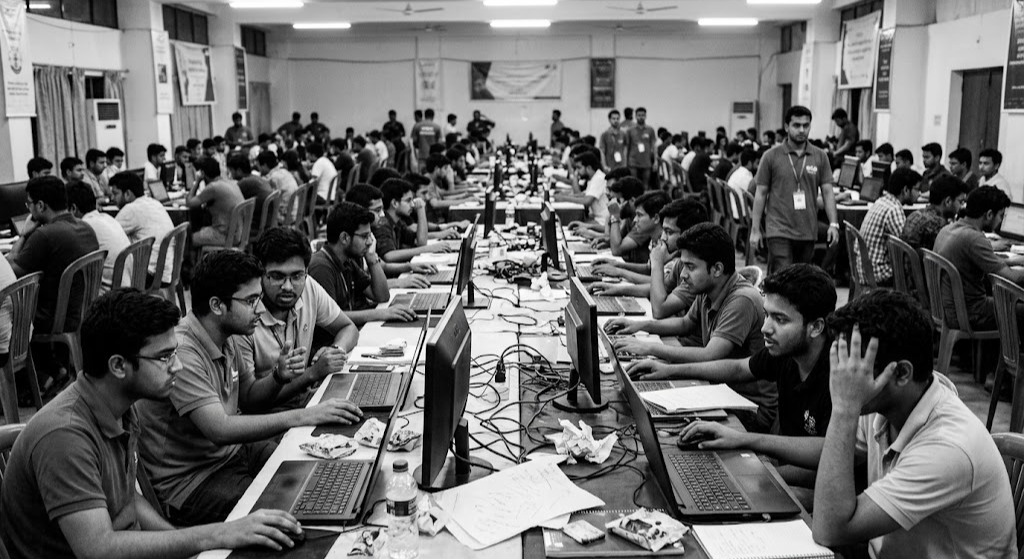
Bangladesh has built a genuine culture of competitive programming. Teams from public and private universities routinely qualify for the world finals of the major collegiate contest, and Bangladeshi participants appear regularly among the top ranks of online platforms and national selection rounds. School students also take part in informatics Olympiads and national programming camps.
Much of this energy grew from below, through university clubs, senior students mentoring juniors, and online communities that share problems and solutions freely. That grassroots strength is the country’s real asset, and it deserves recognition before criticism.
Where the Performance Falls Short
The criticism is that results, while respectable, rarely convert into consistent podium finish at the highest level. Bangladesh tends to qualify and compete rather than dominate, and the gap with leading nations in Eastern Europe and East Asia remains visible. Part of the reason is that success depends on a small number of institutions and a few passionate coaches. When a strong cohort graduates, its knowledge often leaves with it, because there is no systematic way to pass experience to the next batch.
Preparation begins too late. Most serious training starts at university, whereas leading nations identify talent in secondary school and nurture it for years. Schools have limited computing resources, few trained teachers and little exposure to algorithmic thinking, so talented students in districts and villages are rarely discovered. The pool is also uneven in other ways. Girls and students from rural or lower income backgrounds participate far less, which means the country is drawing from a fraction of its potential.
Funding and logistics create further friction. Teams often depend on sponsors, university goodwill and personal contributions for travel, visas and preparation camps. Last minute arrangements disrupt training. Coaching is largely voluntary, and there are few professional trainers with the time and authority to build long-term programmes.
The Missing Link Between Contests and Industry
The deeper weakness lies in what happens after the contest. Competitive programming sharpens speed and algorithmic skill, but the software industry also values design, collaboration, testing, security and product thinking.
Many strong contestants leave for foreign companies and universities, and Bangladesh loses talent that could have anchored a domestic ecosystem. Those who stay often find that employers value them for their résumé but offer little pathway to research, product leadership or entrepreneurship. The country celebrates its champions at the finals and then lets the momentum fade.
What Government Can Do
The government can act most effectively as an enabler rather than an organizer. It can begin by bringing informatics into schools in a serious way, with trained teachers, modern computer labs and an introductory algorithms curriculum, backed by a national Olympiad network that reaches every district. Regional training centers, linked with universities, would give talented students outside Dhaka access to coaching and contest practice, and targeted scholarships and outreach would widen participation among girls and disadvantaged students.
A standing national fund for contest participation would remove the uncertainty that now surrounds teams, covering travel, visas, preparation camps and professional coaching. Recognizing competitive programming as a national academic pursuit, with transparent selection and timely support, would give contestants stability and reduce dependence on private sponsors. Paying and training a core group of coaches, many of whom could be former champions, would turn volunteer effort into a lasting institution.
Turning Champions into an Industry
The larger prize is to use high performing programmers as seeds for the industry. The government can create a national talent registry, with the consent of participants, so that agencies and employers can identify skilled people early. Fellowships and research grants could keep top graduates working on problems in artificial intelligence, cybersecurity, systems software and data engineering within the country. Partnerships between universities and technology firms could offer internships, mentorship and joint projects that turn contest skills into engineering experience.
Start up support matters equally. Seed funding, incubators, tax incentives for new software companies and simpler regulations for foreign payments would encourage champions to build products at home rather than leave. Public procurement can help by giving local software firms real contracts, and government digital projects can offer meaningful challenges to talented developers. Former contestants can serve as trainers, mentors and contest organizers, creating a cycle in which each generation lifts the next.
Conclusion
Bangladesh already has the raw material for success in programming contests: talent, enthusiasm and a vibrant community. What it lacks is a system that finds talent early, funds preparation reliably and connects champions to industry. If the government invests in schools, coaching, funding and entrepreneurship, contest results will improve and, more importantly, the skills behind them will build companies, jobs and exports. A podium finish is a moment, but a thriving programming industry is a legacy.