
A T M Ashfiqur Rahman
London Churchill College, UK
Bangladesh sits at the head of the Bay of Bengal, where the Ganges, Brahmaputra and Meghna rivers deliver nutrients that sustain one of the most productive marine systems in the northern Indian Ocean. After settling its maritime boundary disputes with Myanmar in 2012 and India in 2014, the country gained sovereign rights over roughly 118,000 square kilometres of sea. That is about four-fifths the size of its land territory. Yet marine biology, the science needed to understand and protect this space, remains one of the least developed research fields in the country.
The Scientific Promise
The Bay of Bengal holds mangrove forests, seagrass meadows, coral communities around St Martin’s Island, submarine canyons and migratory routes used by whales, dolphins, sea turtles and commercially vital fish. The Swatch of No Ground canyon was declared a marine protected area in 2014, yet its biodiversity is still only partly documented. A 2025 survey with Norway and the FAO recorded 475 fish species, including 65 newly recorded ones.
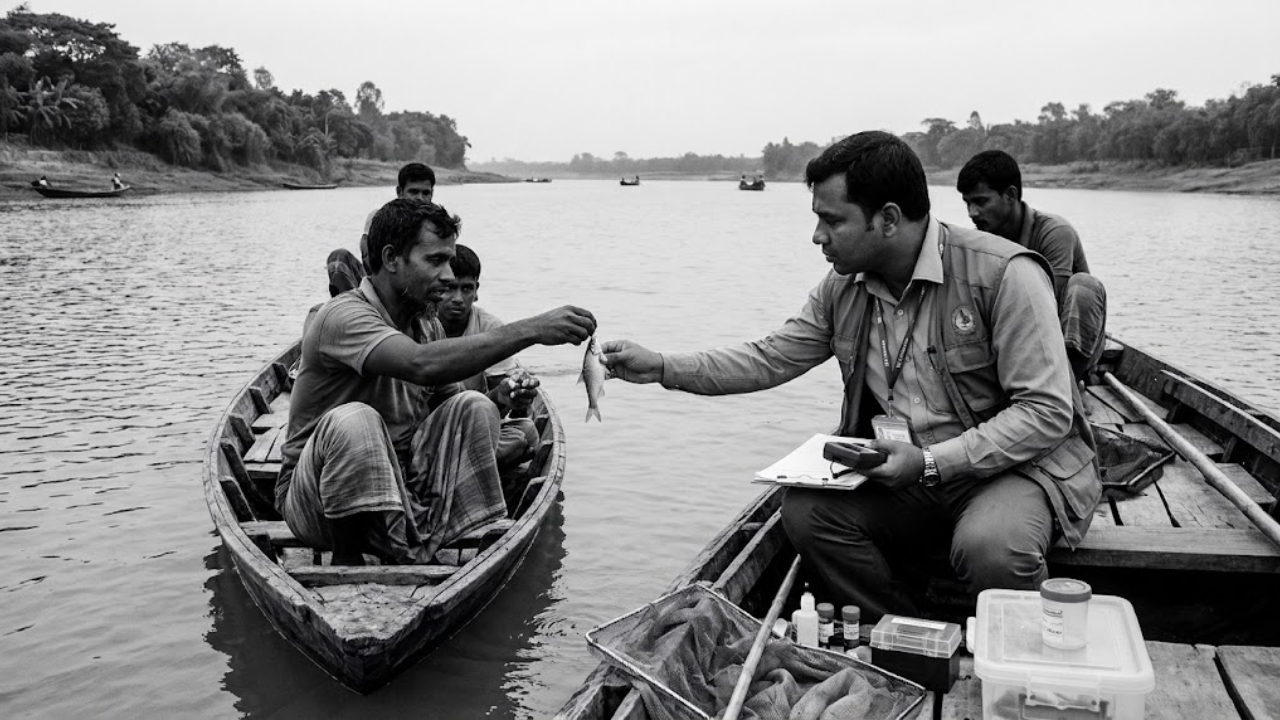
Baseline surveys of fish stocks, plankton dynamics, coral health, microplastic pollution and the effects of warming waters on hilsa migration all need systematic work. Biotechnology also offers promise, from seaweed cultivation and marine-derived pharmaceuticals to sustainable aquaculture in coastal belts. Because so little has been studied, modest, well-designed projects can produce original findings of international interest.
Institutional Landscape
Several bodies carry out marine research. The Bangladesh Fisheries Research Institute operates a marine station in Cox’s Bazar, the Bangladesh Oceanographic Research Institute, under the Ministry of Science and Technology, works on ocean science, and universities in Chattogram, Dhaka and elsewhere run marine science and fisheries departments. The Marine Fisheries Academy in Chattogram trains officers and seafarers for the sector.
Yet coordination is weak. Projects often overlap, data is rarely shared across agencies, and there is no official national repository of marine biodiversity records. Researchers frequently work in isolation, which slows the accumulation of long-term datasets that policymakers need.
The Role of Government Ministries
Marine fisheries fall mainly under the Ministry of Fisheries and Livestock, through its Department of Fisheries, while the Ministry of Water Resources manages rivers, embankments, flood control and estuarine dynamics. Both matter, because what happens upstream shapes salinity, sediment and nutrient flows in coastal waters. The science and technology ministry, which oversees the oceanographic institute, and the environment ministry, which manages protected areas, also play key roles.
The fisheries ministry sets licensing rules, enforces seasonal fishing bans, supports stock assessments and runs programmes that protect hilsa, Bangladesh’s national fish. The water resources ministry influences coastal ecosystems through river management, dredging and polder projects, which affect mangroves and estuarine nurseries. When the two plan independently, priorities can conflict: a flood-protection scheme may degrade the very habitat a fisheries programme is trying to restore.
Policy Reforms Under Way
The Marine Fisheries Act of 2020 replaced older ordinances with a modern legal framework covering licensing, vessel registration, conservation measures and penalties for illegal fishing. The government has also created a Blue Economy Cell, set up marine protected areas, adopted extended fishing closures to protect breeding periods, and begun registering and tracking industrial and artisanal vessels.
These steps matter for science because management without evidence is guesswork. A licensing system generates catch data. Protected areas create natural laboratories. Closed seasons allow researchers to compare stock recovery against fished periods. Policy and research are natural partners, but only if the law explicitly funds and requires scientific monitoring.
Persistent Challenges
The first obstacle is funding. Marine research needs vessels, laboratories and sustained field campaigns, while national research budgets remain small. The country has very few dedicated research vessels, which limits work in deeper offshore waters. A new oceanographic research vessel, begun at Khulna Shipyard in June 2026, is not due until 2028.
The second is human capacity. Few universities offer advanced marine biology training, and graduates often go abroad. Taxonomic expertise, particularly for invertebrates and plankton, is scarce.
The third is data quality. Fisheries statistics rely heavily on estimates, and a large artisanal fleet operates with limited reporting. Illegal and unreported fishing, overcapacity and destructive gear compound the problem; the 2025 survey found stocks declining fast.
Finally, environmental pressure is intensifying. Cyclones, sea-level rise, plastic pollution from rivers, shipbreaking activity and coastal development all threaten habitats before they have even been properly studied.
Recommendations
A national marine data portal should be established so that agencies and universities contribute to and draw from a common database. The fisheries, water resources, science and environment ministries should form a standing joint committee on coastal and estuarine management. Dedicated research funding, including investment in modern research vessels, should be built into blue economy budgets. Partnerships with regional and international institutions can fill training gaps, and fishing communities should be engaged as partners, since their local knowledge is an underused scientific resource. Marine protected areas need enforcement and monitoring, not merely declaration.
Conclusion
Bangladesh has the ocean, the legal groundwork and growing political attention needed to build a strong marine science community. What it lacks is sustained investment, coordination and trained people. If the ministries responsible for fisheries, water, science and the environment align their efforts and treat research as the foundation of policy rather than an afterthought, the Bay of Bengal could become both a source of national prosperity and a model of responsible ocean stewardship.