
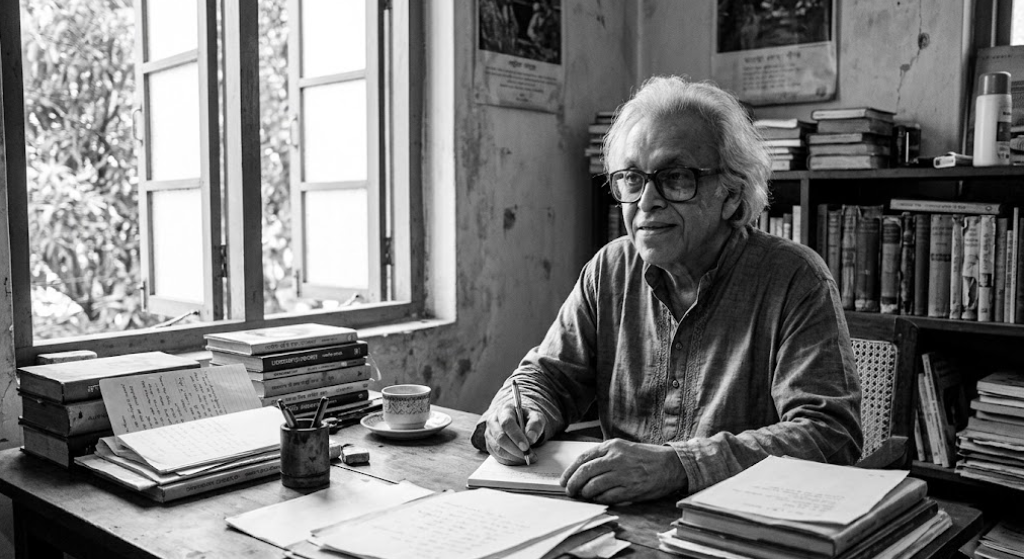
Farah Zahir
Managing Editor, The Oniket Bulletin
On 23 October 2026, Bangladesh marked the 97th birth anniversary of Shamsur Rahman, the poet many readers regard as the nation’s voice in verse. Born in 1929 in his grandfather’s house in old Dhaka, with ancestral roots in Narsingdi on the bank of the Meghna, he died in August 2006 after twelve days in a coma.
Between those dates lay a career of more than sixty poetry collections, a life in journalism, and a body of work that tied the private feelings of an urban Bengali to the public story of his country. The anniversary is a fitting occasion to ask whether the nation has honoured him as fully as it has praised him.
Life Shaped by Dhaka and Its Struggles
Rahman studied English literature at the University of Dhaka and joined the Progressive Writers and Artists Association, reading his early poems at Madhu’s Canteen and supporting the movement to make Bangla a state language. This was the formative circle of his generation, one that carried the language movement into literature. He earned his living through journalism and broadcasting, working at a daily newspaper and at Radio Pakistan before becoming assistant editor of Daily Pakistan in 1964. He stayed with the newspaper after it became Dainik Bangla following independence, and from 1977 to 1987 he edited both Dainik Bangla and the weekly Bichitra. The newsroom kept him close to ordinary events, and his columns and his memoir, Kaler Dhulay Lekha, show a writer who watched a changing society closely.
Literary Work
His first collection, Prothom Gaan Dwitiyo Mrityur Aage, appeared in 1960 and was followed by landmark books such as Roudro Karotite, Bidhwasto Neelima, Niralokey Dibyaratha and Adigantho Nagno Padodhwoni. The range is remarkable, taking in love sonnets, patriotic verse, meditations on mortality and, charmingly, lines about his cat. His best-known poem, Shadhinota Tumi, was written in the throes of the 1971 war and became a hymn of the liberation struggle. Alongside it stands Asader Shirt, which turned the blood stained shirt of a murdered activist of the 1969 uprising into a banner of resistance. Rahman had a gift for making a single everyday object carry the weight of history.
Stylistically he blended the modernist inheritance of Bengali poetry with the speech of Dhaka’s streets. His lines are plain enough to be recited at rallies and subtle enough to reward a quiet reader. Contemporaries have described him as deeply rooted in his own tradition, and that rootedness gave his modernity a local voice rather than an imported one.
The Philosophy Behind the Verse
Three convictions run through his writing. The first is freedom, understood as political independence, as freedom of expression, and as the right of an individual to feel and think without fear. The second is secular humanism: he wrote about human beings first, and his Bengali identity rested on language and shared culture rather than religion. The third is a quiet devotion to the ordinary, to city lanes, rain, love, grief and domestic animals. For him poetry was not a retreat from public life but another way of standing in it.
That stance carried a cost. He lived through years when openly secular writers faced hostility, and he survived an attack at his home in 1999 that was widely read as an attempt to silence him. He did not retreat from his principles, and that steadiness is part of his legacy.
Recognition: What He Received
By most measures his achievements were honoured. He received the Bangla Academy Literary Award in 1969, the Ekushey Padak in 1977 and the Independence Day Award in 1991, the highest civilian honour of the state. Private and literary institutions added many more, including the Adamjee Prize and the Jibanananda Prize. He is often called the unofficial poet laureate of Bangladesh, and the Bangla Academy holds events in his name each anniversary, with a seminar room that carries it.
Recognition: Where It Falls Short
The picture, however, has gaps. The title of poet laureate, which many readers freely give him, remains unofficial, because Bangladesh has never formalised such a post. The nation’s affection has not been matched by an institutional gesture. His highest state honour also came in 1991, fourteen years after the Ekushey Padak, when he was already the country’s most visible poet. The Ministry of Cultural Affairs could close this gap by creating an official national poet laureate post, with a defined term, a modest stipend and public duties such as school visits and readings, so that recognition becomes a standing institution and not a matter of sentiment.
Internationally, the shortfall is larger. Despite more than sixty books, he is little read outside the Bengali world, because translations are scarce and unevenly distributed. Poets of comparable stature from other languages enjoy global audiences largely through consistent translation and promotion, and Bengali literature after Tagore and Nazrul has received less of both. A poet whose images are as universal as a shirt, a lane or a cat deserves to be read in Cairo and Cambridge as readily as in Dhaka. The Bangla Academy and the Ministry of Cultural Affairs already run publication and cultural exchange programmes, and these could fund a systematic translation series, supported by Bangladesh missions abroad and participation in international book fairs and literary festivals.
At home, the question is whether recognition has become ritual. Anniversary programmes, recitations and photo exhibitions are welcome, but they cannot substitute for accessible editions, school curricula that teach his poetry with care, and a well kept archive of his manuscripts and letters. The National Curriculum and Textbook Board could ensure that his poems are taught with context and not merely memorised for examinations, while the National Archives and the Bangla Academy could digitise his manuscripts, letters and newspaper columns and make them freely available to researchers and students.
An Anniversary Worth Keeping
The best tribute to Shamsur Rahman is to read him. His poems remind us that freedom is both a national achievement and a daily practice, that language is a form of home, and that humble things can carry great meaning. On his 97th birth anniversary, Bangladesh would honour him most by giving his work what it still lacks: a formal place in national life, serious translation for the world, and readers in every new generation.


