
Farah Zahir
Oniket Research Group
On 29 October the UN General Assembly gave Bangladesh and Nepal three more years to prepare for leaving the least developed country (LDC) category. Bangladesh will now graduate on 24 November 2029 instead of this month. No country objected, and France, Canada and Ireland, the last speaking for the European Union, backed the delay while urging reforms. Dhaka calls it a diplomatic success. It is, but a narrow one.
Win, or dependence?
It was not a failure on paper. Bangladesh cleared all three graduation tests, including the Human Assets Index. That index counts things such as secondary enrollment and adult literacy, which Bangladesh can show, not whether a child can actually read.
The government’s request, filed on 18 February, did not claim otherwise. It argued that the five-year preparation had been seriously disrupted by the pandemic, the Ukraine war, Middle East instability, irregularities in the financial sector and the political change of 2024, and that more time was needed to steady the economy and finish the Smooth Transition Strategy.
The deeper reason is money and market access. As an LDC, Bangladesh enjoys duty-free, quota-free entry to European markets, and those benefits are not expected to continue in the same form after graduation. Garment exporters wanted time, and millions of jobs depend on them. So the delay is both things at once: a negotiating gain, and an admission that the economy still leans on concessions rather than productivity.
Education shows the same pattern. Development partners, including the Asian Development Bank, the World Bank and the European Union, back primary education through the PEDP-5 programme, while public spending stayed below 2 percent of GDP for a decade, falling to about 1.4 percent last year. The budget presented on 11 June proposes a record Tk 1.36 trillion and a pledge to reach 5 percent of GDP in five years. The pledge is welcome. It has yet to be delivered.
Gap one: children in school, not learning
Primary enrollment is close to universal, yet the World Bank estimates that about half of children at late primary age cannot read and understand a short, age-appropriate text. Its 2024 brief put the figure at 51 percent, using data from the pandemic years. An earlier estimate for children aged 10 to 14 was 58 percent. Spending per primary-age child is about $223 in purchasing power terms, 81 percent below the South Asian average. Teacher shortages, heavy administrative duties and the absence of a comprehensive teacher policy, as a draft Education Sector Analysis this year noted, leave classrooms short of the one thing reading depends on: a trained teacher with time to teach.
The policy that fits is a foundational learning programme for Classes 1 to 3. It would use structured Bangla and mathematics lessons, regular coaching for teachers inside their own schools, and a yearly sample-based reading test whose results are published. Vacant primary posts should be filled first. This can be built into PEDP-5 and the new budget rather than added as another project.
Gap two: secondary dropout and empty teaching posts
Around 16 percent of students leave before finishing primary school, and nearly one-third drop out at secondary level, the same analysis found. UNICEF said 3 to 4 million secondary-age children are out of school. Girls fall behind: in 2020 secondary completion was about 60 percent for girls and 67 percent for boys. The Education Minister told parliament on 7 April that 60,295 teaching posts were vacant across roughly 26,000 secondary schools and colleges.
The policy here is a retention package. Stipends should go to poor families and to girls, paid against attendance. Schools should use their own records to flag children who are slipping before they leave. And a time-bound recruitment drive should fill the vacant posts, with training and a career ladder attached to the pay raise now planned for teachers.
The goals involved
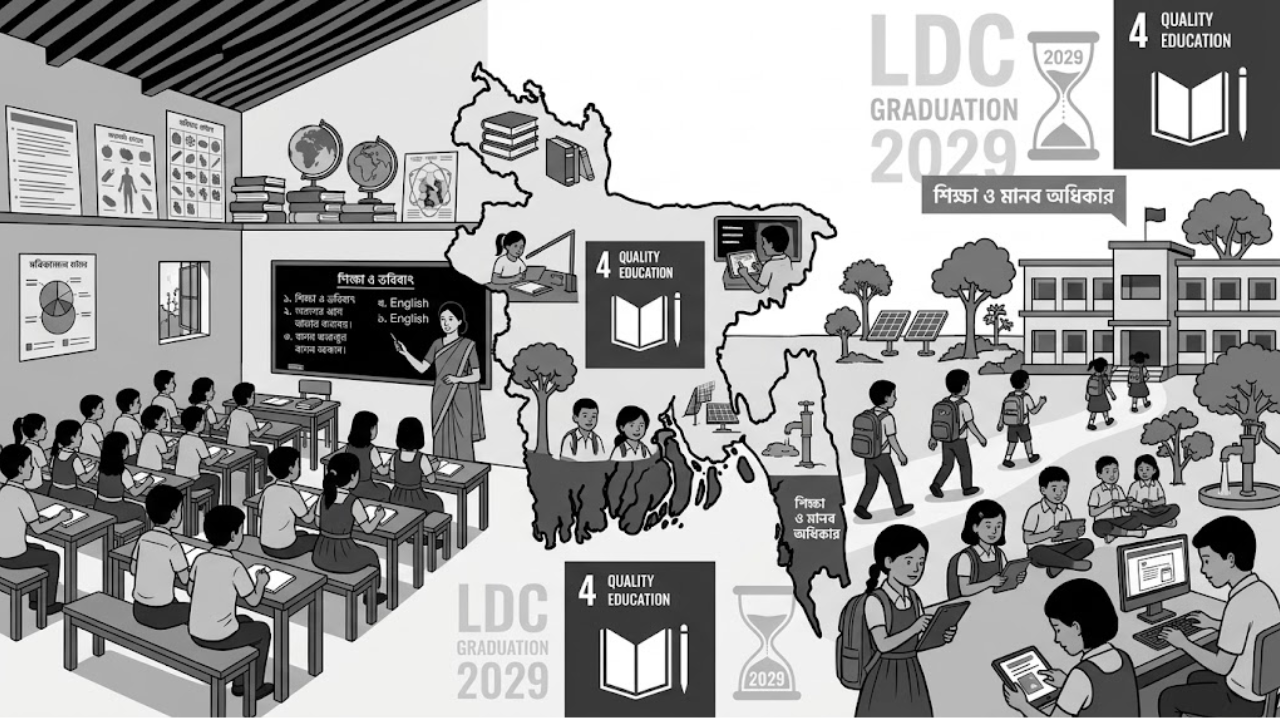
Both gaps sit under Sustainable Development Goal 4. Target 4.1 asks that every child complete primary and secondary school with relevant learning outcomes, and 4.c concerns qualified teachers. Keeping girls in secondary school also serves Goal 5 on child marriage, and Goal 8 on young people outside education and work.
The test in 2029
The extension is a window, not a reward. By November 2029 the measure will not be the number of tablets handed out or classrooms built. It will be whether more ten-year-olds can read, whether fewer teenagers leave school, and whether education spending has moved from promise to practice. A country that leaves the LDC list with half its children unable to read will soon find that its real shortage is not trade preferences but workers able to fill better jobs.



