
Arza Sait
Oniket Research Group
Rice is more than a staple in Bangladesh and India; it is a shared economic link shaped by geography, markets and a long history of cross-border trade. According to a 2013 Asian Development Bank working paper, however, the supply chains that move this rice are undergoing significant structural change. Based on surveys of farmers, millers, traders and retailers in 2009 and 2010, the paper analyses these shifts in the market and traces how rice moves from field to city in each country.
The rice value chains in Bangladesh and India are changing rapidly but quietly, in what the paper call a “quiet revolution.” The chains are lengthening geographically, as farmers now sell to distant cities, while the number of intermediaries is shrinking as farmers sell directly to wholesalers and mills rather than village traders. Farmers keep roughly 60 percent of the final urban retail price; the other 40 percent goes to milling, trading and retailing. Even small farmers are commercial producers, selling 80 to 90 percent of their crop.
However, the two countries are not changing at the same pace. In Bangladesh, around 30 percent of paddy is sold directly to mills, compared with only around 5 percent in India. This is partly due to Uttar Pradesh’s Agricultural Produce Marketing Act, which channels sales through regulated wholesale markets. India’s mills are also tied to the state, selling 59 percent of their output to government agencies, while Bangladesh’s privately driven mills compete to buy directly from farmers. As a result, Bangladesh’s rice chain is modernizing faster, with fewer middlemen and a growing market for branded rice.
Although India is a major exporter of rice, it faces mounting pressure from rising production costs. Farmland is becoming increasingly concentrated: in Uttar Pradesh, medium and large farms account for only a quarter of holdings but control around two-thirds of the land, while the share of rented land more than tripled, from 8 to 26 percent, in just five years. Labor is also becoming more expensive as more rural workers take up off-farm jobs, which is significant given that hired labor already makes up roughly a third of value chain costs. Unless farming becomes more mechanized, the paper warns, rice prices are likely to rise. Additionally, energy adds further risk: fuel is used throughout farming, milling and transport, so a rise in oil prices quickly feeds through to the price of rice.
In the 2000s, Bangladesh imported only about 2 percent of its rice, while India exported an average of 4.6 percent of its output and imported less than 1 percent. Bangladesh’s food supply was thus secured mainly through its own value chain, which is why the paper emphasizes the need for an efficient domestic market. The same cost pressures, however, operate on both sides of the border: in Bangladesh, purchased inputs account for about 36 percent of value chain costs and hired labor for a further 33 percent.
This means that any increase in costs, such as higher fertilizer or fuel prices, would raise rice prices in Bangladesh just as it would in India. Moreover, Bangladesh may need to rely on India when floods or crop failures cause shortages, as it would then have to import rice from its neighbors. As a result, a rise in Indian production costs or a disruption to Indian supply can have knock-on effects in Dhaka’s markets, pushing up the price of rice.
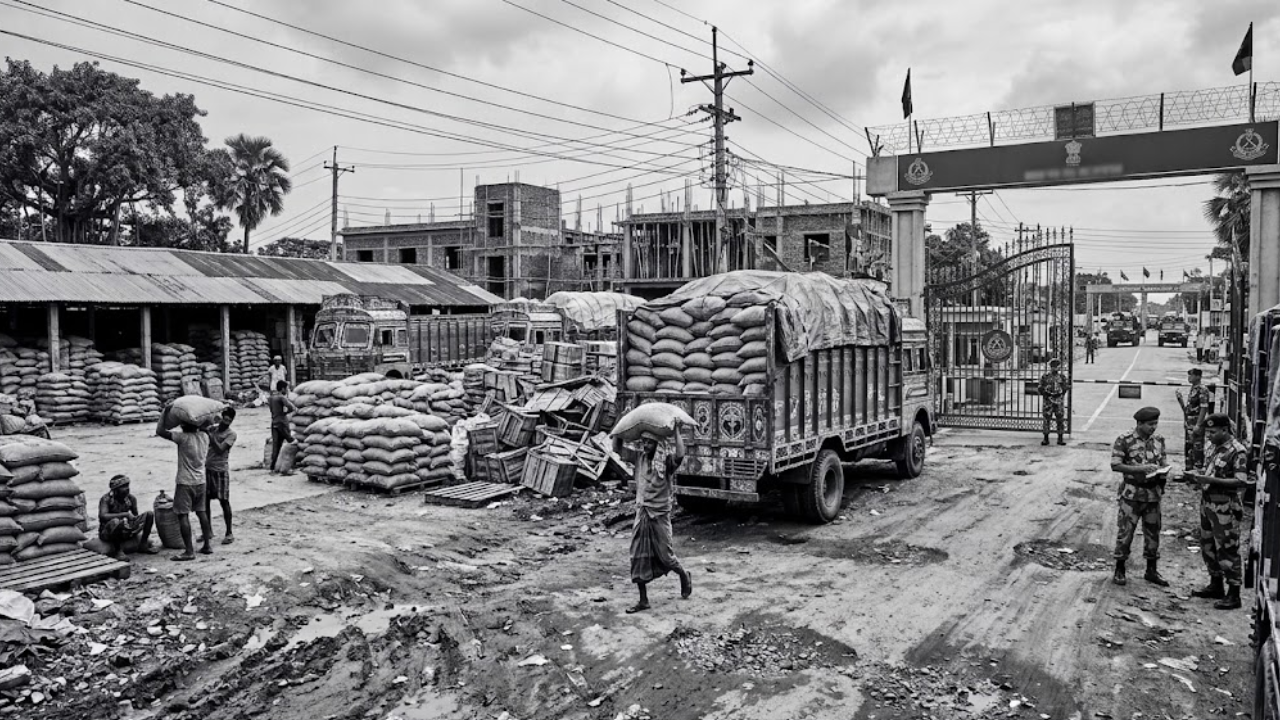
Trade matters only at the margin, but that margin matters. In a normal year, Indian rice makes up a small share of what Bangladesh consumes. Since both countries liberalized trade in the early 1990s, however, imports from India have repeatedly helped Bangladesh cope with shortfalls: after the 1998 floods, private traders brought in more than two million tons of Indian rice, stabilizing domestic prices. Yet Bangladesh cannot assume India will always supply it. Because the Indian state buys most of the output of its mills, export availability depends on government decisions rather than market forces alone.
This risk has materialized more than once. When India banned non-basmati exports in 2008, coarse rice prices in Bangladesh rose by around 7 percent almost overnight, and a similar ban in 2023 left Bangladesh among the countries most exposed. Even so, there is room to make trade more reliable. Bangladesh’s more modern mills and traceable supply chains could help it handle imports efficiently, while transport costs about twice those in China suggest that better border logistics would benefit both countries.
If the rice chain is to become more efficient and resilient, governments on both sides of the border will need to invest in infrastructure such as roads, power, rural wholesale markets and irrigation, which made it possible for millers and traders to modernize. Subsidies should also be better targeted: in India, support for fertilizer, seeds and tube wells went mostly to medium and large farmers rather than the smallholders who need it most (Reardon et al., 2013).
Beyond the farm, policymakers should pay far more attention to milling, trading and retailing, which make up around 40 percent of the price of rice yet remain largely overlooked. For Bangladesh, this means helping private millers and traders upgrade storage and logistics, while maintaining stocks and import arrangements that can respond quickly when the domestic harvest falls short. Finally, for trade between the two countries, clearer rules and better border infrastructure would reduce the uncertainty caused by sudden policy changes, such as India’s export bans.
References:
CNBC (2023). “India’s rice export ban could send decade-high prices spiking even further.” 21 July 2023.
Dorosh, P.A. (2001). “Trade liberalization and national food security: rice trade between Bangladesh and India.” World Development, 29(4), pp. 673–690.
Dorosh, P.A. and Rashid, S. (2012). Bangladesh Rice Trade and Price Stabilization: Implications of the 2007/08 Experience for Public Stocks. IFPRI Discussion Paper 01209.
Financial Express (2008). “Indian ban pushes up coarse rice prices.” 11 February 2008.
Reardon, T., Minten, B., Chen, K.Z. and Adriano, L. (2013). The Transformation of Rice Value Chains in Bangladesh and India: Implications for Food Security. ADB Economics Working Paper No. 375.
The Daily Star (2024). “India lifts ban on non-basmati rice export.” 28 September 2024.