
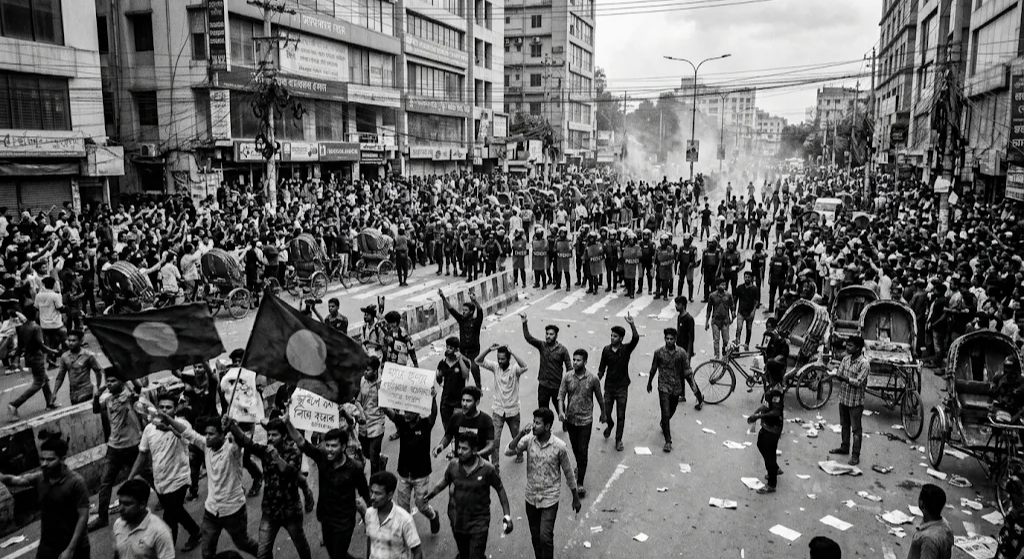
Desk Report
Bangladesh still has no standalone law on mob violence or lynching. Prosecutors rely on the Penal Code of 1860 and the Code of Criminal Procedure of 1898. When a crowd kills someone, charges are usually filed for murder under Section 302, which carries death or life imprisonment, or for culpable homicide under Section 304.
Group liability comes from the provisions on unlawful assembly and rioting, notably Sections 141, 143, 146 and 149. Lawyers say the missing legal definition of mob violence makes cases harder to build, because investigators must prove individual roles inside a fast-moving crowd. The constitutional backdrop is Articles 31 and 35, which guarantee protection of the law and a fair trial, and mob punishment violates both by its nature.
The government’s position has shifted. In May 2026, the Home Minister said laws would be amended or updated if needed to end “mob culture.” By October, however, he was saying that existing laws were sufficient, while the Attorney General proposed sending such cases to speedy trial tribunals. Reform therefore remains an intention rather than a bill.
The constitutional amendments on the table
No proposed constitutional amendment targets mob violence directly, as far as our research could find. The reform agenda grows from the July Charter, where 48 of 84 clauses concern the Constitution. These include broader fundamental rights, stronger independent institutions and curbs on executive power, which could indirectly give victims more avenues for redress.
The process itself is contested. Jamaat and the NCP demand a Constitution Reform Council, citing the roughly 70 percent Yes vote in the referendum, while the government prefers a special parliamentary committee. One proposal before it would enshrine recognition of the uprising and immunity for its participants, so the debate centres on protecting them rather than punishing mob violence.
The July Mass Uprising (Protection and Liability Determination) Ordinance, issued in January 2026 and passed as an Act on April 8, protects participants in the 2024 uprising for acts of political resistance. Supporters call it a moral duty to the uprising’s fighters, while rights groups fear it could shield killings, arson and attacks on vulnerable communities.
Its scope is the key issue. The Act covers uprising related conduct, not all later mob violence. Attacks on shrines, journalists, suspected Awami League supporters or people accused of blasphemy or theft are not clearly resistance. Defendants may argue otherwise, so courts will have to draw the line case by case.
The effect on violence from August 2024 to February 2026
Human rights groups count hundreds of mob killings since the 2024 transition. Ain o Salish Kendra recorded 128 deaths in 2024 and 198 in 2025, reaching 497 by September 2026, while another tally put the figure near 337 through March 2026. Counting methods explain part of the difference, and the Attorney General has questioned the NGO numbers.
For victims of that period, the Penal Code remains the main tool, and murder carries no limitation period. A new anti-mob law could not reach back, because Article 35 of the Constitution bars punishment under laws enacted after the act, so any future statute would apply only to future cases.
Prosecutions have been slow. Reporting this autumn found several 2024 cases with no arrests or visible progress, though a few others led to warrants and dozens of arrests. In February 2026, the High Court asked the government to explain why its failure to prevent and control mob killings should not be declared unlawful, and that case could still produce binding directions.
Official figures point to a decline. The Home Ministry reported 63 incidents in the first nine months of 2026, down about 41 percent from a year earlier, with deaths falling from 63 to 40. Rights groups note, however, that attacks continued even after the government declared mob culture over.
Conclusion
Bangladesh’s response to mob violence rests on colonial era statutes written for ordinary crimes, with no provision that defines the collective nature of lynching. Murder, culpable homicide and rioting charges can reach perpetrators in theory, but prosecutors must prove who did what inside a crowd, and enforcement has depended on local police willingness and political pressure rather than consistent practice.
The constitutional reform debate has largely passed over this gap. Its energy has gone into widening fundamental rights, strengthening independent institutions and recognising the 2024 uprising. These matter for democracy, but they say little about how mobs should be prevented or punished.
The indemnity law shows why precision matters. It protects people who acted in political resistance during the uprising, a defensible aim if applied narrowly. Stretched further, it would blur the line between resistance and vigilante violence, such as attacks on shrines, assaults on suspected loyalists or killings over rumours, and would give defendants an argument for impunity. Courts must keep that boundary firm.
For families still waiting after attacks between August 2024 and February 2026, a new statute offers little, since a later law cannot punish earlier acts and the Penal Code already covers them. Their outcome depends on whether police record complaints and make arrests, whether prosecutors build cases despite local pressure, and whether courts hear them without long delays.