
Jahid Hasan
Freelance Journalist
In November 2025, Bangladesh was still under the caretaker authority of Muhammad Yunus’s interim government, a structure that existed only because the 2024 student uprising had toppled Sheikh Hasina after her long hold on power.
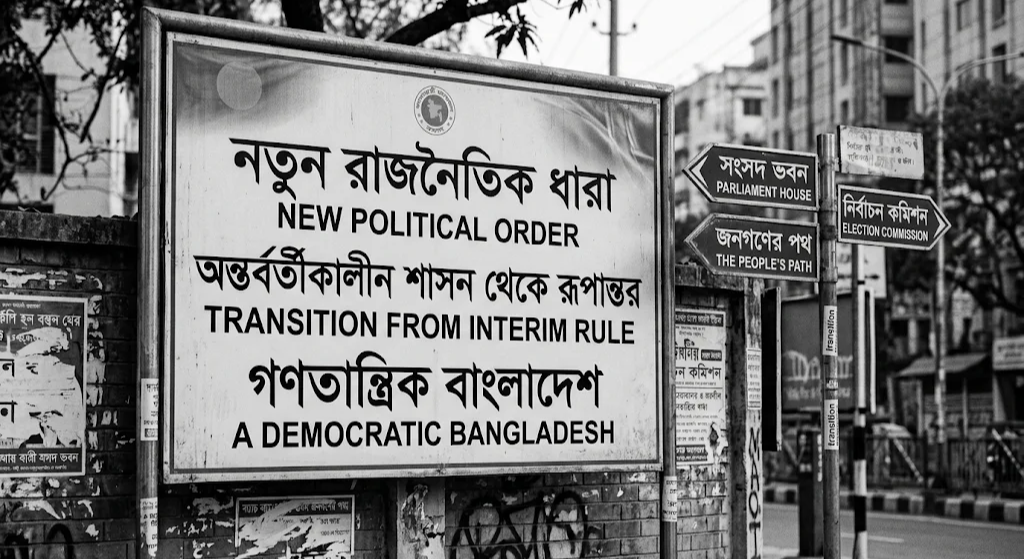
Twelve months later, the country voted, seated a new parliament and handed power from an unelected technocratic administration to a government with an overwhelming mandate. Seldom has Bangladesh’s political order been redrawn so completely in so short a time. We review the year with a view to set some expectations for the coming year of local politics in Bangladesh.
The events that set the stage
Three events drove the change. In November 2025, a tribunal in Dhaka sentenced Hasina to death in absentia over the crackdown on the 2024 protests. She remained in India, and the verdict closed the door on any political comeback for her party. The Awami League was then barred from contesting the election, which left the field to its rivals.
December brought shocks of a different kind. Sharif Osman Hadi, a prominent youth figure from the uprising who planned to run as an independent candidate in Dhaka, was shot while campaigning and later died in Singapore. His death set off angry protests and raised fears for the election climate. In the same month, BNP acting chairman Tarique Rahman returned from seventeen years of exile in London and was greeted by huge crowds. On December 30, his mother Khaleda Zia, three time prime minister and the party’s chairperson, died at 80. Her death gave the party a wave of public sympathy, and her son took over unchallenged.
BNP’s election victory
The election and a referendum on the July Charter were held together on February 12, 2026. BNP took 209 seats with just under half the national vote, and about 212 with its allies, which gave it a two thirds majority. Turnout was nearly 60 percent, well above the previous election. Tarique Rahman was sworn in as prime minister on February 17.
Several factors worked in BNP’s favour. With the Awami League excluded, many of its former supporters and moderate voters looked for the most established alternative. BNP also seemed the safer, more centrist choice for voters wary of a religious party leading the government. Its message was simple and aimed at household worries, and it arrived under a leader who could present himself as a unifier after Khaleda Zia’s death.
The opposition’s rise and the shifting mood
The biggest surprise was Jamaat-e-Islami, which won 68 seats on about 32 percent of the vote and became the main opposition for the first time. Its alliance with the student founded National Citizen Party looked formidable before the vote, yet the NCP won only six seats. Jamaat’s gains show that a large share of the electorate wanted an alternative to the old Awami League and BNP rivalry.
Since then the picture has been mixed. Jamaat has organised in parliament, formed a shadow cabinet and used a gas and power shortage to challenge the government’s claims of success. But its alliance with the NCP is under strain. The two parties disagree over how to run in the local elections, especially the Dhaka mayoral contests. Some NCP members also suspect Jamaat of being too soft on BNP, pointing to the friendly exchange after Jamaat’s loss in the Thakurgaon by-election on October 29. Public support for the opposition is therefore real but not yet consolidated.
The manifesto that appealed to voters
BNP’s manifesto stressed pocketbook promises. The flagship was the Family Card, issued in the name of the woman of each household, offering a monthly allowance of about Tk 2,500 or equivalent essential goods. A Farmer Card promised fair crop prices, subsidies, credit and insurance. The party also pledged 100,000 new health workers, job creation for young people, jobs oriented education and stronger protection for journalists. On governance, it promised accountability and rule of law under its “Bangladesh First” slogan. Critics, including NCP leaders, called the cards vote buying and questioned their cost, but the simple messages clearly resonated.
Challenges for the coming year
The government’s most immediate task is turning promises into results. The Family Card is reportedly being piloted in phases, beginning with the ultra poor, but extending it to millions of households will put real pressure on the budget and raise difficult questions about registration and fairness. Energy compounds that pressure. The country has endured its worst electricity crisis since BNP took office, caused less by a shortage of power plants than by a shortage of fuel to run them, and prolonged outages could erode public trust in the government faster than almost anything else.
Politics adds another layer of difficulty. Roughly 70 percent of referendum voters backed the July Charter, yet BNP opted for a special parliamentary committee rather than the Constitution Reform Council that the opposition demanded. Jamaat and the NCP have warned that they will take the fight to the streets if the council is not convened, which makes the dispute a possible source of sustained unrest.
Local government will test the situation further. Elections for all five tiers are being rolled out in phases over about a year, and they will show how strong BNP’s grassroots machinery and party discipline really are, and whether the opposition can cooperate. Hasina’s vow to return in December, along with the ongoing trials of Awami League figures, means the year ahead is likely to stay unpredictable.
Conclusion
Bangladesh has moved from uprising and interim rule to an elected government facing a strong, if divided, opposition. Whether the next year consolidates that democratic gain will depend on delivering welfare promises, keeping the lights on and treating the reform mandate fairly.