
Nishita Shukla
BRAC University
Introduction
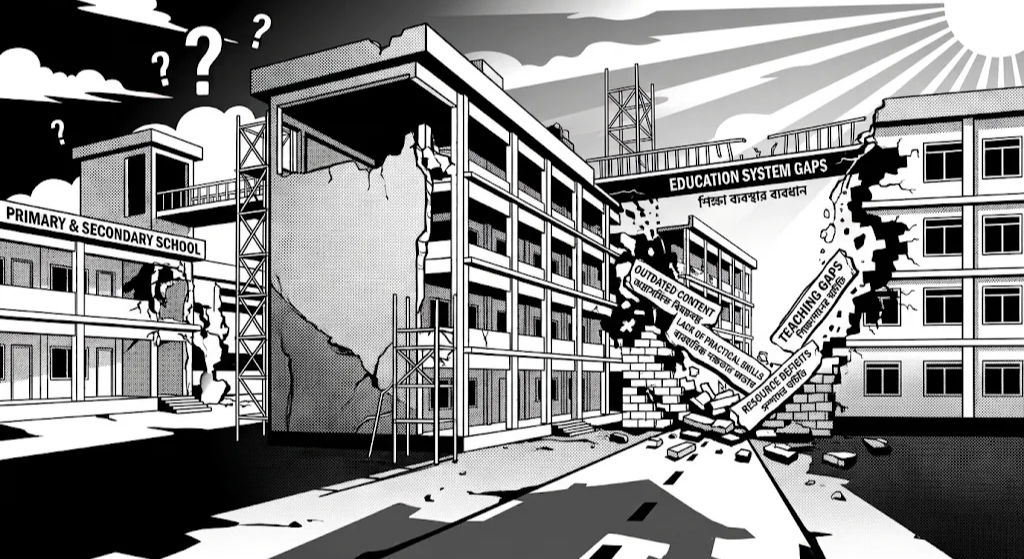
Bangladesh has achieved an important milestone in education: most children now attend school. Primary enrolment is close to universal, gender parity has been achieved, and secondary institutions have expanded. Yet wider access has not produced comparable learning. Assessments repeatedly show that many children completing primary school cannot understand a short passage or solve basic arithmetic problems suited to their grade. The curriculum determines what is taught, examined, and learned. Over two decades, successive reforms have recognized the system’s weaknesses, but many of the same gaps remain unresolved.
Curriculum Context
Bangladesh has a five-year primary cycle and a five-year secondary cycle. Primary education is compulsory and ends with a completion examination, while secondary education concludes with the Secondary School Certificate examination. The National Curriculum and Textbook Board develops syllabuses and textbooks, which are distributed free to students.
Secondary education is divided into general, madrasah, and technical and vocational streams. Reform has been frequent: the National Education Policy appeared in 2010, curriculum revisions followed in 2012, and a competency based National Curriculum Framework was adopted in 2021 and introduced from 2022. Parts of the framework were later withdrawn after public criticism. Yet classroom incentives have changed little.
Gaps in Primary Education
The first gap is between curriculum ambition and classroom practice. Official documents promote competencies, projects, and continuous assessment, but many classrooms still rely on recitation, copying from the board, and reading textbooks aloud. Large classes and limited materials push teachers towards familiar methods. Assessment reinforces this pattern. Completion examinations and school tests reward recall, encouraging students, parents, and teachers to prioritize memorization.
Language is another barrier. The curriculum assumes that children enter school speaking Bangla, the language of instruction. Children from non-Bangla speaking households may fall behind without language support. Preservice preparation is short and general, one teacher may be expected to cover every subject, and subject specific mentoring after appointment is scarce.
A single national textbook can also leave little room for local context or teacher judgement. Uneven access to preprimary education compounds these weaknesses, as children begin grade one with very different levels of preparation.
Gaps in Secondary Education
At secondary level, public examinations shape much of classroom instruction. Results influence student progression, institutional reputation, and employment prospects, so teaching narrows to examinable content. The creative question format was introduced to test higher order thinking, but coaching centers and students soon turned it into a predictable pattern that could be drilled.
Early streaming into science, humanities, and business studies forces choices before students are ready to make them. Technical and vocational education also has lower status than general academic routes. In science and mathematics, many schools lack laboratories or do not use them effectively, while shortages of qualified subject teachers restrict practical learning.
Information and communication technology competencies assume connectivity, devices, and teacher confidence that many institutions lack. Life skills, health, climate awareness, and citizenship are often memorized rather than practiced.
Why the Gaps Persist
The first reason is that reform has changed curriculum documents more than assessment. Second, policy discontinuity weakens progress. Successive governments replace or relabel earlier work, losing the institutional memory needed for long term improvement. Third, teacher development often relies on cascade workshops, with little classroom follow up or evaluation of changed practice. Fourth, reform needs recurring investment in training, materials, laboratories, and supervision, but budgets favor infrastructure and enrolment. Fragmented responsibilities across ministries and directorates further weaken accountability for learning.
Inequality also protects the status quo. Wealthier families can pay for private tutoring to compensate for what schools do not teach, while poorer students cannot. This widens learning gaps and weakens pressure for system wide improvement. Finally, the absence of honest evaluation means failed initiatives are rarely documented clearly, allowing the same mistakes to recur.
Educational Implications and the Way Forward
The consequences accumulate. Children who leave primary school without secure literacy and numeracy enter secondary education with weak foundations. Secondary schooling becomes an exercise in coping, and dropout at the transition is high. Private tutoring widens inequality, while certificates may reveal little about actual competence. Young people may enter work without the technical and interpersonal skills the curriculum promises.
Progress requires more than another framework. Examinations must reward understanding and application, not simply recall. Teachers need stronger preparation, subject specific mentoring, and sustained classroom support. Schools require suitable learning materials, functioning laboratories, and realistic access to digital resources. Responsibilities for learning outcomes must be clear, backed by reliable funding and transparent evaluation.
Conclusion
The gaps in Bangladesh’s education curriculum are neither mysterious nor new. They have been described repeatedly, but reports and revised frameworks have not brought corresponding change to classrooms. The essential priorities are to change what is examined, strengthen the support teachers receive after training, and clarify who is accountable for learning. They must be funded and evaluated across a full student cohort, beyond a single political cycle. A document alone cannot transform education. Lasting improvement will depend on whether policy reaches the classroom and enables every child to learn.