
Rishabh Bhatnagar
University of Birmingham Dubai
September 2021, Bangladesh and Australia signed their first trade framework in 50 years. August 2026, bilateral trade stood at ~US$5.5 billion, yet no binding agreement governs its agricultural side. Five years on, the partnership has grown on goodwill, shared research and mutual need. The question is whether that is enough to secure Bangladesh’s food supply.
Two Countries, One Framework
The Trade and Investment Framework Arrangement (TIFA) is the first of its kind between the two countries in 50 years, and not an elaborate or legally binding agreement. It works through a Joint Working Group. At the third meeting in Canberra, Australia reiterated duty-free, quota-free access for Bangladesh after LDC graduation and said it wanted to import Bangladeshi summer fruits. A fifth meeting is now being prepared.
Science runs deeper than diplomacy. The Australian Centre for International Agricultural Research (ACIAR) has worked in Bangladesh since the mid-1990s, and its salt-tolerant wheat and pulses project ran from March 2017 to April 2024 on a budget of ~AUD 2.1 million before concluding. The ~US$5.5 billion figure is also not an agricultural number. Australia’s own country briefly describes it as Australian natural fibres exchanged for Bangladeshi ready-made garments and puts total trade at A$5.2 billion.
Two Needs, One Imbalance
Both countries gain from the arrangement, but not equally. Bangladesh imported a record ~7.31 million tonnes of wheat in the 2025/26 marketing year, while domestic production meets less than 10% of demand. Australia shipped Bangladesh ~295,000 tonnes in 2022, just over 1% of its total wheat exports. Russia, Ukraine and Canada also supply the market.
The pattern repeats in edible oil, where Bangladesh imports more than 70% of its needs at a cost of over US$2.89 billion a year. The common interest? Real, but lopsided. Australia is a dependable supplier among several, while Bangladesh’s exposure to shocks abroad is close to total.
Two Losses, One Farm
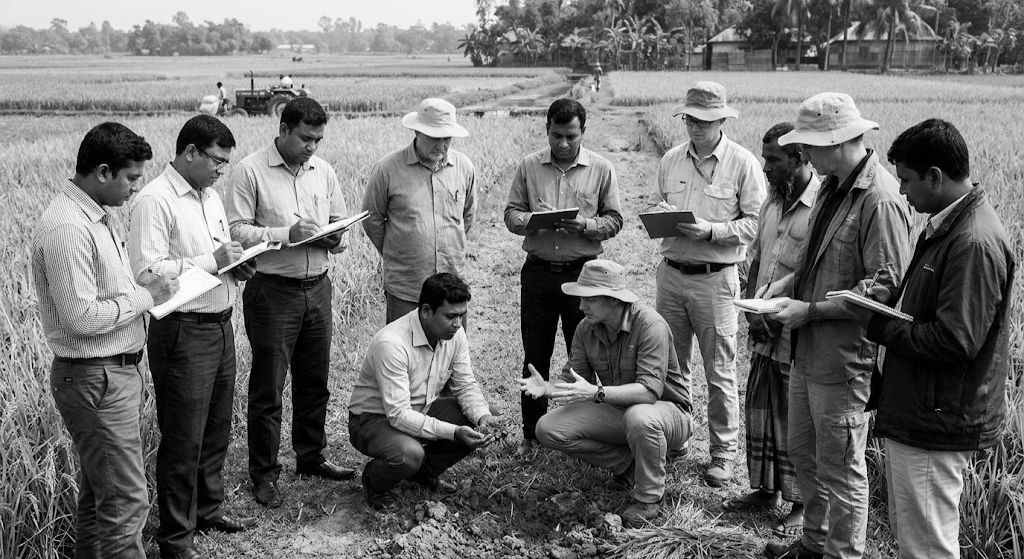
Bangladesh loses food in two places, before the crop is grown and after it is harvested. The 2024 national soil salinity map shows ~1.156 million hectares of the southwest’s ~1.703 million hectares of cultivable land degraded, up from ~1.056 million in 2009. The same reporting cites an economist who says arable land has shrunk from ~9 million to nearly 8 million hectares in two decades.
After harvest, ~25 to 30% of fruit is lost to limited storage and transport, and a study of ten food items put the annual loss at ~5.13 million tonnes worth ~US$2.4 billion. This hurts exports directly. A summer fruit market in Australia is only useful if the fruit survives the journey. Bangladesh asked in 2022 for cold chain technology and registration support for mango exports, and the gap has not closed.
Two Roles, One Deadline
The Ministry of Agriculture should treat the partnership as a development tool, not a diplomatic courtesy. Research must reach the field through faster seed multiplication, certified distribution and demonstration plots across the south. Export readiness needs accredited testing laboratories, plant quarantine capacity and traceability, while cold storage and packhouses would cut post-harvest losses and lift farmer incomes. Cooperative and contract farming can soften land fragmentation, and domestic pulse and oilseed programmes should expand with Australian supply as a backstop rather than a backbone. A dedicated unit should track commitments across the commerce and foreign ministries and publish results, so progress does not depend on any one minister.
The clock is also running. Bangladesh is scheduled to leave the Least Developed Country category on 24th November 2026, but it has asked the UN for a three-year extension, and the General Assembly is to decide before that date. Either way, Australia’s duty-free commitment keeps its value as preferential access narrows elsewhere. The next step is to turn a non binding framework into measurable undertakings: a dedicated agricultural cooperation arrangement with joint funding, defined research targets and clear market access timelines.
Australia has promised access. Whether Bangladesh can use it is a question for Dhaka.