
Desk Report
Oniket Desk
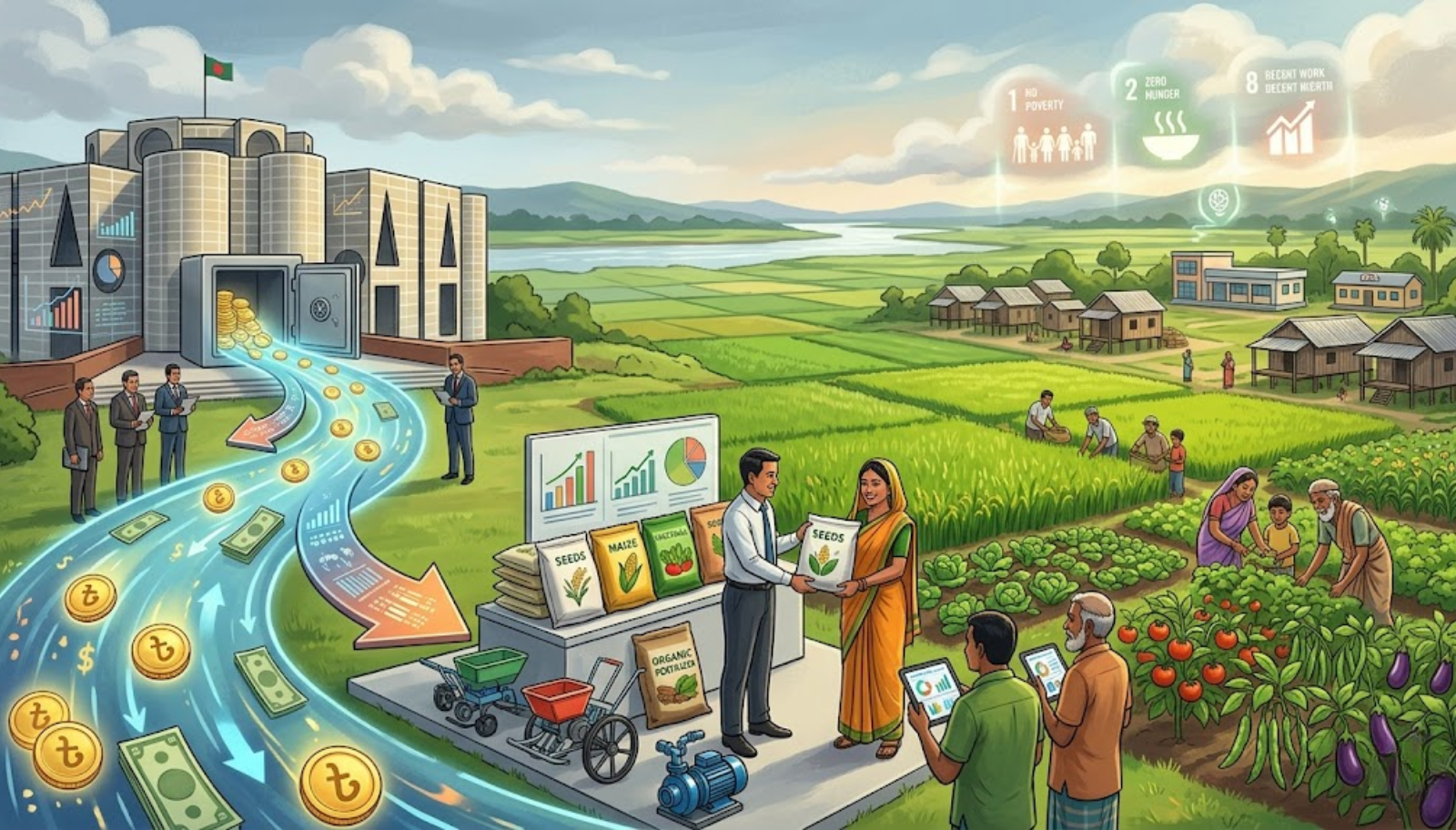
As Bangladesh prepares to table a record Tk 9.30 trillion national budget for FY2026–27, its first as a newly graduated middle-income country transitioning out of Least Developed Country status, the agricultural sector stands at a defining crossroads. Subsidies, long the backbone of farm support policy, face mounting fiscal pressure from currency depreciation, import-dependent input costs, and impending World Trade Organization compliance obligations triggered by LDC graduation.
At the same time, the UN Sustainable Development Goals, particularly SDG 2 (Zero Hunger), SDG 1 (No Poverty), SDG 13 (Climate Action), and SDG 15 (Life on Land), demand not merely the maintenance of agricultural output but a qualitative transformation in how Bangladesh produces, finances, and sustains its food system. The forthcoming budget must navigate this tension with considerably more strategic clarity than its predecessors.
The Current Subsidy Landscape and its Structural Weaknesses
The FY2025–26 budget allocated Tk 17,000 crore in agricultural subsidies. This figure, as the Ministry of Agriculture argued was Tk 8,000 crore below the sector’s actual requirement. The gap between ministry demand and Finance Division approval is itself a symptom of a structural problem: agricultural subsidy policy in Bangladesh is reactive rather than strategic, calibrated to fiscal convenience rather than productivity objectives.
The overwhelming bulk of the subsidy is absorbed by fertiliser, specifically by the growing cost differential between international purchase prices and the subsidised farmer-level price, which has not been revised since April 2023. With urea purchased internationally at approximately Tk 51 per kilogram and sold to farmers at Tk 27, the fiscal burden of a single input dominates what could otherwise be a diversified, productivity-enhancing support architecture.
The consequences of this fertiliser subsidy concentration are compounding. Some 80 percent of Bangladesh’s fertiliser requirement is imported, meaning the subsidy bill fluctuates directly with global commodity prices and dollar exchange rates, both of which have moved sharply against Bangladesh in recent years. Subsidy backlogs have accumulated, private importers are demanding interest payments, and banks are increasingly reluctant to accept the bonds issued by the Ministry of Agriculture in lieu of direct payment. This is not a subsidy policy; it is a fiscal liability without a stabilisation mechanism.
What the Forthcoming Budget Must Address
The FY2026–27 budget must accomplish three things simultaneously: rationalise the subsidy structure ahead of WTO-compliant post-LDC obligations, redirect freed resources toward productivity-enhancing investments, and align fiscal support with the SDG framework that Bangladesh has committed to achieve by 2030.
On subsidy rationalisation, the government must introduce a direct farmer support transfer that is a digitally delivered, means-tested income subsidy payable to smallholder and marginal farmers through mobile financial services. This shift, modelled on reforms successfully implemented in India and Indonesia, would reduce fiscal exposure to global commodity price volatility, improve targeting, and allow fertiliser prices to gradually reflect market reality while protecting vulnerable farmers from the adjustment cost. A phased transition over three budget cycles, announced transparently in FY2026–27, would provide the agricultural supply chain with the planning certainty it currently lacks.
On productivity-enhancing investment, the declining share of agriculture in the Annual Development Programme (from 5.0 percent in FY25 to 4.7 percent in FY26) must be reversed. The forthcoming budget must significantly increase allocations for agricultural research and development, prioritising climate-resilient crop varieties, salinity-tolerant seeds for coastal zones, and drought-resistant cultivars for northern districts. Bangladesh’s agricultural research institutions are chronically underfunded relative to their mandate. Without a step-change in public R&D investment, the productivity gains required to meet SDG 2 targets cannot be achieved through subsidy policy alone.
Cold chain infrastructure must receive dedicated capital allocation, building on the duty exemptions on cold storage machinery introduced in FY2025–26. Post-harvest losses of 20 to 40 percent across perishable categories represent a structural productivity drain that no input subsidy can compensate. Agro-processing zones with reliable energy supply, rural market infrastructure, and last-mile logistics connectivity are prerequisites for the value chain transformation that Bangladesh’s agricultural sector requires.
Fiscal Reforms for SDG Alignment
Sustainable agricultural growth in line with the SDGs requires fiscal reforms beyond the budget line. Agricultural credit policy must be restructured to prevent the crowding-out effect generated by government bank borrowing (projected at 46 percent of the FY2025–26 deficit) from reducing the flow of affordable credit to smallholder farmers and agro-entrepreneurs. A dedicated agricultural credit guarantee fund, capitalised in the forthcoming budget, would de-risk bank lending to the sector without requiring direct fiscal outlay at scale.
Climate finance must be formally integrated into agricultural budget planning. Bangladesh’s haor wetlands, coastal agricultural zones, and drought-prone northern districts are all facing escalating climate risks that conventional subsidy and credit tools cannot address. A climate-adaptive agricultural fund that draws on both domestic budget allocations and international climate finance must be established as a permanent institutional mechanism, not a project-by-project donor dependency. This would directly advance SDG 13 and SDG 15 while building the adaptive capacity that sustained agricultural productivity under climate uncertainty demands.
Bangladesh’s agricultural potential is not in question. What is in question is whether the forthcoming budget will treat agriculture as the strategic productive sector and SDG delivery mechanism it genuinely is, or continue to manage it as a fiscal liability to be minimised. The choice made in June 2026 will have consequences well beyond the fiscal year.

