
Tanzina Fardoush
Judge Court, Dhaka, Bangladesh
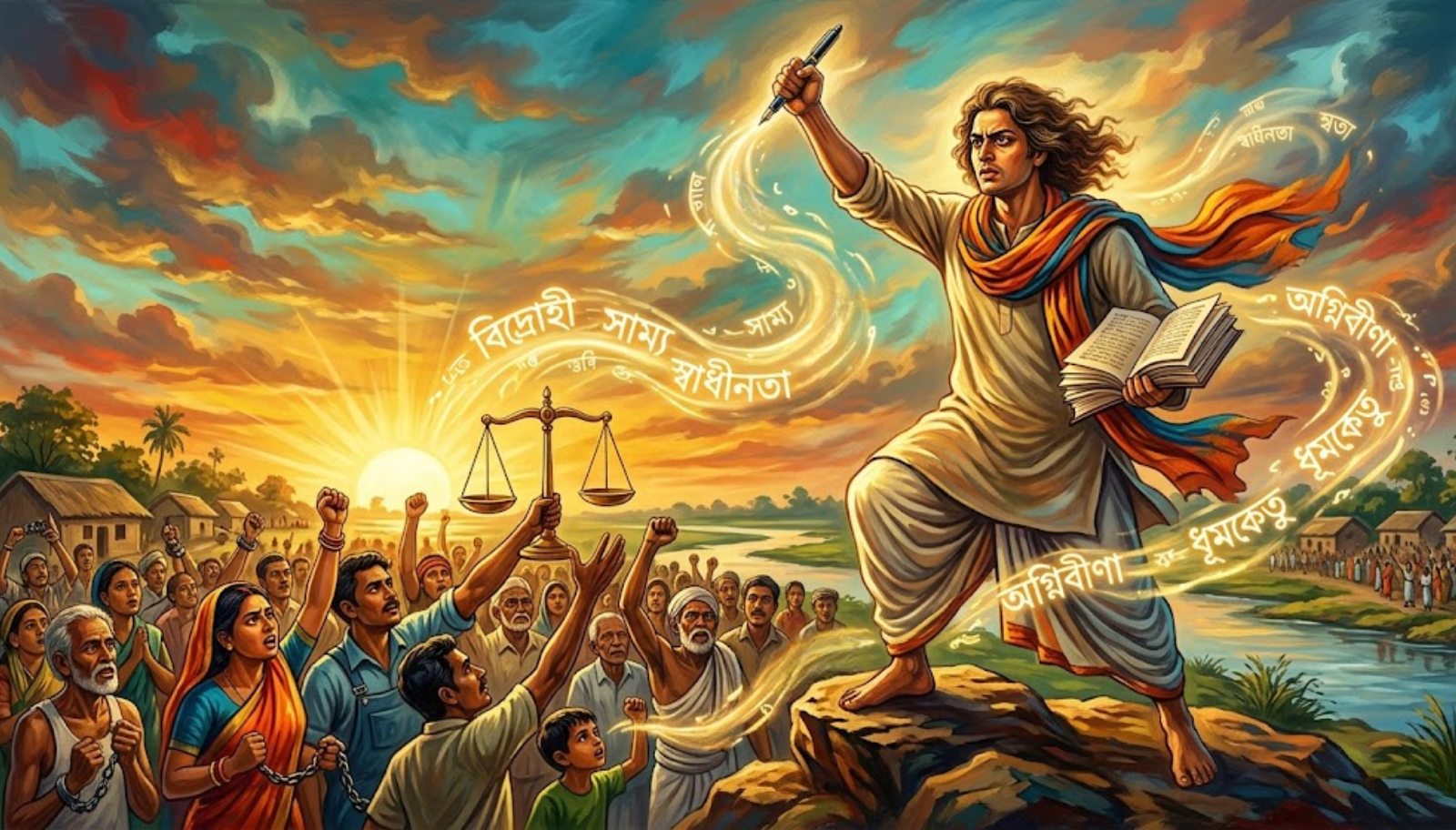
Kazi Nazrul Islam, the national poet of Bangladesh and one of the most towering literary figures of the Bengali-speaking world, was never merely a craftsman of beautiful language. He was a conscience made verse. At the centre of his vast and passionate body of work lies an unrelenting love for equity, a conviction that no human being deserves to live beneath the weight of another’s pride, power, or prejudice. To read Nazrul is to encounter a poet who took the suffering of the ordinary person personally and transformed that suffering into a call for justice that still resonates across generations.
The Rebel as Equaliser
Nazrul’s most celebrated poem, Bidrohi or The Rebel, written in 1922, is often read as an expression of individual defiance. Yet its deeper current is profoundly egalitarian. The speaker in the poem refuses to bow before any throne, any god of oppression, or any system that places one human above another by birth or force. Nazrul casts himself simultaneously as the downtrodden and the liberator, occupying the position of those who have been crushed and declaring on their behalf that the architecture of inequality is not the natural order of the world but a construct that can and must be dismantled. The poem is equity given a voice, a roar rather than a whisper.
Challenging Caste and Class
Nazrul’s assault on caste-based and class-based hierarchies was direct and unflinching at a time when such hierarchies were defended by tradition, religion, and colonial law alike. In poems such as Samyabadi (The Egalitarian) and Manush (Humanity), he argued that the distinctions drawn between the Brahmin and the untouchable, the landlord and the tenant, the ruler and the ruled, were affronts to the divine principle of human equality. In Manush, he famously wrote that the greatest pilgrimage is not to a temple or mosque but toward the human being, asserting that to honour God is to honour every person regardless of station or birth. This was not mere rhetoric. It was a structural critique of a social order that denied dignity to the majority to preserve privilege for the few.
Equity Across Faith and Gender
Nazrul’s vision of equity extended with equal force across the lines of religion and gender. Writing in a society sharpened by Hindu-Muslim communal tension, he composed poetry, songs, and hymns that drew freely from both traditions, insisting that no faith held a monopoly on truth or on the right to human dignity. His Shyama Sangeet and Islamic devotional poems were born from the same spirit, the belief that the sacred belonged to all people equally.
His love for gender equity was equally ahead of its time. He celebrated women not as objects of sentiment or domesticity but as equal bearers of strength, intellect, and moral authority. In his poem Naree (Woman), he declared that nothing great in human history had been achieved without the equal contribution of woman, a statement of radical equity in an era when female voices were systematically silenced.
A Living Legacy
What makes Nazrul’s commitment to equity so enduring is that it was never abstract. It arose from lived experience, from the poverty of his childhood, from his time as a soldier, a labourer, and a witness to colonial humiliation. His poetry did not theorise equity from a distance. It felt it, bled it, and sang it with an urgency that no academic treatise could replicate. In a world that continues to fracture along lines of wealth, identity, and power, his verse remains not an artifact of the past but a present and insistent demand. The rebel poet still speaks, and what he speaks is the simple, radical truth that every human life carries equal worth.




Comments on “The Rebel Poet’s Creed: Equity at the Heart of Nazrul’s Verse”