
Sheikh Selim
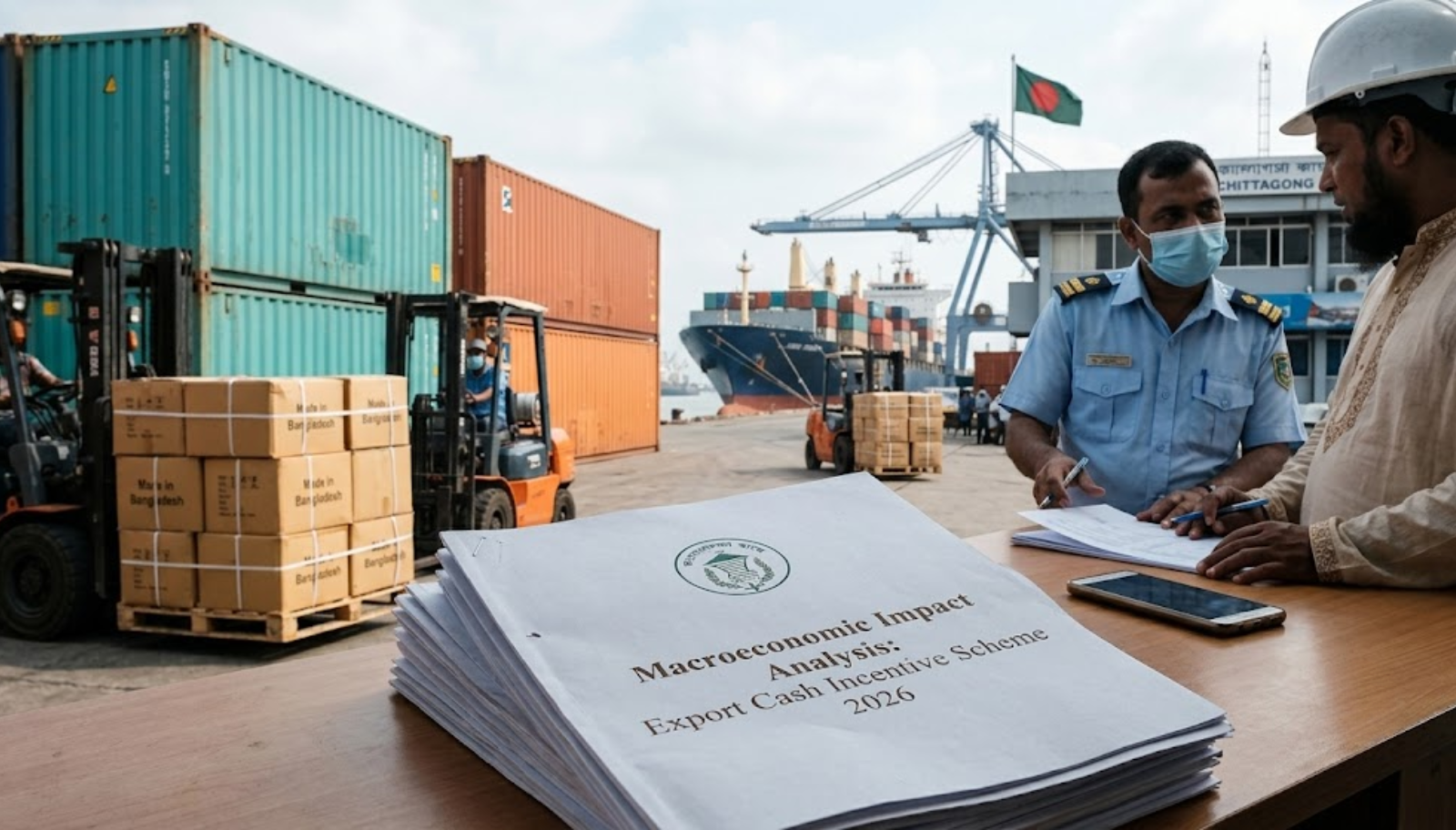
Bangladesh Bank has decided to maintain its export cash incentive scheme for FY2026-27, keeping all 43 product categories and their existing rates (ranging from 0.30 percent to 10 percent) unchanged. This has been framed as a deliberate policy of continuity, meant to sustain export momentum amid shifting global demand. Yet when examined through the lenses of business cycle positioning, short-term growth impact, and inflationary consequences, the decision appears caught between ambitions it cannot fully deliver and risks it fails to adequately address. This article takes a closer look at the policy, assessing its macroeconomic impact across three dimensions: business cycle effects, short-term growth effects, and inflationary effects.
Business Cycle Effects
Export cash incentives are, in principle, a countercyclical instrument. They are most economically justifiable when external demand is contracting and exporters face margin compression that threatens output and employment. By defraying a portion of costs through direct fiscal transfers, the state effectively subsidizes the gap between what the global market will pay and what domestic producers need to remain viable. This logic holds when the economy is in a downturn, or when a specific sector faces a temporary shock. In such cases, the incentive bridges firms through the trough until demand recovers.
Bangladesh’s current macroeconomic position complicates this logic. The report cites “shifting global demand and cost pressures” as the rationale for continuity, while also stating that “the policy is intended without imposing additional fiscal strain.” This framing is internally contradictory. If the economy is in a phase where export competitiveness needs ongoing support at existing rates, the fiscal cost of those rates is not being avoided; it is being absorbed.
If, on the other hand, the economy has moved past the point where incentives are needed to sustain viability, then retaining them is not countercyclical support at all. It becomes a permanent subsidy embedded in the export cost structure, propping up firms that have no real prospect of standing on their own.
The intense business cycle concern is that unchanged incentive rates across an entire fiscal year strip the central bank of its ability to respond to changing conditions within that year. If global demand for garments (the dominant incentivized category) strengthens in the second half of FY2026-27, the incentive continues to flow as a windfall rather than a necessity. If demand weakens further, the existing rate may prove insufficient to bridge the margin gap. Either way, applying a static incentive structure to a dynamic cycle makes for a poorly calibrated tool. The persistence on unmoved rates and unchanged coverage is presented as stability, but stability in a volatile environment is not a virtue. It is rigidity.
Short-Term Growth Effects: Transfer, Not Transformation
In the short term, the incentive scheme will certainly sustain existing export volumes. A cash incentive that returns between 0.30 and 10 percent of export proceeds to the exporter directly improves the effective realized price, making continued production viable at margins that would otherwise be untenable. For labor-intensive sectors like garments, leather, and jute, this translates into preserved employment and maintained production schedules … tangible short-term growth effects that are real and should not be dismissed.
But the growth being sustained is not new growth. It is deferred contraction. A firm that remains in operation only because a cash incentive covers the gap between its costs and its revenues is not growing. It is being sustained in a state of structural non-competitiveness.
The report states that the policy aims to “support diversification into non-traditional sectors,” yet the incentive rates for those sectors, typically at the lower end of the 0.30 to 10 percent range, are unlikely to induce the kind of capital reallocation that genuine diversification requires. A 0.30 percent cash incentive on an emerging export product does not compensate for the absence of infrastructure, skilled labor, or market access. It merely makes the margin slightly less negative. Diversification demands patient capital, technical assistance, and market development, functions that a cash incentive, by design, cannot perform.
The circular’s requirement that incentives apply only to export proceeds realized within the prescribed period, and subject to compliance with existing foreign exchange regulations, introduces further friction. In a banking system where foreign exchange processing delays and documentation bottlenecks are well documented, the gap between earning an incentive on paper and receiving it can be substantial. For smaller exporters without dedicated compliance teams, this administrative burden effectively reduces the value of the incentive below its nominal rate, a distortion that favors large firms over small ones, and inherited sectors over emerging ones.
Effects on Inflation: The Fiscal Channel
Cash incentives are not monetary policy in the conventional sense. They are fiscal transfers administered through the central bank. Their inflationary impact operates through two channels. The first is direct fiscal inflation. Every taka paid as an export incentive is government expenditure that must be financed, and in Bangladesh’s current fiscal context, a sizable portion of government spending is deficit financed. Deficit spending, particularly when it flows to revenue rather than capital expenditure, adds to aggregate demand without expanding supply, exerting upward pressure on prices.
The report’s claim that retaining existing rates avoids additional fiscal strain is technically accurate only in the narrow sense that no new burden has been added. It does not address the cumulative inflationary effect of maintaining a multi thousand crore transfer programme in a fiscal environment already under strain.
The second channel is the exchange rate effect. Export cash incentives are, in substance, a partial devaluation. They lower the effective price of Bangladeshi goods in foreign markets without officially moving the taka’s exchange rate. But by increasing the volume of exports flowing through official channels, the programme also increases the demand for domestic currency needed to repatriate and convert export proceeds, which could temporarily appreciate the taka.
A stronger taka cheapens imports, which is disinflationary in the short run, but only if the appreciation is sustained and the pass through to consumer prices is complete. In practice, Bangladesh’s import pass through is slow and incomplete, meaning the inflationary fiscal effect of the incentive is likely to precede and outweigh the disinflationary exchange rate effect.
The decision to keep export cash incentives unchanged for FY2026-27 is not a neutral act. It is a choice to sustain a fiscal transfer programme that preserves short-term export volumes at the cost of long-term structural adjustment, which supports incumbents over entrants, and that carries an inflationary fiscal burden dressed in the language of monetary policy. A truly strategic approach would have used the current moment when global cost pressures are shifting, to begin a phased reduction of incentives for mature sectors while redirecting resources toward the infrastructure and capacity investments that diversification demands.
Continuity is not a strategy. It is the absence of one.