
Sheikh Selim
According to World Bank statistics, 21% of adults worldwide have no banking inclusion, meaning they do not use any bank account and conduct all transactions using cash or unsafe methods. This population essentially has no financial literacy. The challenge is even more complex in Bangladesh. Only 36% of adult women and 65% of adult men in our country are included in formal banking.
Only 51% of adults in Bangladesh have a bank account for financial transactions. Of these, only 6% possess any kind of bank card and just 34% conduct banking transactions using digital methods (such as online platforms or mobile apps). The remaining 49%, those still excluded from banking, carry out transactions using cash or other non-bank (and relatively insecure) methods.
This week’s article is about financial inclusion in Bangladesh, and particularly in rural Bangladesh. While the goal of improving financial inclusion in Bangladesh aligns with the UN SDG, there is more to this achievement. The “more” is often not discussed explicitly. The primary aim of this article is to highlight the economic and social benefits of greater financial inclusion in Bangladesh. We will also discuss some policy imperatives to achieve it in rural Bangladesh.
The Economics of Greater Financial Inclusion
If the 21% of the global population currently excluded from banking could be brought into the formal financial sector, the global investment market would grow by an additional 26%, tax evasion would decrease by 31% and financial crimes such as money laundering and corruption would be reduced by nearly 46%. The statistics from Bangladesh deeply concern me. In a country where only half the population is included in formal banking, there is a much higher tendency and opportunity for tax evasion and financial crimes and corruption are more prevalent. We have already witnessed this happening.
Due to our lack of financial literacy, money is being laundered, authorities struggle to trace financial records in their efforts to combat corruption and unethical practices within certain banking circles have led to growing public mistrust toward banks in everyday life. People are becoming increasingly disillusioned with the banking system. Many banks are at risk of bankruptcy, leading to widespread panic about the safety of deposits.
According to the World Bank, women in our country are significantly behind men in terms of banking inclusion. Women’s lack of inclusion and financial literacy plays a significant role in the broader lack of recognition for their contributions, positions and responsibilities in our society and economy. A large segment of our workforce, such as drivers, domestic workers and security guards, also remains outside the scope of banking services. If this trend continues, our ability to mobilize savings will stagnate, local investments will fall short, fighting corruption will become nearly impossible and the problem of money laundering will persist.
This is happening because we are too late in understanding the true meaning of formal channels through which money should be managed. The pace is even slower in rural Bangladesh. Financial inclusion is one of the most effective tools for reducing poverty, promoting economic growth, and improving the quality of life in rural Bangladesh. It enables individuals and small businesses to access banking services, savings, credit, insurance, and digital payment systems. This is common sense. How to simplify this progress and how to make common sense more common are the purposes behind this article.
Financial Inclusion in Rural Bangladesh
Although Bangladesh has made some progress in expanding financial services through mobile banking and microfinance institutions, a significant proportion of the rural population still faces barriers to accessing affordable and reliable financial services. Simplifying financial systems and implementing practical reforms can significantly improve financial inclusion and contribute to sustainable rural development. Now, there is no doubt about this. But questions remain, why is it taking so much time to establish this?
One of the biggest challenges in rural financial inclusion in Bangladesh is the complexity of banking procedures. Many rural residents find it difficult to open bank accounts because of extensive documentation requirements, lengthy application processes, and limited knowledge of financial regulations. A commonsense idea is that banks should simplify account opening procedures by minimizing paperwork, using digital identity verification, and offering basic low-cost accounts with minimal balance requirements. Simple and user-friendly financial products encourage greater participation, especially among low-income households. However, these are simpler said than done, as these require multi-staged and coordinated policy as well as regulatory reforms.
Digital financial services have transformed access to banking in most parts of urban Bangladesh, but further and more strategic expansion is needed. Put more simply, a simple tick in the box for this is insufficient. Although mobile financial services allow people to receive payments, transfer money, pay utility bills, and save funds without visiting a bank branch, banking inclusion is the fundamental progress for savings mobilization and access to industrial or agricultural credit of medium to large scale.
Financial inclusion in rural Bangladesh, in its correct form, should be one that includes more rural population in the formal banking system. But many rural people in Bangladesh remain unfamiliar with formal banking systems, interest calculations, digital transactions, or financial planning. The process of educating them is not simple. It is only possible if there is a public private partnership that focuses on the impact and quantifiable outcomes of the awareness programme.
This also needs to be regular and planned year-long with appropriate incentives. Such financial education campaigns should be conducted through schools, colleges, community organizations, agricultural extension services, and local government institutions. These should include practical training on savings, budgeting, responsible borrowing, and digital security. These can increase confidence and reduce the risk of fraud.
Women deserve particular attention in financial inclusion initiatives. Although women’s participation in economic activities has increased, many still face social and economic barriers to accessing financial services. Government initiatives can regulate banks and financial institutions to redesign products specifically for women entrepreneurs, farmers, and self-employed workers. Simplified loan procedures, financial education, and dedicated customer support can encourage greater participation by women and strengthen household economic resilience.
Financial Inclusion and Agriculture
Agriculture remains the backbone of rural Bangladesh, making agricultural finance a priority. Small scale farmers often struggle to obtain affordable credit due to collateral requirements and complicated loan procedures. Financial institutions have introduced flexible agricultural loan products that match seasonal income cycles and crop production schedules. However, for risk assessment of these loan products, structural reforms in agricultural distribution and fair pricing are essential. This may include crop insurance, weather-based insurance, and digital payment systems for agricultural subsidies that can reduce financial risks and improve productivity. Some of these (e.g. farmer cards) are already in place, although the entire reform process to make these initiatives effective will require longer time.
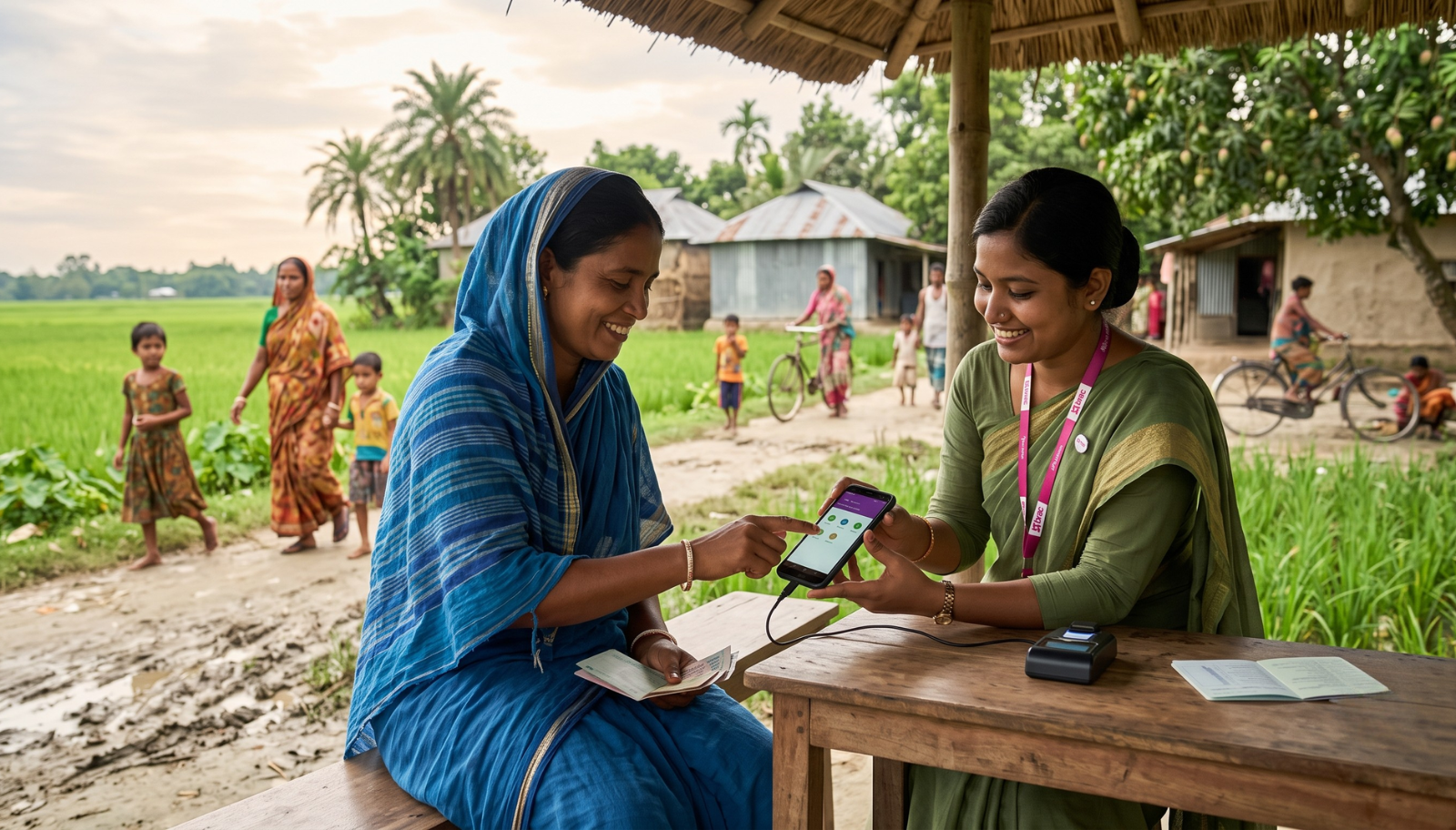
Agent banking offers another practical solution for expanding financial services. Instead of requiring customers to travel long distances to urban bank branches, the central bank can implement local agents of commercial and specialized banks in villages who provide basic banking services. A similar model has been successfully running in India. Such agent banking can reduce travel costs, save time, and increase convenience for rural customers. Local agents also build trust within communities, encouraging more people to participate in the formal financial system.
Government social protection programs can further strengthen financial inclusion by delivering benefits directly into bank or mobile financial service accounts. Digital payment of pensions, scholarships, agricultural subsidies, and social safety net benefits reduce leakage, improve transparency, and familiarize citizens with formal financial services. Such reforms would require developing a resilient telecommunication infrastructure, sustainable power distribution and access to low priced (or subsidized) smartphones. Once beneficiaries begin using these accounts and facilities, they are more likely to adopt additional financial products such as savings accounts and insurance.
Enterprise Development and Financial Inclusion
Small and medium-sized rural enterprises also require better financial support. It is well known that simplified loan approval procedures, credit guarantee schemes, and affordable financing options can stimulate entrepreneurship and generate employment opportunities. This would require financial institutions to evaluate borrowers based on business potential and repayment capacity rather than relying exclusively on traditional collateral requirements. Such arrangements should look beyond social banking or micro finance, since competitive enterprise development at a larger scale should be a more sustainable strategy of rural economic growth in Bangladesh.
In all of these, strong consumer protection is of high importance. Rural customers must have confidence that their money is safe and that financial institutions operate fairly. The same applies for commercial banks which collaborate in B2B arrangements with specialized banks. For banking services and products, transparent pricing, clear communication of fees, effective complaint resolution systems, and protection against digital fraud encourage long-term trust in formal financial services.
Improving financial inclusion in rural Bangladesh requires simplifying banking procedures, expanding digital financial services, strengthening financial literacy, supporting women and farmers, promoting agent banking, and leveraging technology to deliver affordable and accessible financial products. Government agencies, financial institutions, mobile service providers, and community organizations must work together to create an inclusive financial ecosystem.
By making financial services simple, affordable, and trustworthy, Bangladesh can empower rural communities, stimulate local economic development, reduce poverty, and build a more resilient and inclusive economy.