
Dr. Naima Parvin
Coventry University, UK
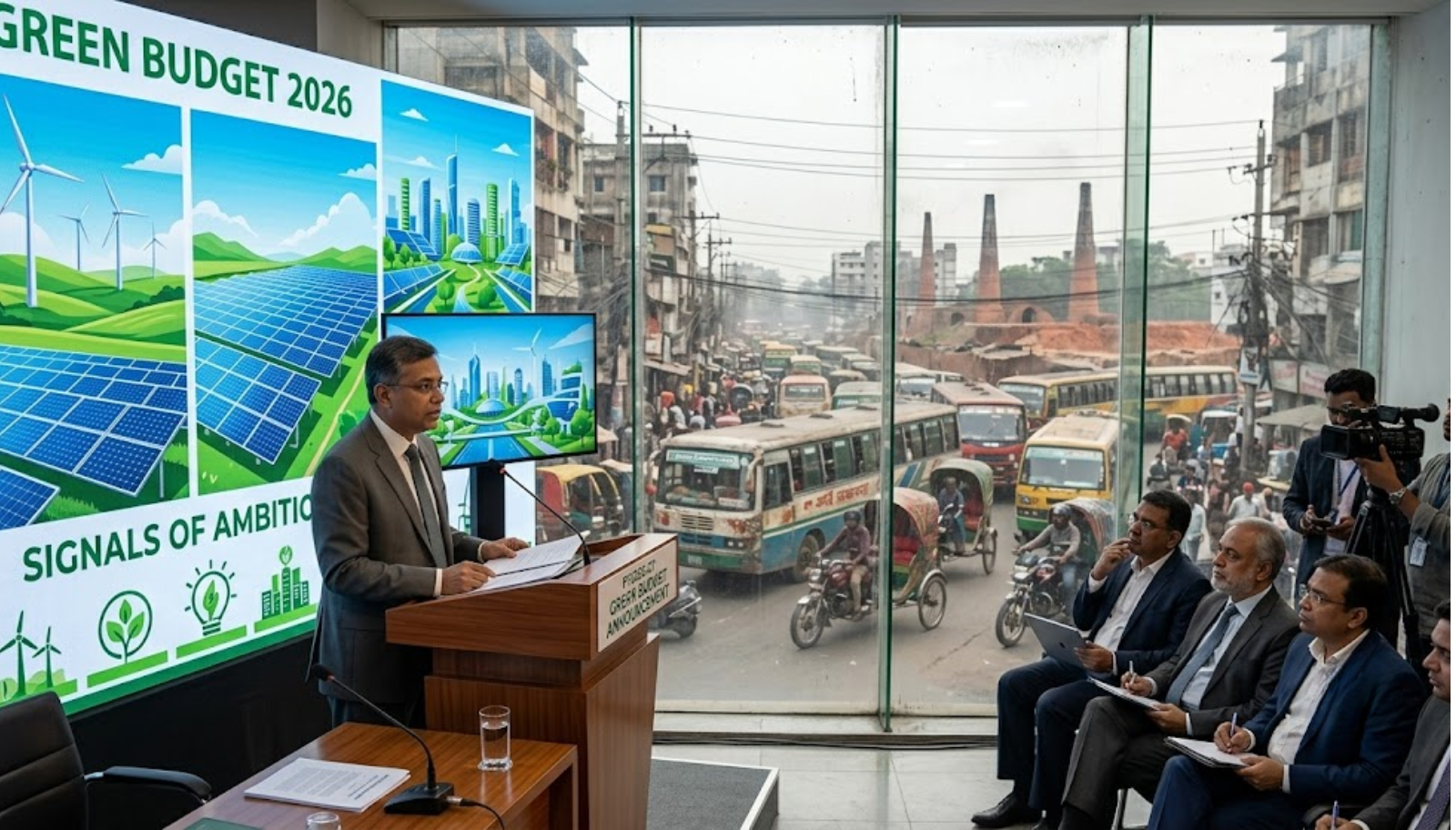
Bangladesh’s FY2026–27 national budget presents itself as a document of growing environmental awareness. Over recent years, allocations for climate-related expenditures have steadily increased across ministries, and the Ministry of Environment, Forest and Climate Change has received a modest boost as well. At first glance, such trends suggest that climate issues are gaining prominence within fiscal policy.
However, a closer reading reveals a deeper and more troubling reality. The budget largely reinforces an approach rooted in incremental adjustments rather than systemic redesign. It signals ambition but stops short of enabling the structural transformation required to respond to Bangladesh’s escalating climate and environmental crisis. The distance between stated intent and meaningful action is no longer marginal, it has become embedded within the policy framework itself.
A Budget Misaligned with Climate Reality
Public expenditure on climate-related priorities has risen significantly, exceeding Tk 42,000 crore compared to around Tk 24,000 crore just five years ago. Yet this expansion remains modest when placed alongside the scale of Bangladesh’s vulnerability. Climate spending continues to remain below one per cent of GDP, despite estimates suggesting that at least three per cent is required annually to meet adaptation and mitigation targets.
This gap is not merely a matter of fiscal capacity; it reflects a deeper misalignment between economic planning and environmental reality. In Bangladesh, climate change is not a sectoral issue that can be addressed within the confines of isolated programmes. It is a systemic challenge that cuts across agriculture, infrastructure, health, and urban development. Flooding, salinity intrusion, extreme heat, and air pollution are already eroding productivity and increasing public health costs.
Despite this, climate expenditure in the budget is still treated as an additive category, something to be layered onto existing development priorities, rather than as a foundational principle guiding all expenditures. This framing limits effectiveness. Without integrating climate considerations into the core architecture of fiscal policy, even increasing allocations risk producing only marginal gains.
Energy Transition: Incentives Without Systemic Change
The budget introduces several incentives intended to encourage renewable energy adoption. The decision to maintain a zero-tax regime for solar power until 2035 and to provide a five per cent rebate on solar electricity bills are noteworthy measures. These policies signal a recognition of the need to diversify the energy mix and reduce dependence on fossil fuels.
Yet these initiatives operate within a system that remains fundamentally misaligned with renewable energy expansion. Allocations to renewable energy continue to account for less than three per cent of the Annual Development Programme. At the same time, critical components required for solar infrastructure, such as batteries, inverters, and grid technologies, are still subject to import duties, raising costs and limiting accessibility.
More significantly, the broader energy landscape remains dominated by fossil fuel subsidies and capacity payments tied to conventional power plants. These financial commitments create long-term lock-ins, diverting resources away from renewable alternatives while reinforcing a carbon-intensive development pathway.
A genuine energy transition requires far more than isolated incentives; it demands the reconfiguration of the entire energy ecosystem. This includes aligning fiscal, regulatory, and infrastructural policies in a way that removes structural barriers to renewable deployment. Without such alignment, current measures risk functioning as signals rather than drivers of transformation. The result is a system where renewable energy is encouraged rhetorically but constrained practically.
Pollution Control: Recognition Without Enforcement Capacity
Environmental degradation in Bangladesh, particularly air pollution, river contamination, and plastic waste, has reached critical levels. While the budget acknowledges these challenges, the financial and institutional resources allocated to address them remain disproportionately small. For instance, the Climate Trust Fund receives only Tk 1 billion, which is negligible relative to the scale of environmental damage.
More critically, there is little evidence of investment in the mechanisms necessary for effective enforcement. Pollution control is not simply a matter of policy recognition; it requires continuous monitoring, regulatory oversight, and penalties that deter non-compliance. At present, these elements remain underdeveloped.
This limitation reflects a broader governance issue. Environmental policy in Bangladesh often operates at the level of declaration rather than implementation. Industries frequently lack both the incentives and the capacity to comply with environmental standards. Meanwhile, monitoring systems are concentrated in urban centres and lack nationwide coverage, reducing transparency and accountability.
To shift from recognition to effectiveness, environmental governance must be strengthened through sustained investment in institutions and enforcement mechanisms. Pollution must be treated not as an externality but as an economic cost that is internalised within production systems. Without this shift, environmental degradation will continue to outpace policy efforts.
Agriculture: Reinforcing an Unsustainable Model
Agriculture remains central to Bangladesh’s economy and food security, yet current fiscal policies risk perpetuating a model that is environmentally and economically fragile. Tax exemptions on fertilisers and pesticides are intended to reduce costs for farmers, but they also entrench a chemically intensive system that is degrading soil health, contaminating water systems, and reducing biodiversity.
This approach may deliver short-term productivity gains, but it undermines long-term sustainability. As soil fertility declines and ecosystems degrade, agricultural output becomes increasingly vulnerable to climate shocks. The absence of significant incentives for sustainable farming practices exacerbates this vulnerability.
What is required is a transition toward ecological and climate-resilient agriculture. Such a transition would involve gradually redirecting subsidies toward organic fertilisers, composting practices, and bio-based pest management. It would also require investment in farmer education, research into resilient crop varieties, and the development of markets that reward sustainable production.
Without these shifts, the agricultural sector risks entering a cycle of declining productivity and increasing environmental degradation, ultimately threatening national food security.
The Climate Finance Gap: Beyond Allocation Challenges
One of the most pressing challenges highlighted in the budget is the persistent gap between climate finance needs and available resources. Bangladesh’s National Adaptation Plan estimates an annual requirement of approximately $8.5 billion, while current flows remain between $2 billion and $3 billion.
This disparity underscores a structural problem that extends beyond funding levels. Even where resources are available, limitations in project design, procurement processes, and inter-agency coordination hinder effective utilisation. In many cases, funds remain underused or are allocated inefficiently.
Addressing this issue requires a focus on institutional capacity as much as financial mobilisation. Strengthening execution capabilities, through improved governance, streamlined procedures, and enhanced technical expertise, is essential. Additionally, Bangladesh must improve its ability to access international climate finance by developing projects that meet global standards of feasibility and impact.
At the domestic level, innovative financing mechanisms such as green bonds and blended finance structures could play a crucial role in mobilising additional resources. However, these instruments are only effective when supported by strong institutions and credible policy frameworks.
Ultimately, closing the climate finance gap is not simply about increasing inflows; it is about ensuring that available resources are deployed strategically and effectively.
Beyond Tree Planting: Toward an Ecosystem Approach
The budget’s proposal to plant 250 million trees is an ambitious initiative that reflects a commitment to environmental restoration. However, such programmes often emphasise scale over ecological integrity. Tree planting, while valuable, cannot substitute for comprehensive ecosystem management.
Environmental resilience depends on the health of interconnected systems, including rivers, wetlands, forests, and coastal ecosystems. In Bangladesh, many of these systems are under severe stress. Rivers are heavily polluted and encroached upon, wetlands are being depleted, and coastal areas face increasing risks from sea-level rise and storm surges.
Addressing these challenges requires a shift from isolated interventions to a holistic, ecosystem-based approach. This involves integrating environmental considerations into all aspects of development planning, from urban infrastructure to industrial expansion. Nature-based solutions, such as wetland restoration, mangrove expansion, and urban green infrastructure, offer significant potential to enhance resilience while delivering economic and social benefits.
Without such an approach, environmental policy risks remaining fragmented and insufficient to address the scale of the crisis.
Conclusion: From Incrementalism to Transformation
Bangladesh stands at a critical juncture in its development trajectory. As one of the most climate-vulnerable countries in the world, it faces mounting economic and social costs from environmental degradation. The FY2026–27 budget reflects an awareness of these challenges, but it stops short of embracing the transformative changes required to address them.
Across sectors, a consistent pattern emerges. Policies signal intent but lack coherence; allocations increase but remain misaligned with needs; initiatives are introduced but not integrated into a broader system of reform. The result is a policy landscape characterised by fragmentation rather than coordination.
The path forward requires a fundamental shift in approach. Climate considerations must move from the margins of fiscal policy to its centre. Energy systems must be restructured rather than adjusted. Environmental governance must evolve from declaratory statements to enforceable frameworks. Agricultural practices must be redesigned to ensure long-term sustainability. And climate finance must be managed through robust institutions capable of translating resources into outcomes.
In essence, Bangladesh does not suffer from a lack of ambition. The challenge lies in converting ambition into alignment, ensuring that policies, institutions, and investments operate within a coherent framework that supports environmental and economic resilience.
The transition required is not incremental; it is structural. It is a shift from isolated incentives to integrated systems, from budgetary arithmetic to strategic planning, and from symbolic gestures to substantive change. Only through such a transformation can green budgeting evolve from a narrative of intent into a practical framework for sustainable development.
Referenced Data Within the Report
- Bangladesh National Budgets (FY2020–21 to FY2026–27)
- Ministry of Environment, Forest and Climate Change
- Bangladesh Sustainable and Renewable Energy Association
- National Adaptation Plan (climate finance estimates)
- Green Climate Fund data
- Annual Development Programme statistics
- Climate Risk Index