
Naima Onamika
Commissioning Editor – The Oniket Bulletin
Bangladesh has long been regarded as a notable example of development success. Since independence in 1971, the country has transformed from a war-torn and low-income nation into a lower middle-income economy. It has achieved significant progress in health, education, and economic development indicators. One of the most important indicators of this progress is literacy, especially adult literacy, which forms the foundation of human resource development. However, recent statistics present both encouraging progress in literacy rates and serious concerns regarding the quality of education and functional literacy.
The Current Picture: Statistical Progress and Skill Limitations
According to the Bangladesh Economic Survey 2024, the literacy rate among the population aged seven and above stands at approximately 77.9 percent, a slight increase from 76.8 percent in 2022. Meanwhile, according to World Bank data, adult literacy among people aged 15 and above reached about 79 percent in 2022. To understand the significance of this achievement, it is necessary to look at the past. In 1990, Bangladesh’s adult literacy rate was only 35 percent. This means that over a little more than three decades, the country has more than doubled its literate population, a significant achievement in the international context.
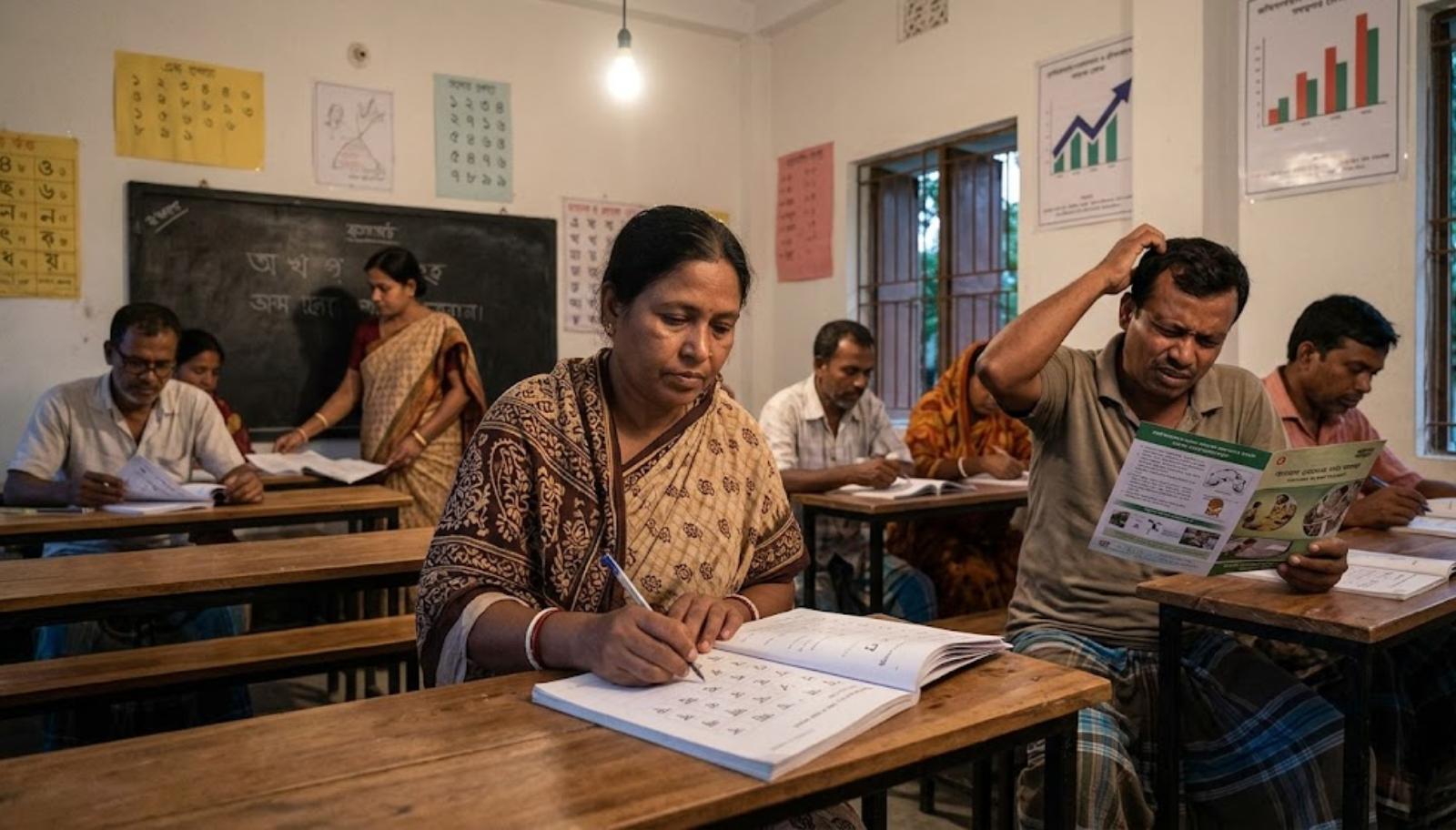
However, behind these positive statistics lies a more complex reality. Functional literacy, meaning the ability to read, write, and perform basic calculations in a meaningful way in daily life, remains significantly limited. A World Bank analysis in 2024 shows that 51.2 percent of adolescents in Bangladesh are in learning poverty. This means they cannot properly read a simple text appropriate for their age. The National Student Assessment 2022 also reflects similar concerns. It found that many students, even after completing five years of primary education, are unable to read a short paragraph fluently, write a simple message, or solve basic mathematical problems. This naturally raises an important question. Does the official literacy rate truly reflect real skills?
Bangladesh’s Position in Development Indicators
Progress in literacy and education is also reflected in Bangladesh’s Human Development Index, or HDI. In 1990, Bangladesh’s HDI score was 0.394, which rose to 0.632 in 2019. During this period, Bangladesh was recognized as one of the fastest improving countries in human development. According to the United Nations Development Programme 2021 and 2022 Human Development Report, Bangladesh ranked 129th among 191 countries. The country’s average years of schooling stand at 6.2 years, which is higher than Pakistan and Nepal.
One of the most notable achievements is progress in female education. Enrollment rates at secondary level for boys and girls have become almost equal, placing Bangladesh ahead of many South Asian countries.However, inequality persists. There are significant regional differences in literacy rates. For example, Barisal records a literacy rate of around 75 percent, while Sylhet stands at around 60 percent. Similarly, there are differences in average years of schooling between men and women. More importantly, when inequality is considered, Bangladesh’s HDI value decreases by around 24 percent. This shows that the benefits of education and literacy have not reached all regions and social groups equally.
Why Functional Literacy Is Now the Biggest Challenge
As literacy rates increase, the main challenge for Bangladesh has shifted toward ensuring the quality of education. Simply enrolling in school or passing examinations does not make a person truly skilled. In today’s labour market, digital economy, and knowledge-based society, individuals must have analytical ability, reading comprehension, communication skills, and basic technological knowledge. However, a large portion of students still fail to acquire these essential skills. As a result, despite the expansion of the education system, the qualitative improvement of human resources has not reached the expected level.
The Need for Policy Reform
To develop a truly literate and skilled population, Bangladesh needs several important policy interventions. First, the definition and measurement of literacy must be reconsidered. Functional literacy assessment should be introduced in line with international standards to reflect real skills more accurately. Second, the Bureau of Non-Formal Education (BNFE) must be strengthened and made more effective. Adult education programmes should include life skills, financial literacy, digital literacy, and vocational training.
Third, coordinated partnerships between government and non-government organizations must be developed. The successful experience of NGOs in community-based education, especially in rural areas, can be expanded further. Fourth, primary education must prioritise foundational skills in language and mathematics. It must be ensured that no student completes primary education without the ability to read or write properly. Fifth, special programmes should be introduced for women and disadvantaged regions. Flexible schedules, women focused learning centres, and incentive based initiatives can help reduce inequality in literacy.
Finally, digital literacy must be considered an essential part of literacy itself. In today’s world, effective literacy is incomplete without the ability to use smartphones, the internet, and digital information systems.
Conclusion
The increase in adult literacy from 35 percent in 1990 to nearly 79 percent today is undoubtedly a major development achievement for Bangladesh. However, numerical progress alone is not enough. When many students fail to acquire basic reading and numeracy skills, literacy statistics do not fully reflect real human resource development. The country now faces a new challenge: moving from “education for all” to “quality education for all.” Through functional literacy, improved education quality, reduced regional and social inequality, and stronger digital skills, Bangladesh can move to the next stage of human development. Otherwise, despite high literacy rates, the goal of building a truly skilled workforce may remain unfulfilled.