
Arif Reshad
University of Essex, UK
A follow up to Rimsha Seethe, “Pornography, Policy, and the Bangladeshi Dilemma: Law, Mental Health, and the Limits of Prohibition,” Oniket Bulletin, September 3, 2026
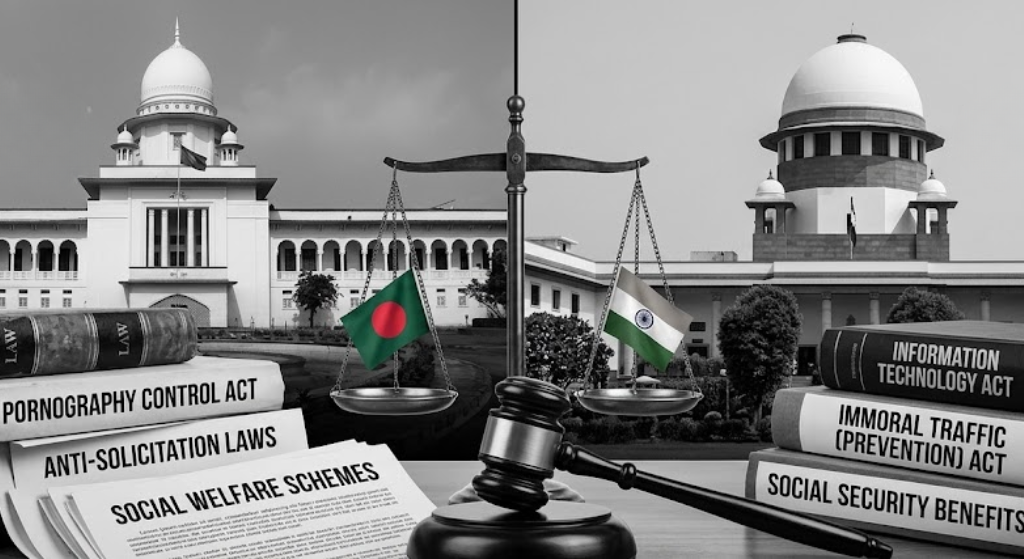
Seethe’s article lays out a dilemma that is distinctly Bangladeshi in its framing but far from unique in the region. Bangladesh criminalizes pornography outright under the Pornography Control Act of 2012 and its cyber legislation, yet enforcement collapses against VPNs and mirror sites.
That collapse pushes demand underground, where it feeds a shadow economy of coercion and nonconsensual image sharing. India, sharing a border, a colonial legal inheritance, and much of the same digital infrastructure, has arrived at a strikingly different answer.
Placing the two frameworks side by side, and extending the comparison to the parallel problem of solicitation advertised through illicit blogs and websites, shows how much a country’s social welfare outcomes depend not just on what a law forbids but on the cultural logic underneath it.
Two Legal Philosophies on the Same Behavior
Bangladesh’s framework criminalizes private consumption itself. As Seethe documents, the Pornography Control Act bundles production, distribution, and possession together as offences, while the ICT regime adds website blocking on top.
India chose a narrower path. Under Sections 67 and 67A of its Information Technology Act, privately viewing or downloading adult content isn’t a crime; only publishing, uploading, or transmitting it is. Sharing such material through platforms like WhatsApp is punishable, but watching it in private is not, and mere possession carries no penalty either.
Child pornography is the one clear exception, where even viewing is criminalized regardless of whether it’s shared, since anyone under eighteen is legally a child under Indian law. This marks a real structural difference from Bangladesh, where possession alone is the crime rather than the act of sharing. Bangladesh’s model assumes the state can and should police what happens on a person’s own device. India’s, shaped partly by its Supreme Court’s recognition of privacy as a constitutional right, assumes it generally cannot, and regulates the market instead of private consumption itself.
Solicitation in the Shadows
The comparison sharpens once solicitation enters the picture. Neither country flatly criminalizes commercial sex work the way Bangladesh criminalizes pornographic possession.
India’s Immoral Traffic Prevention Act does not outlaw sex work itself, but it does penalize related conduct such as brothel keeping, living off its earnings, and soliciting, with all such offences allowing arrest without a warrant. Advertising sexual services through illicit blogs and websites sits in a grey zone in both countries. Rarely prosecuted directly, it effectively functions as the digital successor to street solicitation, minus the visibility that once made enforcement feasible.
One Indian advocacy fact sheet names the real cost: criminalizing soliciting has stripped sex workers of legal protection, leaving them more exposed to exploitation by intermediaries. Bangladesh’s situation is murkier still. With no real regulatory conversation around sex work, illicit advertising blogs get folded into the same broad obscenity and cybercrime laws that, as Seethe shows, already struggle against VPN circumvention.
Why the Two Cultures Diverge
The legal gap traces back to differing social and religious architectures rather than differing technical capacity. Bangladesh is religiously homogeneous, and Islamic norms shape public discourse on sexuality to a degree that makes legislative acknowledgment of pornography or sex work as a regulated rather than prohibited activity politically difficult.
That is precisely the dynamic Seethe identifies when she notes that Bangladesh lacks the unified religious institutional authority that lets a country like the United Arab Emirates enforce a total ban credibly, while still carrying the cultural instinct toward prohibition.
India’s religious and cultural pluralism, by contrast, has historically pushed its legal system toward a more procedural, rights-based approach. A Hindu majority, a large Muslim minority, and dozens of other religious communities make it harder to moralize uniformly about private conduct through law.
Judicial philosophy compounds the divide. India’s courts have increasingly treated privacy as a constitutional anchor shielding personal conduct from state intrusion, while Bangladesh’s judiciary and legislature have not developed an equivalent doctrine, leaving prohibition as the default posture even when it cannot be enforced.
The Social Welfare Stakes
For social welfare, the point is not that one country has solved the problem while the other has not. Both frameworks generate harm, only through different mechanisms.
Bangladesh’s approach, as Seethe argues, risks pushing ordinary curiosity and unmet intimacy into secrecy, guilt, and an underground industry built on coercion. India’s narrower prohibition avoids criminalizing private behavior, but it leaves solicitation and sex work in a legal limbo that intensifies exploitation for the most vulnerable participants, exactly as the ITPA fact sheet documents.
A social welfare centered reform in either country would need to move past prohibition as the sole policy lever. What is needed instead is what Seethe calls a regulated middle path: realistic legal boundaries paired with mental health infrastructure, digital literacy, and protective mechanisms for those most exposed to coercion, rather than treating total prohibition or total tolerance as a substitute for that harder work.
Reference: