
Tanzina Fardoush
Judge Court, Dhaka, Bangladesh
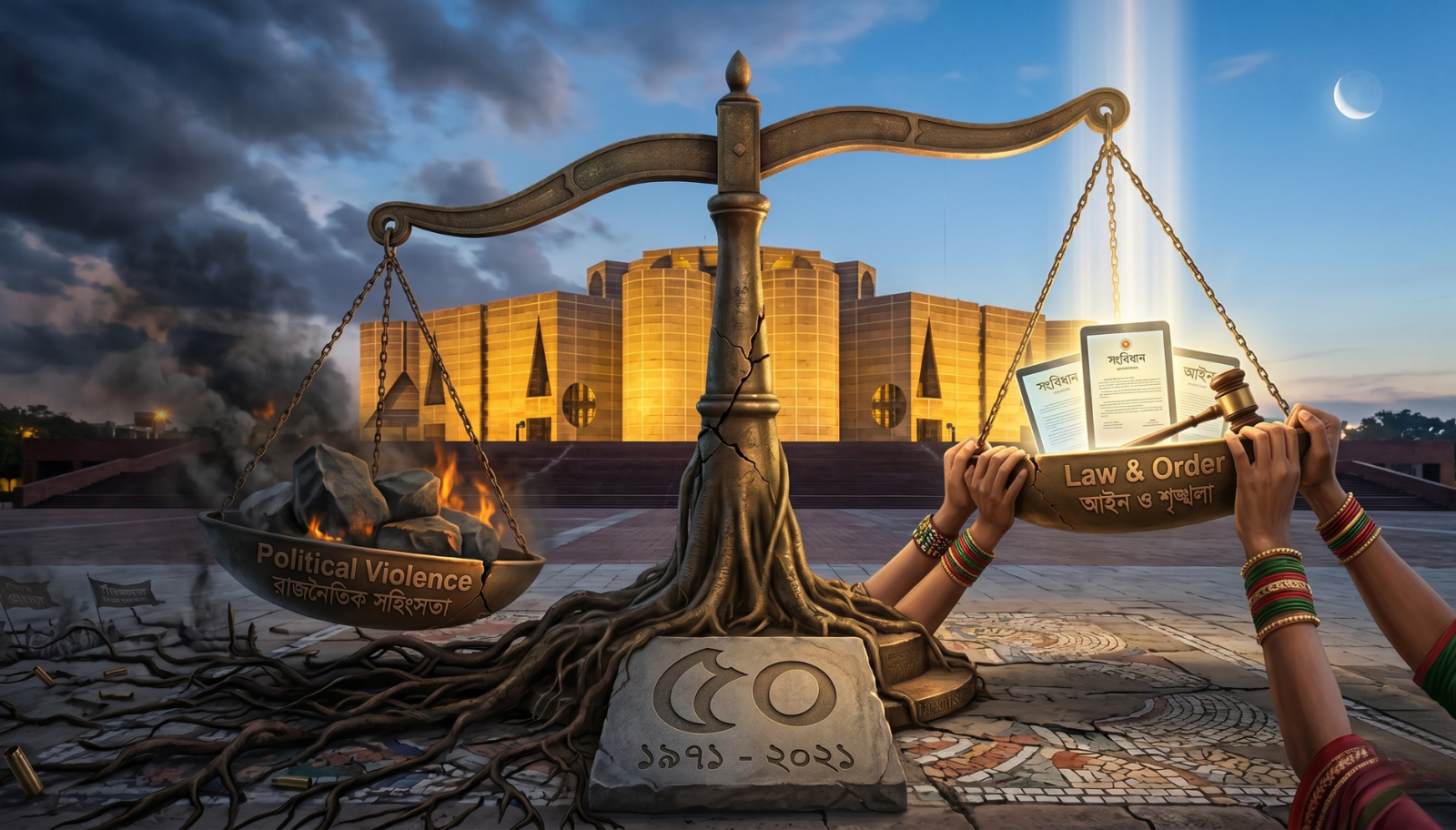
Since its independence in 1971, Bangladesh’s political history has been characterised by a continuous narrative of violence.
In contemporary Bangladesh, military coups, political assassinations, electoral clashes, instances of arson and mass violence in the context of hartals and blockades, and bloody conflicts between party cadres have become a grim normality in the nation’s political culture. Throughout the duration of this fifty year period, no government or political party has been able to successfully disrupt this cycle of violence. The fundamental question that needs to be addressed is the following: why?
Roots of Violence: Historical and Structural Causes
The roots of political violence in Bangladesh are firmly anchored in the political culture that emerged in the immediate post-independence period. The violent overthrow of the government in 1975, which occurred a mere three and a half years after the country’s independence, established a perilous precedent. The utilisation of force is a legitimate method of attaining and maintaining power. Since that time, both the ruling and opposition parties have utilised violence as a political instrument.
The political system of Bangladesh is dominated by two primary parties: the Awami League and the BNP. This two-pole competition is a ‘winner-takes-all’ affair. This has engendered a mentality in which the absence of power is tantamount to complete deprivation. Consequently, both sides are willing to resort to violence to gain or maintain power, regardless of the cost. The interplay of political intolerance, a desire for retribution, and mutual mistrust has served to exacerbate the ongoing cycle.
This issue has been further exacerbated by the criminalisation of politics. Individuals engaged in terrorist activities are afforded protection under the umbrella of the organisation, and in return, perpetrate violent acts on its behalf. Party-affiliated student and youth organisations have effectively become instruments for the exercise of armed authority, with positions and control over resources being established through violence.
This phenomenon is pervasive, manifesting across diverse settings including university campuses and the most isolated union councils. The prevailing culture is characterised by a pervasive sense of impunity, whereby legal frameworks are in place, yet the pursuit of justice remains elusive.
The primary factor contributing to the ongoing prevalence of political violence in Bangladesh is the pervasive culture of impunity. It is noteworthy that there have been virtually no convictions for political violence. It is evident that, due to the political control exerted over the police force, there is a consistent tendency for cases filed against supporters of the ruling party to be either neglected or dismissed. The judiciary is also not immune to partisan influence. Consequently, perpetrators are emboldened to commit further acts of violence without fear of punishment.
This phenomenon of impunity is not confined to political cadres; members of law enforcement agencies are similarly protected. The failure to prosecute these egregious crimes, extrajudicial killings, torture, and enforced disappearances, has become the norm. In this environment, violence has escalated rather than diminished, as every party is aware that upon coming to power, they can protect their own interests.
It is imperative that the following laws are changed
Firstly, it is essential to ensure the political neutrality of the police force and the Police Act. The present Police Ordinance originates from the colonial era. It is imperative that this legislation be revised to place the police under the jurisdiction of an autonomous commission, as opposed to that of the government. It is imperative that legal provisions are established to ensure the recruitment, transfers and promotions of police officers are immune to political influence.
Secondly, a complete overhaul of the Election Commission Act is required. It is imperative that constitutional guarantees are established to ensure the autonomy of the Election Commission. It is imperative that legislation is enacted to provide for the cancellation of candidate and party registration in cases of election related violence, the strict control of election expenditure, and the disqualification of individuals with terrorist links from participating in elections.
Thirdly, the reform of the political party registration law is imperative. It is imperative that political parties are legally bound to ensure that their own personnel or supporters are held responsible for any violent activities. The party registration law must include provisions whereby if a registered member of a party is found guilty of political violence, the party faces legal and financial liability.
Fourthly, the establishment of legislation to ensure the autonomy of judiciary is imperative. The process of appointing and removing judges must be completely free from the influence of the executive branch. To address this issue, it is imperative to implement a legislative measure that will establish an autonomous judicial commission. It is imperative that provisions are made for the establishment of special tribunals with the objective of expediting the disposal of cases of political violence.
The fifth legislative measure to be considered is pertaining to the regulation of the activities of student and youth political organisations. It is imperative that specific legal provisions are enacted to prohibit armed politics in educational institutions and to hold the parent party accountable for the violent activities of its student wing.
Sixthly, the establishment of legislation aimed at the prohibition of extrajudicial killings and disappearances is imperative. It is imperative that a distinct legislative framework is established in accordance with international standards to ensure that members of law enforcement agencies are held accountable for incidents of extrajudicial killings and disappearances.
The political violence in Bangladesh does not constitute a natural disaster; rather, it is a structural problem that has been sustained by political beneficiaries over the course of several decades. It is evident that a mere alteration in legislation will not result in the eradication of violence. To achieve this, a shift in political culture is required, as well as a genuine environment of accountability. Furthermore, an active role for civil society is necessary. Nevertheless, the absence of legal reform will inevitably preclude the establishment of a sustainable framework for change. Drawing upon five decades of violent history, the nation of Bangladesh is confronted with a critical juncture in which it must elect to either perpetuate the vicious cycle of violence or initiate the establishment of a new and equitable political system.

