
Farah Zahir
Managing Editor, The Oniket Bulletin
On 31 August, the Centre for Policy Dialogue (CPD), Bangladesh organised a significant discussion titled “E-Governance in Local Government Institutions: Current State and the Way Forward.” The analysis and recommendations presented by the panelists show that Bangladesh has already gained positive momentum on its path toward digital transformation, and that the time has come to make this progress deeper and more inclusive to establish good governance at the local level. Inspired by this CPD dialogue, in this report I present, from my own observations, several additional gaps that I believe deserve the government’s attention, so that e-governance can be established smoothly and effectively within local government institutions.
The overall framework of this discussion has been shaped considering Sustainable Development Goal 16 (SDG-16), which aims to promote peaceful and inclusive societies, ensure access to justice for all, and build effective, accountable and inclusive institutions at every level. Keeping in mind the principle that people should be able to live free from fear and safety, regardless of ethnicity, religion or sexual orientation, it is necessary to prepare a roadmap for digital services at the local government level with 2030 as the target year. If implemented properly, digital means can bring the greatest benefit to ordinary citizens, particularly women, young people and marginalised communities.
Infrastructural Realities: Where Technology Meets Poverty
In my assessment, the success of e-governance depends on two types of infrastructure, physical infrastructure and institutional infrastructure. On the physical side, access to smartphones, electricity connections, Wi-Fi and computers is essential. However, since Bangladesh remains a developing economy, there is a real risk here. For those who struggle daily to earn a living, these digital devices can sometimes end up being sold or pawned in times of urgent need.
This is not anyone’s personal failing, but rather a structural reality that policymakers need to acknowledge and address, for instance through affordable device support programmes or the establishment of community digital centres, so that dependence on personal devices is reduced. Alongside this, the question of data protection is equally important. There is still no fully established, clear policy or oversight mechanism to ensure how securely citizens’ personal information is stored within the current infrastructure.
A Crisis of Trust: Rethinking the Role of Middlemen
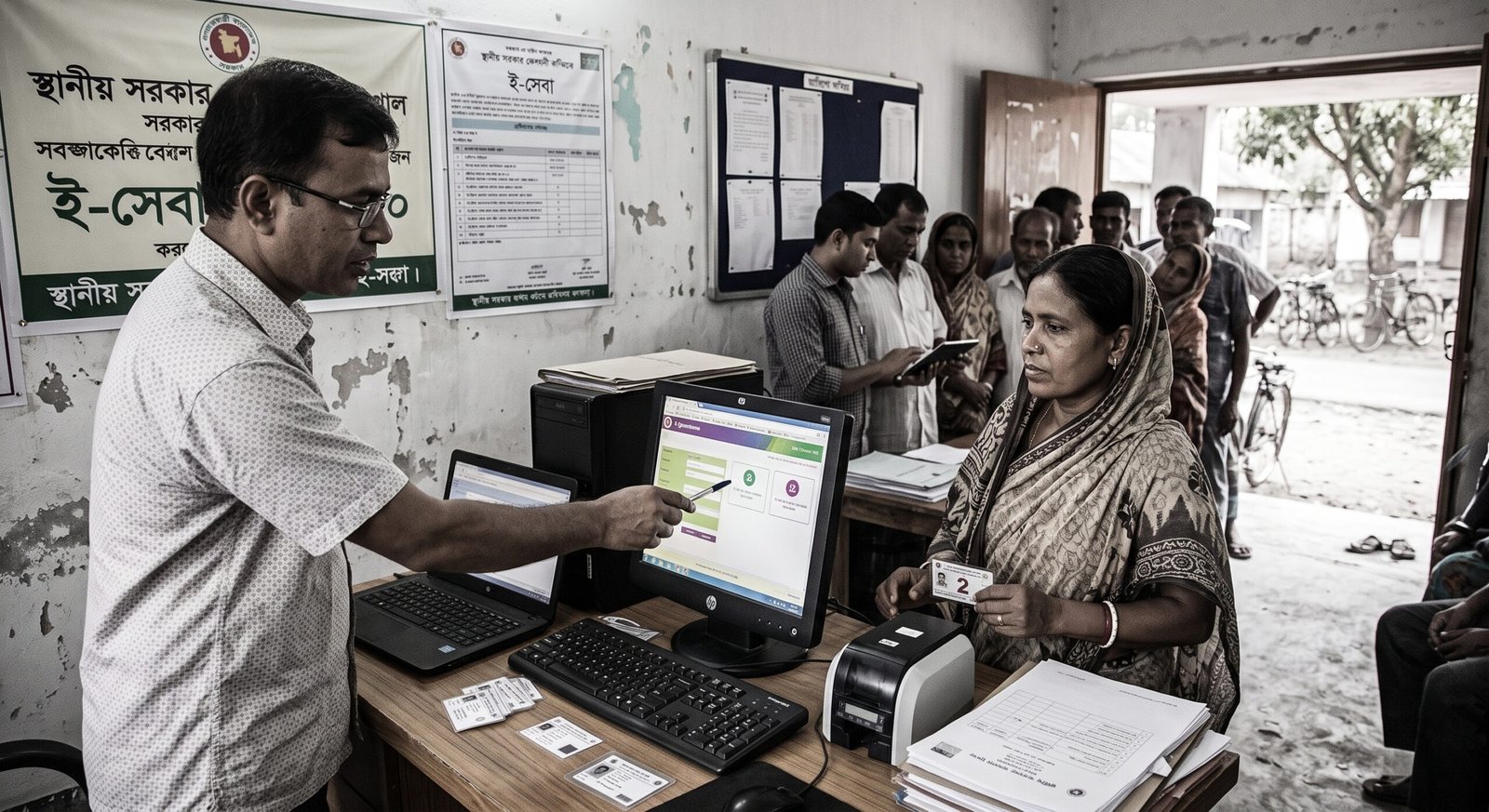
We often see that citizens seeking services at the union and upazila level face unnecessary harassment at the hands of middlemen. Even though online forms can be filled out and urgent documents completed digitally, in practice many cases still require citizens to visit union or upazila offices in person, and it is there that a long-standing culture of dependence on middlemen weakens public trust.
In this context, one constructive proposal deserves consideration. Instead of eliminating these middlemen altogether, if the government creates an opportunity to formally rehabilitate them as officially recognised digital service agents, their livelihoods will remain protected on one hand, while on the other citizens would receive services through a trained and accountable channel. Such a transformation would make institutions more inclusive and would also align directly with SDG-16’s goal of building accountable institutions.
The Way Forward: A Village-Based Representative Model
My proposal is that one or two trained representatives be appointed for each sector in every village, such as separate representatives for healthcare, educational institutions, women’s health and youth-focused agricultural development. They would assist citizens through the entire process, from filling out digital forms to receiving the correct service. The most important aspect of this model is building trust, so that villagers can feel confident that their personal data will never be misused or become a source of unnecessary harassment.
A Balanced Relationship Between Citizens and Institutions
Simply increasing the number of digital platforms is not enough. The real goal should be to ensure how much citizens are benefiting. A relationship must be built between citizens and local governments in which both sides benefit equally. Every department should provide the same standard of service, and both service recipients and service providers should have a transparent understanding of the process. Building such an integrated structure is the need of the hour.
Conclusion
This CPD dialogue has clearly highlighted both the real challenges and the potential of e-governance at the local government level. Alongside this, the additional gaps outlined in this report, such as weaknesses in physical infrastructure, questions around data protection, the need to constructively include middlemen, and the potential of a village-based representative model, deserve serious consideration in the government’s policy discussions.
If these areas are addressed in a coordinated manner, it will be entirely possible to build effective, accountable and inclusive local government institutions in line with SDG-16 by 2030. A coordinated effort involving the government, development partners and civil society can truly help build an inclusive digital Bangladesh.