
Jahid Hasan
Freelance Journalist
In November 2025, Bangladesh was governed by Muhammad Yunus’s interim administration. Twelve months later it has an elected government with a two thirds majority, a new main opposition in Jamaat-e-Islami and a constitutional dispute that will shape the coming year.
Such a fast-moving story depended on journalists, both local and foreign, to explain what was happening and why. Their record is mixed, and it matters for how the country understands its own transition.
Where local media rose to the moment
Bangladeshi outlets supplied the detail that outsiders could not. They covered the tribunal verdict against Sheikh Hasina, the shooting and death of Sharif Osman Hadi, Tarique Rahman’s return and the death of Khaleda Zia as they unfolded, and they tested BNP’s manifesto promises, including the Family Card, against what the budget could bear. Local reporters also exposed the gaps between official claims and the reality of gas and power shortages, and they tracked the Jamaat and NCP rift over local elections.
Daily fact checking units were important too. Their work showed that political misinformation roughly doubled in December, driven largely by the Hadi killing and Khaleda Zia’s final illness, and that around one in ten fact checked falsehoods in 2025 involved AI generated content.
Where local media struggled
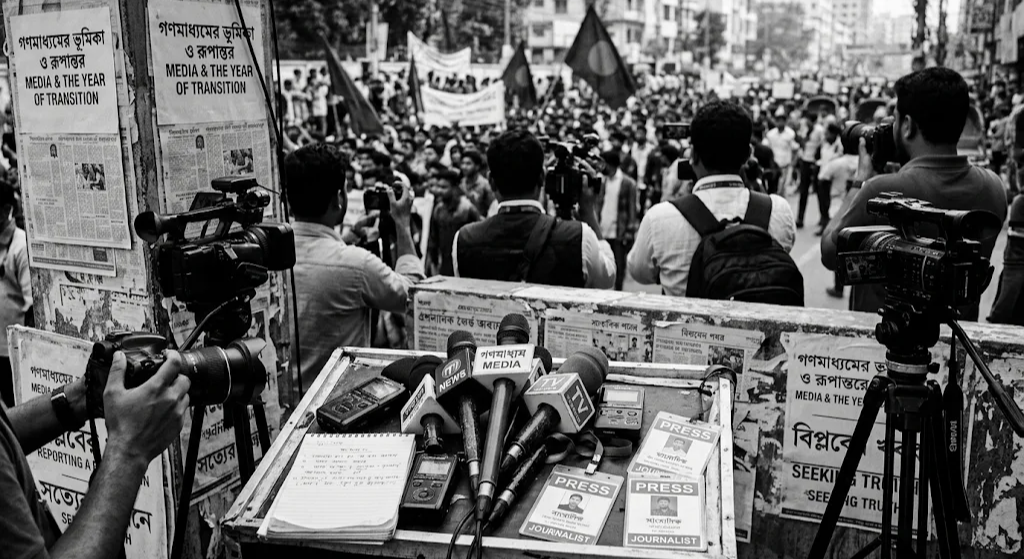
The struggle was physical before it was editorial. After Hadi’s death in December, mobs set fire to the offices of Prothom Alo and The Daily Star, trapping staff for hours and forcing both papers to suspend print editions. Journalists reported that they stopped showing press cards in public. The danger did not end with the election. Press groups recorded 51 cases of attacks, harassment or obstruction in August 2026 alone, and in October four journalists were assaulted at Rajshahi University, allegedly by members of the ruling party’s student wing. A journalist was also shot dead in the north. These conditions push reporters toward caution on exactly the topics the public most needs examined: mob violence, party muscle and the conduct of those in power.
Economic weakness compounds the fear. Senior editors themselves have blamed falling credibility on owner influence, financial pressure and misinformation. Outlets that depend on political goodwill or advertising find it harder to challenge a government with such a large majority.
Where media failed
Some failures were avoidable. Early election night coverage carried differing seat counts, and the referendum figures were later revised, which fed doubts that clearer, more patient reporting could have eased. Coverage also leaned toward conflict. Rallies, walkouts and party rivalries received more space than the slower questions of how welfare cards would be registered, how fuel would be financed or how a constitutional committee differs from a reform council. Voters were shown the contest more often than the consequences.
International media had their own weaknesses. Several foreign outlets reported the BNP result as a landslide in the first truly competitive election in years, which was accurate, but fewer explored in depth what it meant that the Awami League and its supporters were excluded. Sections of the Indian media, meanwhile, portrayed unrest as organized persecution of Hindus. Fact checkers, including BBC Verify, found a mix of real attacks and recycled or fabricated claims, and Dhaka accused India of spreading a misleading narrative.
Both sides lost credibility. Exaggeration allowed officials to dismiss genuine incidents as rumor, and genuine incidents, including lynchings, then received less careful attention than they deserved.
The role media must play next
The coming year is a test of local politics, and journalism has clear work to do. Local government elections across five tiers will need reporters in districts and upazilas, not just in Dhaka, to verify turnout, candidate conduct and results. The Family Card pilot needs independent tracking from the first household to the last, so that numbers, not slogans, show who benefits. The energy crisis requires reporting on fuel contracts and payments. The dispute over the Constitution Reform Council deserves plain explanation, because a debate about institutions can become street conflict if citizens do not understand it. Mob violence, including cases still stalled from 2024, should be followed until a court rules.
Two foundations make this possible. The government should keep its election pledge to protect journalists, investigate attacks and drop politically driven cases. Newsrooms, for their part, need sustainable funding models, shared standards for verification and partnerships between local and foreign outlets, so that international readers receive context from people who live the story. If the media stay safe, independent and careful, Bangladesh can hold its next phase of politics to account. If they do not, the country will argue over rumors at the very moment it needs reliable facts.