
Desk report
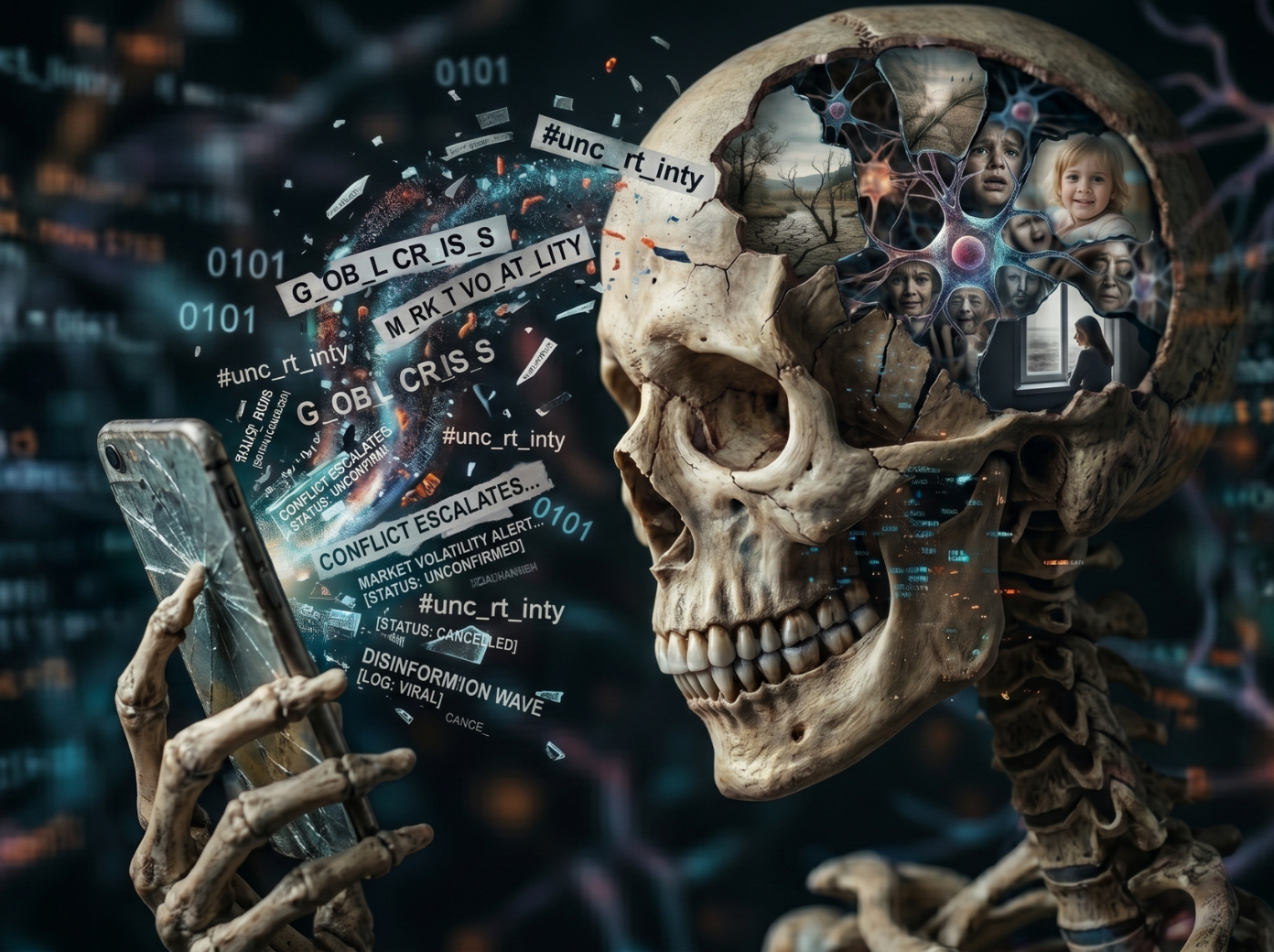
The contemporary habit of news consumption has evolved into a profound psychological conflict that challenges the very foundation of human welfare. As global uncertainty intensifies, individuals increasingly confront a formidable dilemma: to disengage from the information landscape in order to preserve mental well-being, or to remain perpetually updated at the cost of enduring psychological distress. This ‘Information Paradox’ compellingly suggests that while news awareness serves as an instrument of survival, the prevailing architecture of digital news delivery transforms that awareness into a liability, progressively eroding the fundamental human right to mental peace.
The Uncertainty-Inducing Effect and Psychosocial Deterioration
A critical analysis of this phenomenon reveals that news-related psychological distress is not merely an immediate emotional response to tragic events; rather, it is deeply rooted in what may be termed the ‘uncertainty-inducing effect’. Academic frameworks established in 2024 demonstrate that negative media representations generate a pervasive sense of volatility regarding the future, which in turn precipitates profound anxiety and chronic stress. Assessed from the perspective of social welfare, existing preventive strategies remain almost exclusively focused on limiting exposure to news content. This approach, however, fails to interrogate a more fundamental question: how perceived uncertainty functions as the mediating mechanism between news consumption and psychosocial deterioration. For a society navigating shifting economic and political landscapes, the absence of a clear understanding of whether resilience is better cultivated through expanded knowledge or reduced consumption constitutes a significant impediment to the formulation of effective public health policy.
Media Literacy: Theoretical Prescription versus Evidence-Based Reality
Conventional advisory directives such as ‘select trustworthy websites’ or ‘filter your content’ remain insufficiently grounded in rigorously tested interventions. While emerging scholarly perspectives advocate media literacy training as a protective measure, empirical evidence confirming that such competencies substantively reduce anxiety levels, as compared with straightforward avoidance, remains conspicuously absent. In the context of national education reforms that now prioritise mental health and digital wellness, it becomes essential to determine whether formal literacy programmes or algorithmically curated news alerts are capable of generating a measurable ‘psychological buffer’. Without this empirical foundation, the concept of “digital guard-railing” remains a theoretical proposition rather than a validated instrument for safeguarding human well-being within a digitised society.
The Psychological Complexity of Activism
The role of activism as a counterpoint to helplessness equally demands a more nuanced and critical examination. Prosocial engagement, including charitable giving and participation in advocacy movements, is frequently prescribed as a means of alleviating feelings of inadequacy; however, the psychological implications are considerably more complex. Research conducted in 2024 indicates that activism functions as an effective coping mechanism only when individuals perceive their actions as generating tangible and discernible outcomes. Where the social or political environment is experienced as unresponsive, heightened activism may, paradoxically, intensify burnout and despondency rather than mitigate them. This finding decisively demonstrates that the recommendation to ‘take action’ cannot be treated as a universal remedy; its efficacy is critically contingent upon the individual’s sense of personal agency and the responsiveness of the surrounding institutional context.
Conclusion and Policy Directions
The persistence of news-related psychological distress is symptomatic of a broader institutional failure: the inability to integrate media consumption practices with the principles of humanity and social welfare. As state policies advance toward mandating mental health education within national curricula, the conceptual focus must shift decisively away from mere ‘screen time limitations’ and toward a structural model that addresses the underlying dynamics of uncertainty and critical cognitive appraisal. Restoring an individual’s sense of agency in a conflict-ridden world necessitates a fundamental philosophical reorientation: news literacy must be understood not merely as a technical competency, but as an indispensable constituent of public health. It is this transformation that will empower citizens to engage with the world as informed and autonomous human beings, without being consumed by the very information ostensibly designed to protect them.

