
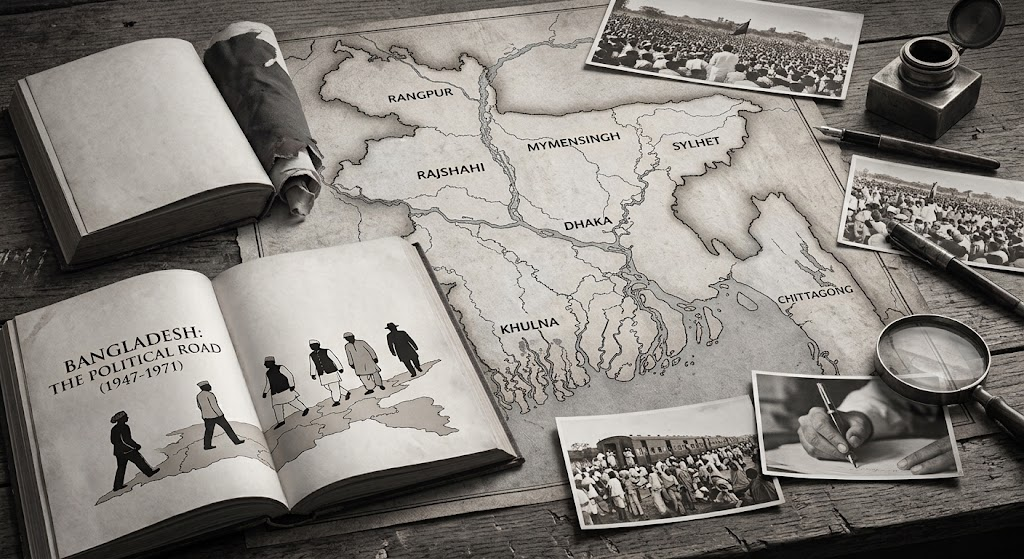
Five leaders, five political traditions, and the long road to the birth of a country
Farah Zahir
Managing Editor, The Oniket Bulletin
Bangladesh was born in 1971. But its political identity had begun taking shape much earlier, and the history of East Pakistan between 1947 and 1971 remains one of the most important chapters in that journey. Politics during these years was not limited to resistance against Pakistani rule. The rights of farmers, provincial autonomy, the status of the Bengali language, democracy, the relationship between religion and the state, economic justice, and eventually the question of independence gradually became central to political life. Several important leaders emerged from this period, each leaving a distinct mark on the political thinking that shaped Bangladesh.
From Fazlul Huq to Bhashani: The Roots of Mass Politics
After 1947, the presence of veteran leader A. K. Fazlul Huq in East Bengal politics represented an important link with an earlier political tradition. The economic rights of farmers and ordinary people, provincial interests, and the question of Bengal’s political identity had long been part of his political career. As the proposer of the Lahore Resolution in 1940, he played an important role in the political history of the Muslims of the subcontinent. Historian Sana Aiyar has shown that Fazlul Huq’s politics went beyond the simple divide of all India religious politics, bringing Bengal’s regional interests and political realities to the centre.
Abdul Hamid Khan Bhashani took mass politics closer to peasants, workers and marginalised communities. The Awami Muslim League was formed in 1949 under his leadership. He later built a strong left-leaning political tradition through the National Awami Party. His politics brought together religious values, social justice, the rights of peasants and workers, and opposition to imperialism. Research by historian Peter Custers shows that Bhashani’s political thinking did not reject religious identity, while moving towards a separation between the running of the state and an individual’s religious belief.
Suhrawardy and Mujib: From Democracy to Autonomy
Huseyn Shaheed Suhrawardy was an important advocate of parliamentary politics. He also played a significant role in Pakistan’s central politics. In the United Front politics of 1954, leaders such as Fazlul Huq, Bhashani and Suhrawardy, despite coming from different political traditions, came together around the interests of East Bengal. The Muslim League’s defeat in the 1954 election marked a major shift in the region’s political landscape.
It was within this political environment that Sheikh Mujibur Rahman emerged as a major leader. His politics increasingly centred on the Bengali language movement, autonomy and, later, the Six Point Programme of 1966, giving clearer expression to the political demands of Bengalis in East Pakistan. After the Awami League won a majority in the 1970 election, the refusal to transfer power and the military crackdown that followed pushed the independence movement towards its decisive stage. During the Liberation War of 1971, the Awami League became the principal political force leading the struggle.
Mujib’s political thought centred on Bengali nationalism, democracy, secularism and socialism. After independence, these four principles became part of the fundamental principles of state policy in the Constitution. His political legacy, therefore, extends beyond his leadership of the independence movement to the larger question of what kind of state Bangladesh would become.
Tajuddin: Political and Administrative Leadership During the Liberation War
Tajuddin Ahmad played a particularly important role in the politics immediately before independence and during the Liberation War. While Bangabandhu was imprisoned in Pakistan, Tajuddin led the organisation of the government in exile and helped establish and run the political, diplomatic and administrative structures of the war.
His political thinking supported democracy, secularism and a socialist economic system. In a recent memorial lecture, Professor A. F. Serajul Islam Choudhury discussed Tajuddin’s understanding of secularism in terms of keeping the state and religion separate. He described Tajuddin as someone drawn to socialism while also seeing democratic change as a necessary condition.
The political paths of these five leaders were not the same. They disagreed on many issues, and their political strategies differed. But one concern returned in their politics: the political dignity of the people of East Bengal, their economic rights, and their right to determine their own future.
Why Have We Moved So Far from Their Political Ideas?
The question is not simply whether we have forgotten their political ideas. A larger question is how much of their history we have had the opportunity to learn.
Bangladesh’s political history has been written and taught for decades amid intense political competition. Research has shown that school textbooks have also placed different emphasis on historical interpretations and political identities as the country’s political circumstances changed. The teaching of national history has, at times, therefore become part of political debate rather than a space for inquiry.
As a result, a young person may know one leader very well while knowing little about the political contributions of others who stood beside or opposed him. One may be remembered only as a party leader, another as a symbol of a particular ideology, while someone else is reduced to a chapter in a textbook. History is far more complicated than that.
To see Fazlul Huq only as the leader associated with the Lahore Resolution is to miss the regional character of his politics. To describe Bhashani simply as a leftist leader leaves out the complexity of his thinking on religion, peasant politics and social justice. To remember Suhrawardy only as Mujib’s political mentor diminishes the importance of his commitment to parliamentary politics. Remembering Mujib only as the leader of independence leaves his ideas about the state incomplete. And to remember Tajuddin only as the first Prime Minister of the wartime government leaves much of his democratic and secular political thinking unexplored.
History Must Be Brought Back from Party Politics
A relationship with history is not built simply by observing national days. To understand history, people must ask questions, read different perspectives and examine how the same event has been understood from different political positions. Bangladesh’s political heritage needs to reach the next generation in much the same way.
We also need to move beyond the idea that changing a textbook alone can change how history is understood. Research based history, original documents, speeches, letters, autobiographies and contemporary newspapers can become part of how history is taught. Universities, libraries and the media also have an important role to play. History should be something students investigate, compare and debate, rather than simply memorise.
Most importantly, political heritage should not be treated as the exclusive property of any one party or family. Bangladesh’s road to independence was shaped by decades of movements, disagreements, struggles and the participation of countless people. The story belongs not only to its political leaders but also to ordinary citizens who were part of that journey.
A nation truly understands its political heritage when it does not remember only the parts of its history that it finds comfortable. It must also be willing to read the difficult and contested chapters. The history of 1947 to 1971 is therefore more than a story of the past. Many of the questions surrounding Bangladesh’s state, politics and civic identity have their roots in those years.
How much the next generation learns about that history will shape whether they grow up simply as citizens of an independent country, or as citizens who also understand the political meaning of independence.
References
- Schendel, Willem van. A History of Bangladesh. Cambridge University Press, 2009.
- Aiyar, Sana. “Fazlul Huq, Region and Religion in Bengal: The Forgotten Alternative of 1940–43.” Modern Asian Studies, Cambridge University Press.
- Custers, Peter. “Maulana Bhashani and the Transition to Secular Politics in East Bengal.” Indian Economic & Social History Review, vol. 47, no. 2, 2010.
- Ankit, Rakesh. “Probing Early Pakistan: East Bengal Politicians and Their Exchanges with Prime Minister Liaquat Ali Khan, 1947–51.” Modern Asian Studies, Cambridge University Press.
- Schendel, Willem van. “Key Political Figures Since 1947.” In A History of Bangladesh. Cambridge University Press.
- Ghosh, Shreya. Identity, Politics and Nation-building in History Textbooks in Bangladesh. Georg Eckert Institute for International Textbook Research.
- Ghosh, Shreya. “The Politics of Learning Reforms in Bangladesh.” Oxford Research Encyclopedia of Education. Oxford University Press.
- Government of Bangladesh. The Constitution of the People’s Republic of Bangladesh. Bangladesh Government Press.