
Sumaiya Hasi
Oniket Research Group
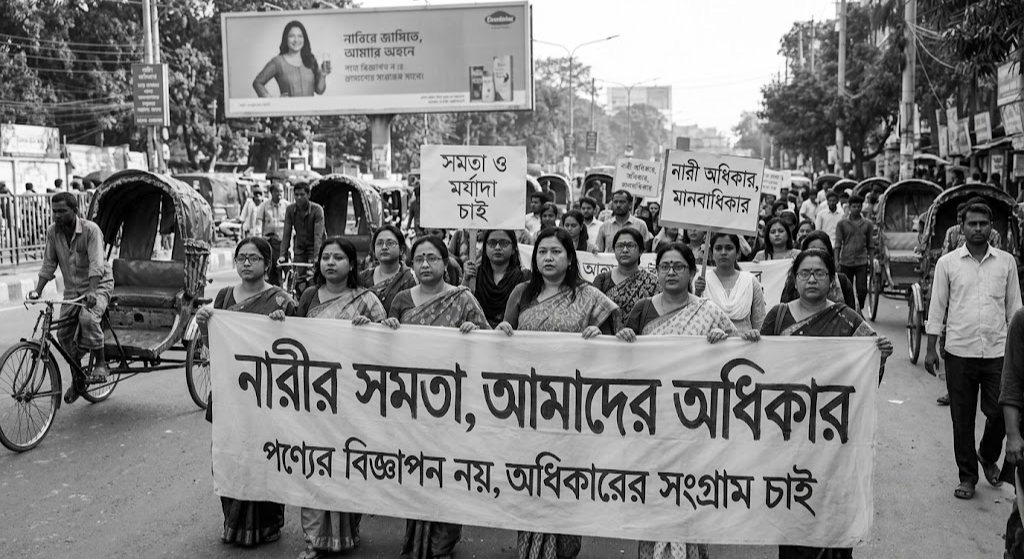
In today’s globalised capitalist society, feminism has increasingly been turned into a glossy, marketable product. Multinational corporations and fashion brands around the world sell T-shirts, cosmetics and lifestyle products bearing slogans such as “Women Empowerment” and “Girl Power”, turning feminism into a form of consumer culture known as commodity feminism. Through polished advertising and commercial campaigns, women are often led to believe that freedom means being able to buy certain cosmetics, wear branded clothes or afford a particular lifestyle. The reality, however, is that feminism is neither a shopping choice nor a passing fashion statement or a brand of outward modernity.
Feminism is an ongoing struggle against everyday social inequality and a commitment to practising equality in every sphere of life. When the fashion industry turns feminism into a commodity, it cleverly conceals the history of social and structural exploitation that lies beneath the surface. Changing the appearance of cosmetics or clothing cannot dismantle deeply rooted patriarchal attitudes or eliminate economic inequality.
A look at history and the philosophical foundation of feminist thought makes one thing clear: feminism has always been a social movement seeking to change existing structures. In her landmark book The Second Sex, the renowned French philosopher and feminist thinker Simone de Beauvoir wrote, “One is not born, but rather becomes, a woman.” In other words, society and the culture it creates determine the position a woman is expected to occupy, how she should behave, what work she should do and how far the boundaries of her life may extend. No woman is born subordinate or helpless. It is the one-sided education, social expectations and restrictions imposed by existing structures that limit her potential.
Long before these ideas gained wider recognition, Begum Rokeya Sakhawat Hossain, a pioneer of women’s emancipation in Bengal, recognised the same truth in the context of our own society. She argued that girls should not be confined to needlework and domestic duties at the expense of their abilities. Instead, they needed proper education and opportunities for economically productive work. More than a century ago, Rokeya understood that a society could never reach its full potential if women remained confined within four walls and were denied economic independence.
Our national poet, Kazi Nazrul Islam, expressed the same principle of equality and shared contribution in his vision of a just society: “Whatever great and beneficial creations the world has known, women have contributed half, and men the other half.” The fundamental philosophy behind women’s rights, therefore, is not an imported idea. It is deeply rooted in our own history, struggles for rights and social transformation.
Since independence, women in Bangladesh have made considerable progress despite numerous obstacles. The active participation of millions of women workers in the readymade garment industry has transformed the national economy. The positive effects of microcredit initiatives at the grassroots level, the remarkable presence of girls in primary and secondary education, and women’s participation in political and administrative decision making all stand as important signs of progress.
Yet beneath the visible achievements, inequality remains deeply rooted in our social attitudes. A few statistics showing women’s participation in the economy cannot, on their own, measure genuine freedom. Such freedom requires fundamental changes in social values, the legal framework and the way society thinks about women.
To secure meaningful, lasting and practical empowerment for women in Bangladesh, far reaching changes are now needed in several key areas.
Transforming Mindsets and Social Attitudes
Household responsibilities such as raising children and cooking are still widely regarded as the sole responsibility of women. The social and economic value of unpaid care work must be recognised, and these responsibilities must be treated as a shared duty of women and men within the family.
Women must no longer be viewed as commodities, someone’s property or inherently helpless members of society. Above all, they must be recognised as independent and complete human beings, entitled to dignity, freedom and equal respect.
Establishing Economic and Legal Equality
Under existing family and inheritance laws, women do not always receive an equal share of property with men. Such inequalities remain a major obstacle to women’s economic independence. Legal reform is therefore essential to secure equal property rights for women.
The state and society must also ensure that women can travel safely at any time of day or night. Sexual harassment on public transport, in educational institutions and in workplaces must be addressed firmly, with effective enforcement and accountability.
Equal Pay and Leadership Opportunities
Significant wage gaps between male and female workers persist in the garment industry, agriculture and other informal sectors. The principle of equal pay for equal work must be made legally binding and enforced in practice.
Women must also have equal opportunities to reach senior leadership and policy making positions in both public and private institutions. Their participation should not be limited to junior roles. They must have a fair chance to shape decisions and influence the policies that affect their lives and society.
Technical Education and Awareness of Rights
Beyond general education, girls’ participation in technology, digital literacy, technical training and science, technology, engineering and mathematics (STEM) must increase substantially. This will help prepare them for the changing demands of the global job market.
At the same time, child marriage must be ended, and women must be made more aware of their fundamental human and legal rights. Education should equip them not only with qualifications but also with the knowledge and confidence to claim those rights.
In our society, the word feminism is often misunderstood. Some people dismiss it as blind imitation of Western culture or interpret it as hostility towards men. To overcome these misconceptions, feminism must be explained through the lens of our own history and traditions.
The struggles and sacrifices of Begum Rokeya, Sufia Kamal and Pritilata Waddedar should be brought to the attention of younger generations. Their lives demonstrate that the pursuit of women’s rights is an inseparable part of our own history of social change and the struggle for equality.
Men, too, need to understand that women’s empowerment is neither a contest nor an act of hostility. Rather, it can relieve men of the financial and psychological burdens of being regarded as the sole providers for their families, making room for shared responsibilities and collective progress.
The media also has a responsibility to move beyond portraying women merely as helpless figures, symbols of sacrifice or models promoting brands. Women should be represented as capable, independent and intelligent individuals who make decisions and shape their own lives.
The consumer driven society and corporate world may seek to confine feminism to catchy slogans, T-shirt captions and the packaging of commercial products. But feminism is not about shopping or consumption. It is about awareness, human equality and the everyday practice of fairness.
True freedom will become a reality only when women enjoy equal rights, full respect and safety in their families, communities, workplaces and the policies of the state. The temporary appeal of commodity feminism must therefore give way to the deeper struggle for changes in attitudes, social values and the structures that sustain inequality.
The real measure of progress is not how effectively a brand sells the language of empowerment, but how far women can exercise their rights, make their own choices and live with dignity and security.