
Ameera Haidar
Freelance Architect
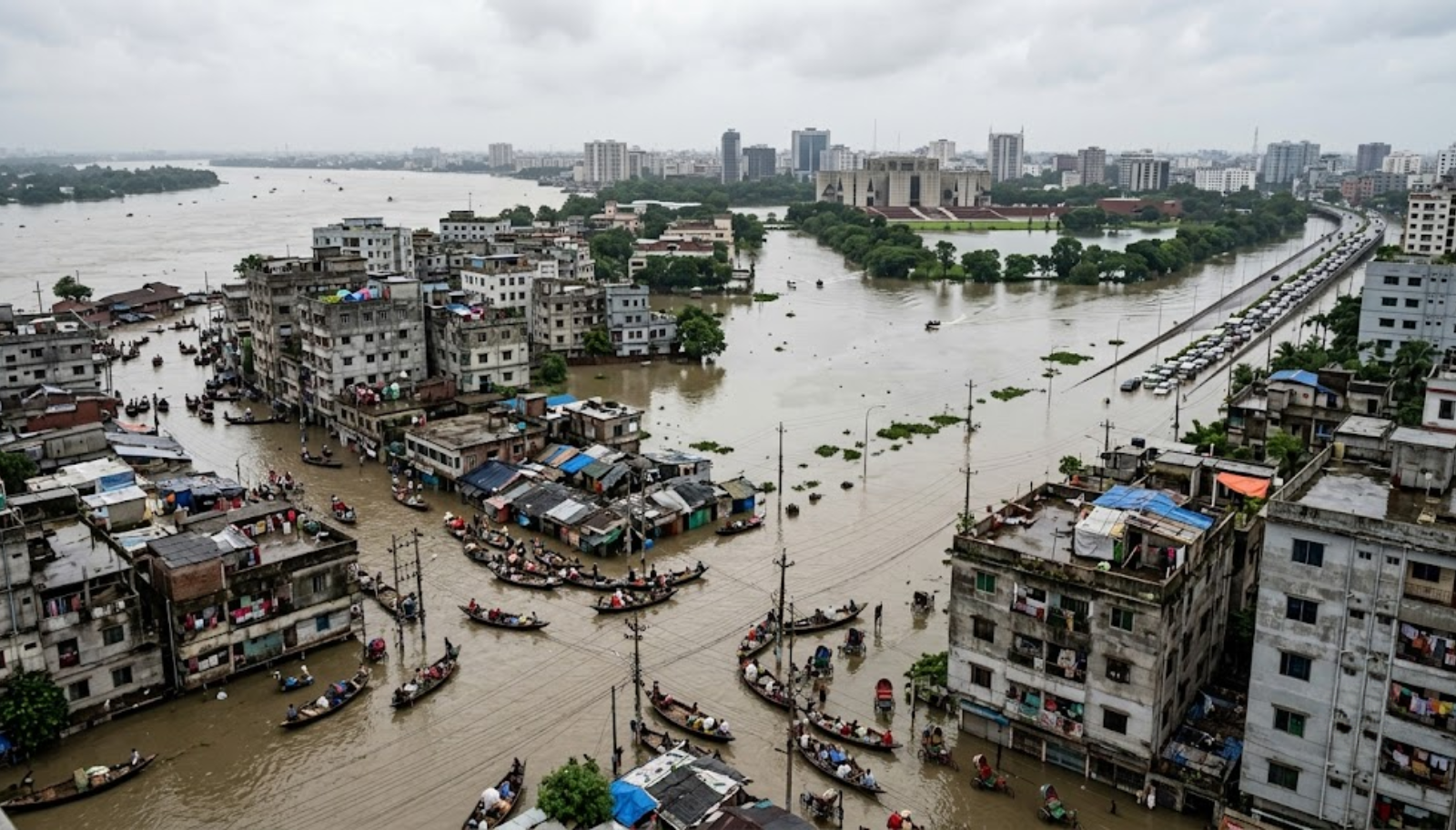
Dhaka floods after thirty to forty millimetres of rain. A capital of over twenty million people, built on the world’s largest delta, submerges under the modest downpour that any functioning monsoon city should absorb without incident. This is not an act of nature. It is the accumulated consequence of a century and a half of planning decisions that treated water as an obstacle to be buried, drained, and paved over rather than as the infrastructure around which a delta city must be organised.
Reforming Dhaka’s sewerage and drainage system requires nothing less than dismantling the philosophy that created the crisis. This article is an attempt to motivate this already overdue discussion.
Undoing the Philosophy of Fill
The original Mughal city understood its setting. The Dholai Khal served simultaneously as moat, drain, and trade highway, stitching the Buriganga to the Balu and the Lakhya. Water was not the backdrop to Dhaka; it was the city’s operating system. That logic was overthrown during the colonial period, when standing water was reclassified as a sanitary liability and canals became low lying land waiting to be filled.
When Patrick Geddes proposed dredging and reviving the khals in 1917, he lost. The colonial ledger, water traded for land, prevailed. And it has prevailed ever since, through independence, through multiple master plans, and through decades of institutional encroachment that has erased roughly eighty of the city’s historic canals and channels, shrunk its watercourses from approximately 326 kilometres to 206 kilometres, and consumed some 15,000 of the 20,282 hectares of perennial wetlands that survived as recently as 1967. Reform must begin by reversing this philosophical orientation. Every subsequent technical measure depends on accepting that water is an asset to be retained and managed, not a nuisance to be removed.
Restoring Canal Networks and Retention Capacity
The most urgent structural reform is the reclamation and rehabilitation of surviving canal networks. Approximately ninety-five canals and channels remain, many silted, narrowed, or partially built over. Each one must be surveyed, mapped against historical records, and restored to functional width and depth.
Box culverts that entombed natural canals, including stretches of the Dholai Khal, Segunbagicha, and Panthapath, must be reopened. These channels were the city’s natural drainage arteries; sealing them beneath roads did not eliminate the water, it merely removed its exit. The precedent exists: the restoration of the Hatirjheel and Begunbari wetland into a functioning retention lake demonstrated that a degraded waterbody can be brought back to hold stormwater and moderate urban heat. That model must be replicated across every surviving canal corridor in the city.
Making Flood Flow Zones Inviolable
The Natural Water Bodies Protection Act of 2000 was intended to prevent the filling of canals, floodplains, and retention ponds. It has been systematically subverted. The metropolitan area lost more than half of its designated flood flow zones in a single decade, much of it to housing schemes advanced by government agencies themselves.
The 2016 to 2035 Detailed Area Plan’s allowance of conditional construction in general flood flow zones effectively converts encroachment into policy. This must end. Flood flow zones should be reclassified as inviolable public water infrastructure, with no conditional exceptions. RAJUK’s custodianship of Dhaka’s development must be measured by the retention capacity it restores, not by the square footage it approves for construction.
Reforming Institutional Mandates
Institutional fragmentation has paralysed drainage governance. The Dhaka Water Supply and Sewerage Authority managed canal channels for decades as they silted and shrank. In 2020, twenty-six canals and ten kilometres of box culverts were transferred to the two city corporations, with over Tk 730 crore subsequently spent.
The same roads are still flooding. No single agency currently holds a complete register of the city’s waterways, let alone bears accountable authority for their maintenance. A unified drainage authority with jurisdiction over all canals, retention ponds, box culverts, and outfall points must be established, with a publicly accessible register of every water body, its condition, and the agency responsible for its maintenance. Accountability requires visibility.
Rethinking Embankments and Outfall Infrastructure
The flood control embankments built after the catastrophic floods of 1988 and 1998 sealed the western part of the city from its rivers but simultaneously cut the natural lines of drainage, transforming protected neighbourhoods into bowls that flood from within after rainfall. The embankments keep river water out but trap rainwater in.
Reform must incorporate gated drainage outfalls and pumping stations that allow interior stormwater to discharge when river levels are high, integrated with real time river level monitoring to coordinate gate operations. Without this, embankments that protect against riverine flooding will continue to cause rainfall flooding.
Sewerage and Drainage Separation
Dhaka’s existing sewerage infrastructure is inadequate in coverage and frequently interlinked with stormwater drains, meaning rainfall flushes raw sewage into streets and waterways. A separated system, in which foul sewage is conveyed to treatment facilities through dedicated sewer lines while stormwater is conveyed through rehabilitated natural and engineered drainage channels, is essential.
The current mixed system contaminates floodwater, creates public health emergencies during every monsoon event, and overloads treatment capacity precisely when it is most needed. Prioritising sewerage separation in the most flood prone wards would yield immediate benefits in both drainage performance and disease prevention.
Financing and Governance
Reform at this scale demands sustained capital investment. Tk 730 crore has already been spent without measurable improvement because spending addressed symptoms rather than structural causes. Future investment must be tied to quantifiable retention capacity restored, kilometres of canal reclaimed, and hectares of flood flow zone protected.
Independent monitoring, publicly reported benchmarks, and community oversight mechanisms must accompany every allocation. Dhaka’s drainage crisis is not a problem of insufficient spending. It is a problem of spending against the logic of the delta rather than with it. Until the city’s infrastructure plans accept that water belongs in the city, not beneath it, every monsoon will write the same story on the same submerged streets.