
Ayon Sabbir Alam
Freelance Consultant – Business & Policy
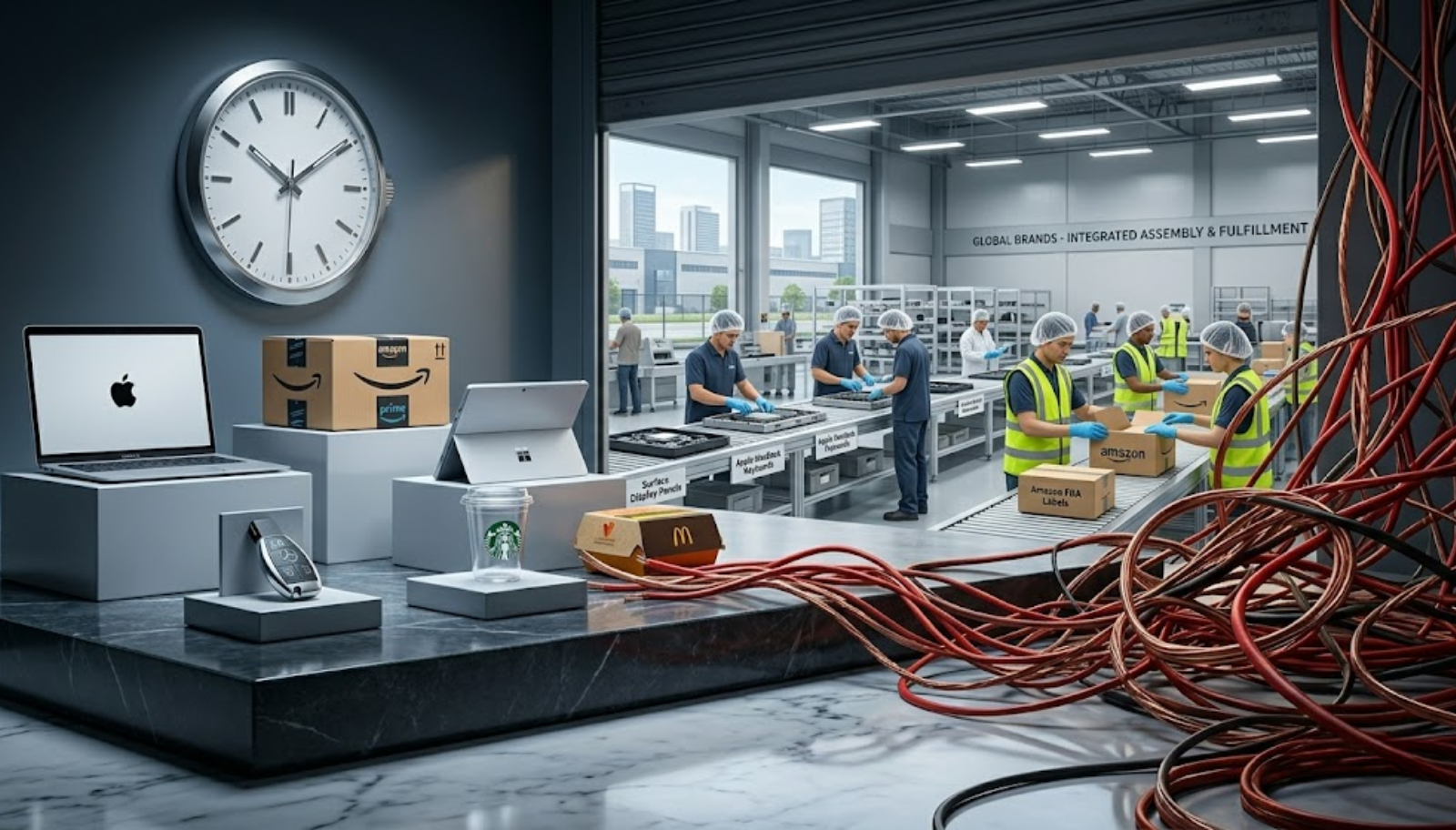
Bangladesh manufactures garments for some of the world’s most recognisable brands, yet it cannot persuade those same global corporations to set up shop within its own borders. Moreover, Apple, Amazon, McDonald’s, Mercedes Benz, Microsoft, and Starbucks are conspicuous by their absence from the country’s consumer landscape, operating instead through grey market imports, unauthorised resellers, or simply not at all.
The standard (and public) explanation points to low consumer purchasing power, but this is a superficial verdict. The deeper reasons are structural, political, and institutional, and they reveal a country that has built an export economy while simultaneously failing to create a domestic environment fit for the very brands whose products it helps to produce.
Despite boasting a massive, cost-competitive workforce and holding the rank of the world’s second-largest apparel exporter, Bangladesh continues to face a stark paradox where premier global brands and high-value foreign direct investors show persistent hesitation. While the country attracts mass-market, volume driven manufacturing, top-tier global brands often bypass it or cap their exposure due to a dense web of structural and operational bottlenecks that undermine investor confidence.
Chief among these bottlenecks is chronic regulatory unpredictability and a maze of bureaucratic hurdles; setting up a business requires navigating fragmented, non-transparent compliance channels where theoretical policy incentives rarely translate smoothly into administrative reality. This is compounded by acute infrastructural deficits, particularly a volatile energy crisis characterized by severe natural gas shortages and a heavy, costly reliance on imported Liquefied Natural Gas (LNG), which routinely causes factory work stoppages and elevates production costs.
Furthermore, the logistical ecosystem is hampered by long lead times and inefficiencies at the primary seaports, making it nearly impossible for high-end fashion or tech brands which operate on hyper-fast, seasonal “just-in-time” delivery models to guarantee reliable global supply chain timelines. Investors are also deeply unnerved by systemic macroeconomic challenges, notably persistent foreign exchange shortages and stringent capital controls that severely delay or obstruct the repatriation of corporate profits and dividends back to parent companies.
On the production floor, a significant skills mismatch acts as a barrier; the local industry has historically optimised for mass-producing low-complexity, basic garments, leaving a deficit in high-end design capabilities, advanced research and development (R&D), and workers trained to execute complex, high-value technical packs.
This operational rigidity makes it difficult to shift away from traditional manufacturing toward premium sectors, a risk intensified by the country’s looming graduation from Least Developed Country (LDC) status, which threatens to strip away critical duty-free tariff benefits like the Generalised System of Preferences (GSP).
Compounding these issues is an undercurrent of labor and political instability marked by frequent demonstrations, supply chain disruptions, and evolving global scrutiny over labor welfare and environmental sustainability metrics. Faced with these compounding risks, top global brands increasingly opt for regional competitors like Vietnam, Indonesia, or India, which offer superior logistical speed, more robust regulatory guarantees, and seamless capital mobility.
Weak intellectual property protection compounds the political risk. Brands such as Apple and Microsoft depend absolutely on the integrity of their intellectual property as their primary commercial asset. In Bangladesh, enforcement of intellectual property rights is inconsistent, and counterfeit goods circulate with limited regulatory consequence. For companies whose products carry premium valuations built entirely on brand integrity, this is not a manageable risk. It is a fundamental incompatibility.