
Farah Zahir
Oniket Research Group
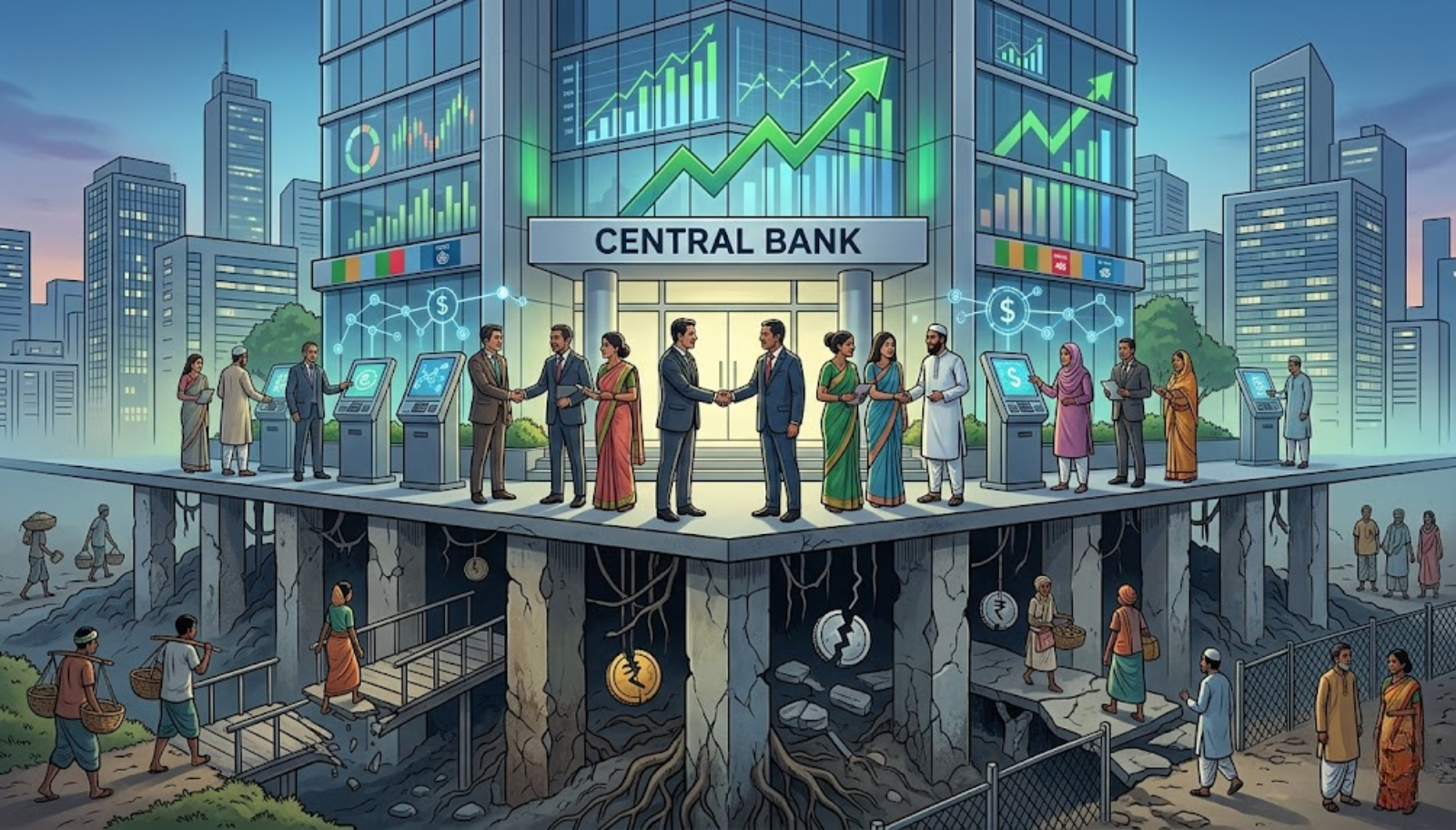
Bangladesh’s financial inclusion narrative, long hailed as a signature global development success story, is facing a critical reality check. While macro-level statistics showcase genuine quantitative milestones, such as adult financial account ownership jumping from 31 percent in 2011 to 53 percent in 2021 through mobile financial services (MFS) giants like bKash and Nagad, disaggregated data reveals a much darker reality.
Beneath the surface of the architecturally ambitious National Financial Inclusion Strategy (NFIS) 2021–2026, which boasts 12 strategic goals and 69 targets, lies a stratified system that structurally excludes the country’s most vulnerable populations.
The Deficit Against UN SDG Benchmarks
When measured against the United Nations Sustainable Development Goals (SDGs), Bangladesh’s institutional framework falters significantly. Financial exclusion directly undermines SDG 8.10 on universal financial access, SDG 1 on poverty eradication via shock-absorbing safety nets, SDG 10 on reduced inequalities, and SDG 5 on gender equality. Highlighting these systemic gaps, the Economist Intelligence Unit’s Global Microscope ranked Bangladesh 44th out of 55 nations on its overall financial inclusion index, exposing acute deficiencies in financial infrastructure, governance quality, and consumer protection.
Stalling Momentum and the Compounding Gender Chasm
The trajectory of financial access reveals an alarming trend of rapidly stalling momentum. Between 2011 and 2017, account ownership surged by 19 percentage points, but between 2017 and 2021, growth flattened to a meager three percentage points. With the low-hanging fruit of basic MFS registration fully harvested, the remaining 47 percent of unbanked adults represent deeply entrenched cases poorer, rural, less educated, and predominantly female that market dynamics alone cannot resolve. The gender crisis remains the most damning indictment of the current architecture, given that 65 percent of all unbanked adults in Bangladesh are women, men are 24 percentage points more likely to utilize MFS platforms than women, and only 43.5 percent of adult females hold any form of financial account.
Social Barriers and the Vulnerability of Exclusion
This severe exclusion is reinforced by patriarchal domestic norms that assign financial decision-making to men, a widespread lack of digital literacy, and English-only USSD interfaces that alienate non-English literate users. Research underscores that financially excluded women are significantly less capable of mobilizing emergency funds, leaving them highly vulnerable to economic shocks and forced self-sacrifice during domestic crises. Therefore, closing the gap between Bangladesh’s financial inclusion reality and its SDG obligations requires an immediate, comprehensive policy overhaul that addresses the core institutional architectures producing this exclusion.
A Five-Point Policy Imperative for Structural Reform
To achieve this, Bangladesh Bank must first mandate gender-responsive financial product design, requiring MFS providers and agent banking networks to meet public, gender-disaggregated outreach targets as a binding condition for market licensing. Second, regulators must legally require that USSD platforms, the primary digital interface for low-income users, operate entirely in Bangla.
Third, financial and digital literacy must be embedded into national primary and secondary school curricula and distributed via Union Digital Centres and NGO networks as a public investment. Fourth, the dormant three-tier coordination structure of the NFIS, the National Council, Steering Committee, and administrative unit must be immediately resourced and operationalized. Finally, government-to-person social protection payments must be fully digitalized and routed exclusively through accounts registered in the female beneficiaries’ own names to guarantee direct financial autonomy. Ultimately, Bangladesh has proven it can scale financial products, but it must now prove it can dismantle the structural discrimination that prevents true economic democratization.