
Sheikh Selim
Oniket Research Group
There is a paradox at the heart of resource-rich developing economies: the very natural endowments that promise prosperity can, if mismanaged, entrench poverty, distort policy, and hollow out long-term economic resilience.
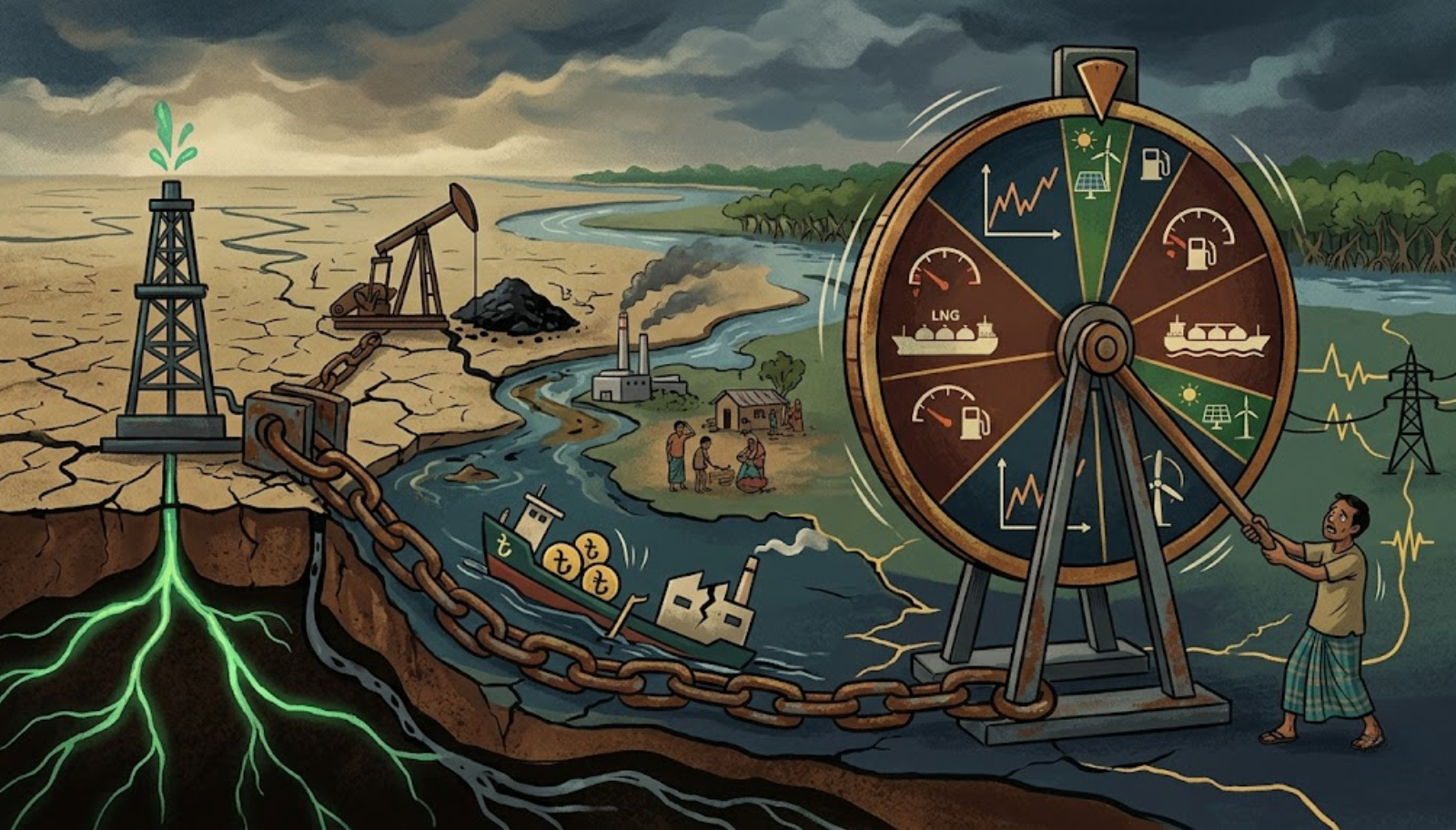
Economists call this the ‘resource curse’. For Bangladesh, a country that has drawn extensively on its natural gas reserves over the past five decades while allowing other productive capacities to lag, the concept is not a distant academic warning. It is an increasingly visible economic reality, and one that demands urgent reckoning as those reserves approach exhaustion.
Why Resource Curse matter?
The resource curse refers to the counterintuitive phenomenon whereby countries abundantly endowed with natural resources (oil, gas, minerals) tend to experience slower economic growth, weaker institutions, and greater inequality than resource-poor nations. The reasons are well understood. When a government can fund itself through resource revenues rather than broad-based taxation, it has less incentive to invest in human capital, diversify the productive economy, or build the accountable institutions that sustain long-term development. Revenues fluctuate with global commodity prices, creating boom-and-bust cycles that destabilize planning. And domestic industries outside the resource sector can be crowded out by the influx of resource income, a phenomenon known as Dutch Disease.
Exhaustible resource theory adds a further dimension. Resources like natural gas and coal are finite, i.e once extracted, they are gone permanently. Economist Harold Hotelling established decades ago that the optimal extraction of a non-renewable resource requires balancing present consumption against future need, ensuring that the wealth generated from depletion is reinvested into alternative productive assets so that future generations are no worse off. This principle, often termed as the sustainability criterion, provides the theoretical benchmark against which any nation’s resource policy must ultimately be judged.
Bangladesh’s Fifty-Year Resource Story
Bangladesh’s most significant natural resource endowment has been natural gas. Discovered in substantial quantities before independence, gas became the backbone of the country’s energy economy following 1971, fueling power generation, industrial production, fertilizer manufacturing, and domestic cooking. For much of the 1980s and 1990s, Bangladesh’s gas reserves were regarded as a strategic national asset. It created a competitive advantage that could underpin industrialization and reduce energy import dependency.
For much of this period, however, the management of this asset fell well short of the sustainability criterion. Successive governments subsidized gas heavily for domestic consumption keeping prices artificially low for households, power plants, and industries and without building the alternative energy infrastructure, fiscal savings mechanisms, or industrial diversification strategies that would protect the economy once reserves declined. The subsidies, while politically popular, meant that gas was consumed at rates that prioritized short-term affordability over long-term sufficiency. Revenue generated from gas production was not systematically channeled into a sovereign wealth or resource fund of the kind that Norway, for instance, established to convert petroleum wealth into permanent national savings.
Compounding this was a prolonged failure to invest adequately in exploration. New gas field discoveries tapered off, while consumption grew rapidly alongside population and industrial expansion. By the 2000s and especially the 2010s, the gap between domestic gas production and demand had widened to the point where Bangladesh was forced to enter the global market for Liquefied Natural Gas that was imported at international prices far exceeding the subsidized domestic rate. The country had, in effect, spent down a finite domestic asset without building the alternative energy and economic foundations needed to absorb the transition.
Coal extraction from the Barapukuria mine in Dinajpur has followed a similarly suboptimal trajectory … modest in scale, logistically constrained, and embedded in persistent controversy over land rights, environmental damage, and displacement of local communities. The broader question of whether Bangladesh should pursue large-scale coal extraction from its deeper reserves has remained politically unresolved, caught between developmental urgency and environmental risk. Meanwhile, the country’s renewable energy potential (particularly solar, in one of the world’s highest solar irradiance zones) went substantially underexploited for decades relative to the opportunity it represented.
Was the Policy Strategically Optimal? An Honest Assessment
Measured against the twin benchmarks of the resource curse literature and exhaustible resource theory, Bangladesh’s resource policy over the past fifty years was not strategically optimal. The absence of a ring-fenced resource revenue fund, the prolonged reliance on consumption subsidies without transition investment, the underinvestment in exploration and renewable alternatives, and the failure to systematically convert resource wealth into human capital and industrial diversification represent a pattern consistent with resource curse dynamics.
The economy grew, and grew impressively in garments, remittances, and services, but largely despite, rather than because of, its resource policy. Gas was a prop that delayed structural transformation rather than a springboard that enabled it.
A Policy Roadmap for the Next Twenty Years
The next two decades present Bangladesh with a defining choice: repeat the patterns of the past and face an increasingly energy-insecure and fiscally strained future, or pursue a deliberate, structured transition that converts the lessons of resource mismanagement into the foundations of a resilient, diversified economy.
The first priority must be the establishment of a national energy transition fund. It should be a dedicated fiscal mechanism, independently governed and insulated from short-term political pressures, into which revenues from remaining gas extraction are systematically deposited and invested in renewable energy infrastructure, energy efficiency, and human capital development. This is the institutional embodiment of the sustainability criterion: converting depleting underground wealth into enduring above-ground assets.
Second, domestic energy pricing must be rationalized over a phased timeline. Blanket subsidies must be replaced with targeted support for genuinely low-income households, while industrial and commercial consumers pay cost-reflective prices that incentivize efficiency and reduce wasteful consumption. Price reform is politically difficult, but it is the single most powerful lever for extending the productive life of remaining reserves and accelerating the market economics of renewable alternatives.
Third, Bangladesh must pursue an accelerated renewable energy program at national scale. It should not be the incremental solar home system expansions of the past, but utility-scale solar and wind installations, grid modernization, and regional energy cooperation frameworks that can replace gas-based generation within a twenty-year horizon. The target of 40 percent renewable energy by 2041, articulated in the government’s energy vision, must be matched with procurement pipelines, regulatory reform, and investment mobilization commensurate with its ambition.
Fourth, resource governance must be institutionally strengthened. Transparent public reporting on reserve levels, extraction rates, revenue flows, and fund performance must become standard practice, enabling citizens, civil society, and investors to hold government accountable for the stewardship of national assets. The resource curse is ultimately a governance failure, and governance is the one resource that, unlike gas, can be renewed by deliberate political will.
Bangladesh did not suffer the most extreme manifestations of the resource curse. It did not become a petro-state, nor did it collapse into conflict over its reserves. But it did allow a finite and valuable national asset to be gradually consumed without adequately building the alternative foundations its future requires. The next twenty years are not a second chance so much as a final window … an opportunity to govern the endgame of fossil fuel dependency with the strategic intelligence and institutional seriousness that the past fifty years often lacked. The ground beneath Bangladesh is running low. What is built above it now will determine whether the next generation inherits a curse or a foundation.