
Desk Report
Oniket Desk
Sustainable infrastructure is not merely a development ambition for Bangladesh; it is a strategic imperative. As the country continues its trajectory of economic growth, bridges have emerged as critical connectors of markets, regions, and communities. They reduce transport costs, enable disaster response, and draw peripheral areas into national value chains. How Bangladesh finances, builds, and maintains these structures will determine whether its infrastructure dividend is realized across generations.
Bridges as Engines of Connectivity
Bangladesh’s major bridges illustrate how single infrastructure assets can reshape entire regional economies. The Bangabandhu (Jamuna) Multipurpose Bridge serves as the backbone of north-south connectivity, linking economically important northern districts with Dhaka and its export corridors. By accommodating both road and rail traffic, it has reduced travel times, stimulated agricultural and industrial linkages, and opened new pathways for goods destined for international markets.
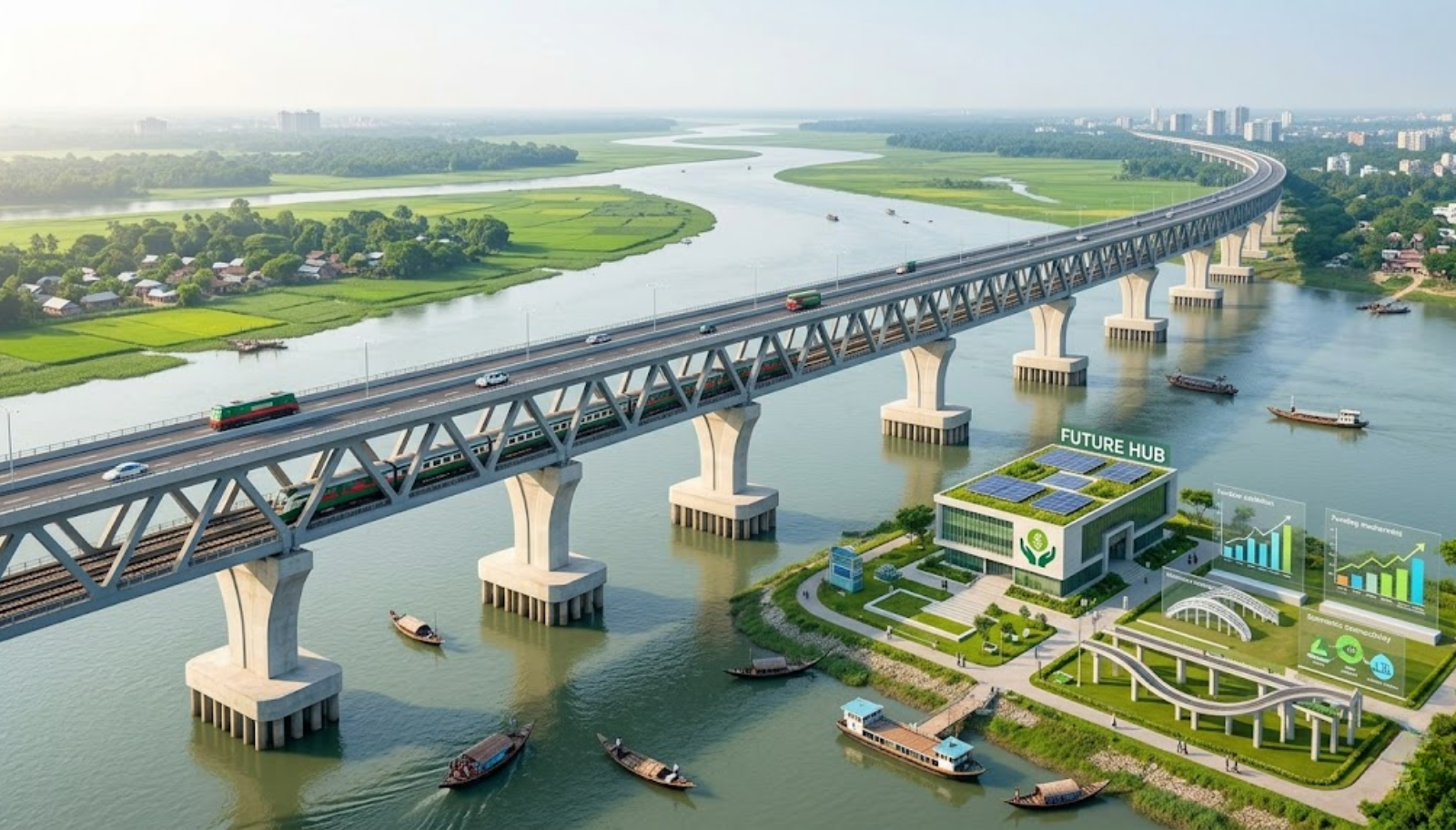
The Padma Multipurpose Bridge has proven equally transformational. Cutting travel time dramatically between the capital and the south-western districts, it is designed not only to ease movement but to catalyze regional investment, expand labor markets, and improve access to public services for millions of residents who were previously underserved. At the same time, historic rail assets like Hardinge Bridge continue to play an essential role in low-carbon freight and passenger transport, underscoring that sustainability also means maintaining what already exists. A network of regional and district bridges, including the Lalon Shah, Kazi Nazrul Islam, and Meghna crossings, reinforces intraregional trade and provides vital evacuation and supply routes during floods and cyclones.
Financing: Lessons Learned
Bangladesh has drawn on a diverse financing toolkit including central government budgets, concessional loans, export-credit facilities, and hybrid arrangements incorporating toll revenues. The Padma Bridge stands as a landmark case: when major multilateral donors withdrew during the pre-construction phase, Bangladesh mobilized domestic resources, demonstrating strong sovereign commitment and considerable project management capacity. The experience showed that political ownership, when genuine, can unlock alternatives that external dependency might otherwise foreclose.
Yet significant lessons remain for future projects. While donor finance and concessional loans can accelerate delivery, they introduce conditionalities and project complexity; diversified funding sources reduce this dependency risk. User-pay mechanisms such as tolls are effective revenue tools but must be balanced carefully against equity considerations, ensuring that access is not denied to those who cannot afford to pay. Perhaps most significantly, innovative instruments such as infrastructure bonds, public-private partnerships (PPPs), and blended finance remain underutilized. These instruments hold substantial potential to mobilize private capital, particularly for secondary bridge construction and ongoing maintenance programs.
Maintenance: The Weakest Link
Construction is only the opening act. The long-term sustainability of bridge assets depends on robust operation and maintenance, and it is here that Bangladesh faces its most pressing institutional challenges. Operations and maintenance budgets are frequently too small relative to lifecycle needs, leading to deferred repairs, accelerated deterioration, and ultimately higher costs. Fragmented institutional mandates across multiple agencies hinder coordinated planning, while technical capacity gaps leave local bodies ill-equipped to conduct complex structural health monitoring or climate-proofing retrofits. These challenges are compounded by growing climate and load pressures, extreme weather events, riverbank erosion, siltation, and heavier vehicle loads are all accelerating the rate at which infrastructure wears.
A Roadmap for Sustainable Infrastructure
A credible path forward requires action on several fronts simultaneously. Ring-fenced maintenance funds fed by shares of fuel levies, tolls, or dedicated budget lines would provide predictable financing and eliminate the cycle of ad hoc repairs. National bridge asset registries and lifecycle cost models, underpinned by risk-based prioritization, would ensure that limited funds are directed toward the highest-impact interventions. Performance-based contracting and long-term concessions can transfer appropriate risks to private partners while maintaining service standards and incentivizing preventive care.
Equally important is embedding climate resilience into infrastructure from the outset. Green bonds and sustainability-linked instruments can finance climate-proofed designs, while nature-based solutions such as river training, embankment stabilization, and landscape-level erosion management protect bridge foundations over the long term. Alongside these technical measures, investing in engineering training, modern inspection technologies such as drones and sensors, and enforceable quality standards will build the institutional capacity that underpins every other reform.
Bangladesh’s bridges are more than transport links; they are instruments of economic inclusion. To ensure they continue delivering social and economic value for decades to come, the country must pair continued strategic investment with equally deliberate reforms in how infrastructure is financed, managed, and protected against a changing climate.