
Desk Report
Oniket Desk
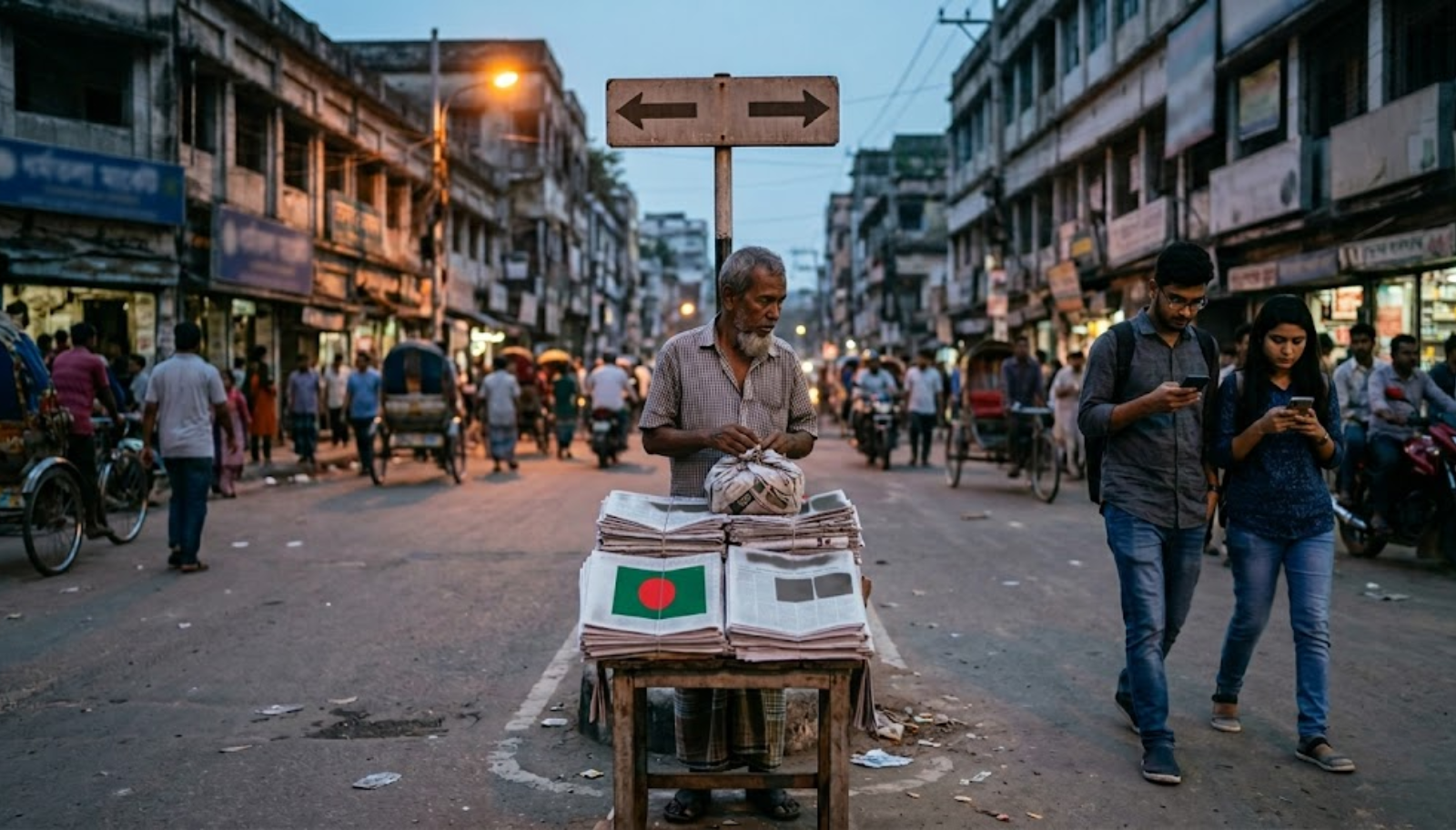
Bangladesh’s printed newspapers are currently facing a period of significant upheaval, representing the most substantial challenges they have confronted in their history. The advent of social media platforms, particularly Facebook, which boasts over fifty million active users in the country, has profoundly transformed the way the public accesses, consumes, and evaluates news.
In this context, the editorial newspaper confronts not only a circulation challenge but also a crisis of legitimacy, a crisis of revenue, and an identity crisis, all concurrently.
A Platform War the Press Is Losing
For most Bangladeshis, the morning news now arrives not through newsprint but through a smartphone screen. Prothom Alo, The Daily Star, Samakal, and their peers have retained digital presences, yet the economics of digital advertising favour the platforms over the publishers. Facebook and YouTube absorb the bulk of online advertising spend, leaving news outlets competing for a narrow and shrinking slice. Print circulation, once the backbone of revenue, has fallen steadily as younger readers demonstrate no attachment to the physical newspaper and older ones migrate online.
The harm caused by misinformation exacerbates the structural crisis. The advent of social media has given rise to a parallel information ecosystem, characterized by the rapid dissemination of unverified rumors, politically motivated fabrications, and overt propaganda. The velocity at which this content pieces propagate exceeds the capacity of editorial teams to effectively monitor and rectify them in a timely manner. The printed newspaper, bound by the constraints of daily or weekly publication cycles, reaches the reader’s hands hours or days after a false narrative has already become entrenched in public consciousness. The press tends to respond in a reactive manner, often correcting the information that has already been accepted as factual by social media platforms.
The Erosion of Editorial Trust
Political polarisation has further eroded the authority that newspapers once derived from institutional independence. Ownership concentration compromises the perception, and in some cases the reality, of editorial independence. When the public suspects that editorial positions reflect ownership interests rather than journalistic judgement, the newspaper loses its fundamental advantage over social media: the credibility of a verified, edited, and accountable source. A Facebook post by an anonymous account and an editorial by a senior correspondent carry equal weight in an environment where institutional trust has been squandered.
Reforms That Can Sustain the Edited National Daily
The future of printed journalism in Bangladesh is not inevitable decline; it is a question of whether the industry can execute a credible transformation before its financial foundation collapses entirely. Several reforms are both necessary and achievable.
Ownership transparency must be legislated. A mandatory public register disclosing the ultimate beneficial owners of all newspaper titles, modelled on existing frameworks in the European Union, would allow readers to contextualise editorial positions and hold proprietors accountable for conflicts of interest. Opacity is incompatible with the trust that print journalism must now be rebuilt.
A reader-revenue model must replace the advertising dependency. Subscription-based digital editions, tiered to accommodate income levels, with a reduced-price print edition for rural and elderly readers, would diversify the revenue base and align the newspaper’s commercial incentive with the reader’s informational interest rather than the advertisers.
Newspapers must invest in institutional fact-checking desks with visible, bylined reporters whose corrections are published prominently, not buried. Speed cannot be the press’s competitive advantage against social media. Accuracy, verification, and accountability must be. A dedicated corrections column, treated as a mark of credibility rather than an admission of failure, would differentiate edited journalism from the unaccountable noise of the platform economy.
Journalism education must be reformed. Universities producing the next generation of reporters must train graduates in data journalism, digital verification, and investigative methods, skills that give print journalism a distinctive and irreplaceable public function.
The Stakes of Getting This Wrong
Bangladesh’s democratic health depends on the survival of credible, independent journalism. If the edited national daily is displaced entirely by algorithmically curated social media feeds, the institutional capacity to challenge power, verify official claims, and give marginalised communities a documented voice will diminish with it. The printed newspaper may not survive in its current form. The editorial values that built it must.




Comment on “The Printed Press at a Crossroad”