
Sumaiya Hasi
Editor – Public Relations, The Oniket Bulletin
Bangladesh is a living museum of rich cultural, historical, and archaeological heritage in South Asia. Layers of history from the early Stone Age through the Pala, Sena, Sultanate, Mughal, and British periods are embedded in its soil. In the red earth of the Varendra region in northern Bengal lies the ruins of Paharpur Buddhist Vihara, once the largest residential educational center in South Asia, and Mahasthangarh, the ancient capital of Pundravardhana, both bearing testimony to early urban civilization. In the south, the Sixty Dome Mosque of Bagerhat represents the unique architectural style of the Sultanate period, while the Sundarbans mangrove forest stands as an unmatched natural heritage recognized globally. These three UNESCO World Heritage Sites, along with intangible cultural heritage such as Jamdani weaving, rickshaw painting of Old Dhaka, and the Mongol Shobhajatra of Pohela Boishakh, reflect the deep aesthetic richness of the country’s way of life. More recently, archaeological sites such as Mainamati, the Lalmai hills, and the 2,500-year-old trading civilization of Wari-Bateshwar further demonstrate that Bangladesh’s tourism portfolio is of international standard. However, despite this vast historical wealth, due to inadequate international promotion, lack of visionary conservation, and weak commercialization, Bangladesh remains significantly underrepresented in global tourism flows.
An analysis of the World Bank’s World Development Indicators (WDI) and the World Travel and Tourism Council (WTTC) 2026 annual economic impact report presents a stark and disappointing picture of this promising sector. According to the latest Bangladesh Bureau of Statistics (BBS) data, international tourist arrivals in Bangladesh stand at approximately 630,685. In comparison, regional neighbors show a dramatic contrast: Thailand attracts around 30 to 40 million tourists annually, Vietnam, recovering from years of conflict, receives over 12 million tourists, Sri Lanka, despite economic crises, attracts 1.5 million, and Nepal, despite geographical constraints, draws nearly 1 million international visitors. This disparity has a direct impact on the economy. While tourism contributes approximately 5 percent of GDP in Vietnam and 12 percent in Thailand, in Bangladesh the direct contribution of international tourism to GDP remains below 0.5 percent. According to the World Bank official indicator database, Bangladesh earned only 440.47 million US dollars from international tourism in the fiscal year 2024–25, which is less than 2 percent of Thailand’s total tourism revenue and only about 5 percent of Vietnam’s.
The root causes of this underperformance lie in deep institutional and structural weaknesses within Bangladesh’s heritage tourism sector. First, responsibility for heritage site maintenance and management is divided among the Department of Archaeology, local administration, and the Bangladesh Tourism Board in such a fragmented way that any improvement in visitor facilities often takes years due to bureaucratic red tape. This lack of coordination prevents timely decision making and accountability. Second, world class sites such as Mahasthangarh, Paharpur, and Mainamati fail to meet visitor expectations. International tourists visiting these ancient civilizations seek to understand their philosophy, folklore, and social structure. However, the absence of multilingual signage, modern information centers, and internationally certified guides reduces their experience to merely observing some old brick structures, significantly diminishing its impact. In addition, there is no dedicated Heritage Conservation Fund, which causes chronic delays in essential restoration and excavation work. Furthermore, unplanned urbanization and legal loopholes have allowed illegal encroachment and modern construction within archaeological boundaries, seriously threatening the authenticity and historical value of these ancient sites.
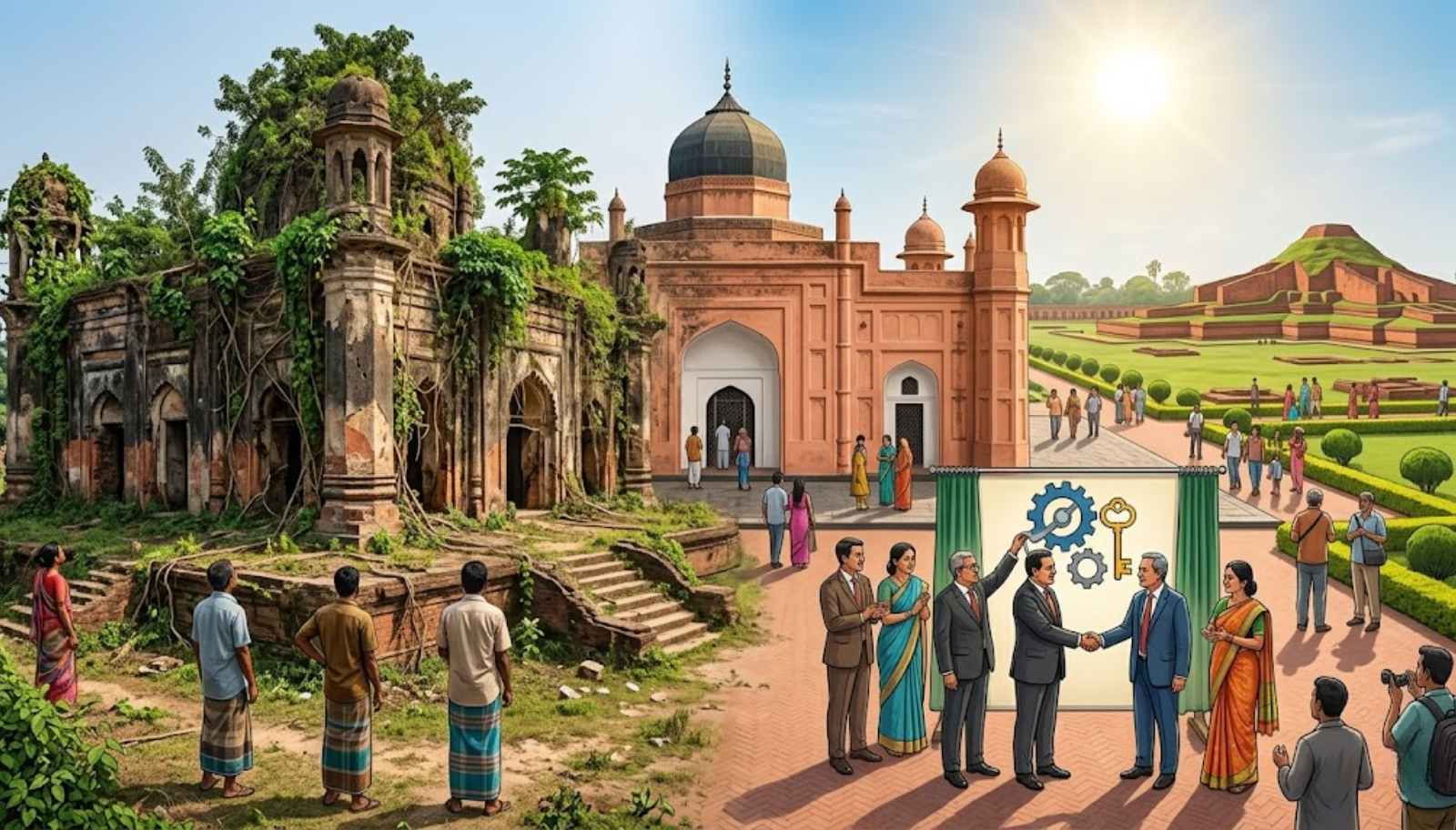
To overcome this stagnation, comprehensive and transformative reforms based on international best practices are required in the heritage tourism framework. To reduce bureaucratic complexity, each major heritage site should be managed by a dedicated autonomous authority staffed by trained professionals, with archaeologists and heritage experts empowered to make direct decisions beyond the Department of Archaeology and Tourism Board. Instead of relying solely on annual government budgets, a Public Private Partnership model should be introduced, and a National Heritage Conservation Fund should be established through tourism revenue, corporate CSR contributions, and international grants. At the same time, sensitive ecological heritage such as the Sundarbans, green finance mechanisms and strictly regulated eco-tourism policies must be implemented to ensure environmental protection.
In the digital age, adopting the concept of smart heritage is essential for preservation and promotion. QR code based multilingual audio guides should be installed at every archaeological site, and major sites should include virtual reality booths that allow visitors to experience reconstructed ancient cities in three-dimensional form. A unified central ticketing gateway should be introduced for all heritage sites in the country. Local youth should be trained and certified as tourist guides, creating employment opportunities in rural economies. In international marketing, the promotional strategy must also shift focus. Alongside Europe and North America, the large Buddhist population in East and Southeast Asia should be targeted by branding Paharpur, Mahasthangarh, and Mainamati as part of a dedicated Buddhist Circuit Tourism initiative. At the same time, to attract long term visitors, the current complex visa system must be replaced with fully digital e visas and seamless on arrival visa facilities at international airports.
World Bank and WTTC indicators clearly show that the failure of Bangladesh’s heritage tourism sector is not due to a lack of resources but due to a lack of institutional foresight and strategic branding. If countries like Vietnam can generate billions of dollars from relatively limited heritage assets, Bangladesh can also reach that level through effective policy reform. With successful implementation of these institutional and structural reforms, this sector has the potential to generate more than 5 billion US dollars annually, making it the second largest source of foreign exchange earnings after the readymade garments sector. Standing at this critical moment in 2026, if such policy transformation is not undertaken immediately, these glorious historical assets risk losing their relevance, attractiveness, and even their existence in the long term.




Comment on “Heritage Tourism in Bangladesh and the Need for Institutional Reform: The Awakening of a Sleeping Power of a Century”