
Sumaiya Hasi
Editor, Public Relations – The Oniket Bulletin
The branch of healthcare that operates on the narrow boundary between life and death, intensive care or critical care, is one of the most essential components of modern medicine. A young person critically injured in an accident, an elderly patient suffering from respiratory complications, or a child weakened by a severe infection, all depend significantly on whether an effective ICU facility is available at the nearest hospital.
In a recent article published in The Daily Star, Dr. Shaiful Azam Sazzad, Vice President of the Bangladesh Society of Critical Care Medicine, identified the shortage of skilled manpower as the primary barrier to establishing ICUs in district hospitals. His observation is valid, but a deeper analysis reveals that the challenge extends far beyond staffing. It is a complex intersection of statistics, economics, governance, and operational realities.
The Current ICU Crisis: Growing Numbers, Persistent Inequality
The statistics reveal a clearer picture of the crisis. According to a national survey published in the Bangladesh Critical Care Journal in 2022, Bangladesh had only 1.70 non-COVID intensive care beds per 100,000 people. In Dhaka district, the number was 12.32, while 38 out of the country’s 64 districts had no critical care beds at all.
Even considering the minimum standards recommended by international guidelines, Bangladesh requires at least 5,000 ICU beds for its population, as noted in a recent report by New Age. Since the pandemic, the number of ICU facilities has increased, with 1,372 ICU beds established across 72 institutions and 1,054 CCU beds across 51 institutions. This is nearly three times higher than the 498 beds available before the pandemic.
However, according to a report by The Observer, 55 percent of operational ICU beds, amounting to 758 beds, are concentrated in only 22 hospitals in Dhaka. Despite numerical expansion, geographic inequality remains unchanged.
The Manpower Crisis: Infrastructure Exists, But Operators Are Missing
The shortage of skilled personnel is an even deeper concern. In 2021, the government appointed 409 anaesthesia consultants, but no structured framework was developed for recruiting dedicated ICU or critical care physicians. As a result, many eventually returned to their original positions, leaving several ICUs vacant or non-functional.
Although the first postgraduate MD programme in Critical Care Medicine was introduced under the University of Dhaka in 2007, only 14 to 18 students are admitted annually. According to an article published in the IMC Journal of Medical Science, this remains far below the country’s requirement of at least 600 postgraduate-qualified intensivists.
An investigative report by The Business Standard quoted the Head of the Department of Anaesthesia at Bangladesh Medical University as stating that Bangladesh produces only 150 to 200 anaesthesiologists and critical care specialists every five years. The limited opportunity for private practice in this specialised field has reduced interest among young doctors. More than 1,000 doctors, nurses, and technicians temporarily appointed during the pandemic were not renewed after their contract ended in December 2024. As a result, while infrastructure remained, the workforce needed to operate it disappeared.
Financial Constraints and Structural Weaknesses in Healthcare
Financial and structural barriers have pushed the crisis deeper. According to a review by the Centre for Policy Dialogue, healthcare allocation in Bangladesh has remained below one percent of GDP for the past two decades. Combined public and private investment in healthcare stands at 2.34 percent of GDP, less than half of the South Asian average of 5.1 percent.
A report published in Bonik Barta, citing World Bank data, stated that health expenditure accounts for only 1.19 percent of total government spending, among the lowest globally and far below the South Asian average of 4.59 percent. Due to this limited public investment, out-of-pocket healthcare expenses have reached approximately 73 to 74 percent of total health expenditure.
The private sector, which stepped in to fill this financial gap, has itself become a source of inequality. According to a review article published in PMC, 78 percent of ICU facilities in Bangladesh are privately owned. Daily ICU bed charges can range from Tk 15,000 to Tk 100,000, while government hospitals charge only around Tk 100 per day.
District-Level Inequality and Governance Challenges
An investigation by Prothom Alo found that at least 22 districts have no ICU facilities in government hospitals. As a result, many low-income families are forced to sell land and assets to cover medical expenses. The problem is further complicated by political influence in staff deployment, the absence of specialists in remote areas, and weak accountability mechanisms. These governance failures create major obstacles even after infrastructure is established.
Is Building ICUs Alone Enough?
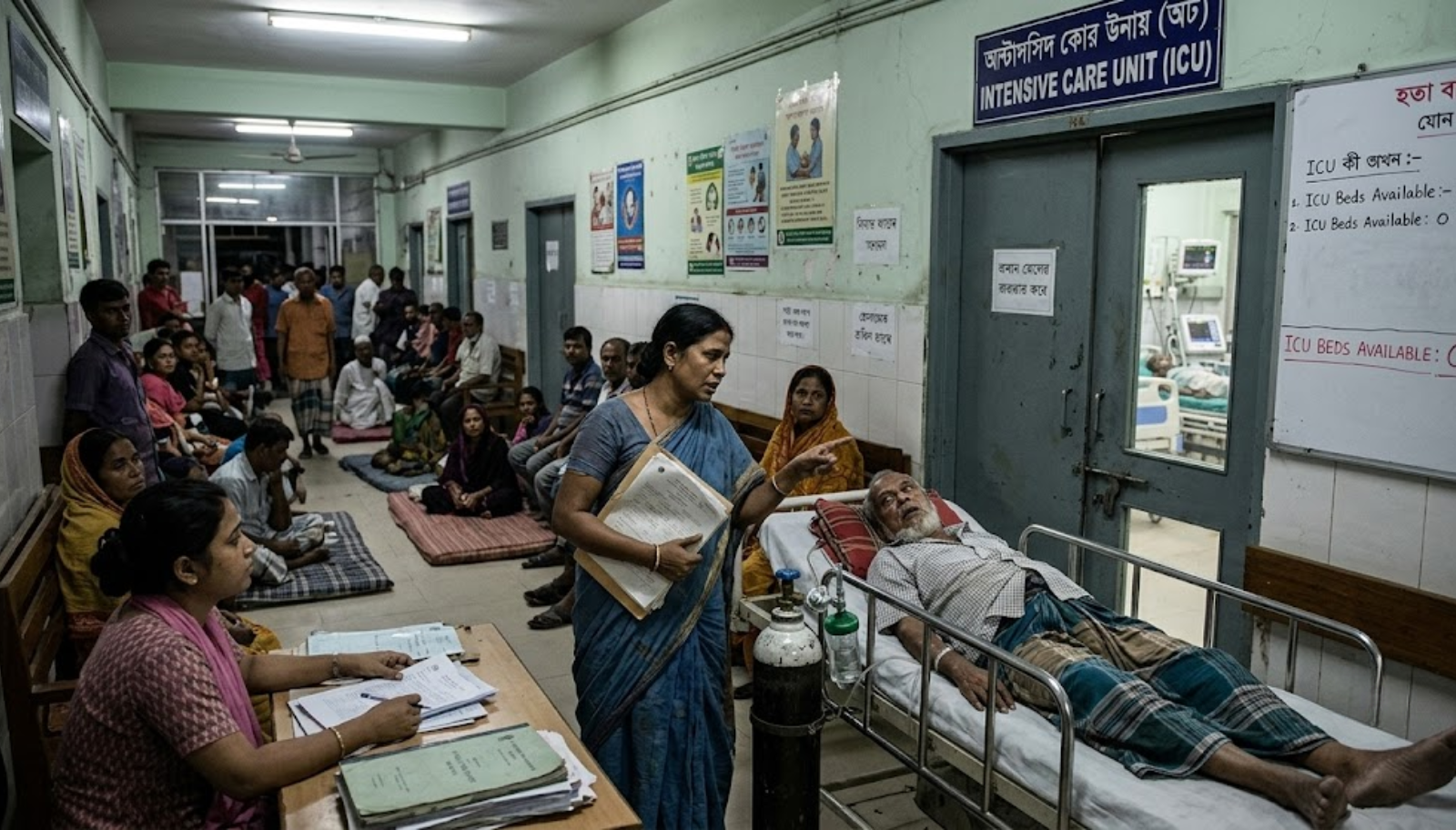
There is also a need to question whether constructing full-scale ICUs alone can solve the problem. An investigation by New Age found that more than half of ICU beds established in government hospitals remain unused due to shortages of manpower and maintenance problems.
In Rajshahi Division, nearly 50 of the 94 ICU beds are operational, while 44 remain closed due to a lack of skilled personnel. This has placed immense pressure on Rajshahi Medical College Hospital. According to a report by The Daily Star, 91 children waiting for ICU beds died in March alone this year. This reality demonstrates that building infrastructure does not automatically make it functional.
In such circumstances, alternative models such as High Dependency Units (HDUs), standardised emergency critical care protocols in general wards, and tele-ICU systems connecting district hospitals with specialists at divisional or medical college levels deserve serious consideration. The concept of High Dependency Units mentioned in the National ICU Quality Improvement Framework is not new in Bangladesh. Similar units are already operating at the National Institute of Cardiovascular Diseases.
Instead of spreading limited specialist manpower thinly across distant district hospitals, using technology to extend specialist support could provide a more practical and cost-effective solution for a country facing critical shortages of trained personnel.
Operational Weaknesses and the Pre-Hospital Care Gap
Operational realities are equally important. A national assessment conducted following World Health Organization infection prevention and control standards found that only 27.3 percent of tertiary hospitals maintained adequate spacing between patient beds across all units.
Around 73 percent of hospitals achieved only basic or foundational infection control standards. The same assessment found that no hospital had a regular monitoring system for identifying hospital-acquired infections. According to a national health facility survey, rural and district-level facilities lag behind urban facilities by 21 percent in terms of readiness.
Equipment maintenance gaps are also a major concern. At Bangladesh Medical University’s 100-bed Super Specialized Hospital, The Business Standard reported that 80 beds remain closed due to manpower shortages, despite more than three years passing since its inauguration. The crisis is further intensified by failures in pre-hospital care. Patients from remote areas often spend critical hours travelling to district hospitals through untrained transportation systems. As a result, the most important first hour of emergency care is lost, and many patients deteriorate before reaching medical facilities.
Conclusion: The Need for an Integrated Healthcare System
Considering all these factors together, it becomes clear that establishing ICUs in district hospitals is not a single-dimensional challenge. Recruiting more personnel alone will not solve the problem unless it is accompanied by adequate funding, transparent deployment policies, maintenance systems, and a tiered healthcare model based on capacity.
Implementing the manpower structure proposed by Dr. Sazzad for 2024 is undoubtedly an urgent step. However, without increased healthcare investment, regulation of private-sector pricing, and technology-based monitoring systems, there remains a risk of repeating the same pattern. A system where expensive equipment is installed, but no skilled people are available to operate it.
This chapter of Bangladesh’s healthcare journey reflects a much larger question: how prepared is the state to protect its citizens during their most critical moments, and how willing is it to translate that commitment into resources, priorities, and action?