
Farah Zahir
Editor, Oniket Research Group
Bangladesh has always been a nation that breathes poetry. From the electrifying songs of 1971 to the melancholic love verses whispered into the rainy season, poetry has never been merely a literary form here. It has been a pulse, a prayer, a way of being alive. But today, that very intimacy between a people and their poetry faces a quiet, uncomfortable reckoning. There are more poems than ever before. And there are, it must be said, more poor ones too.
A Nation of Poets, For Better and Worse
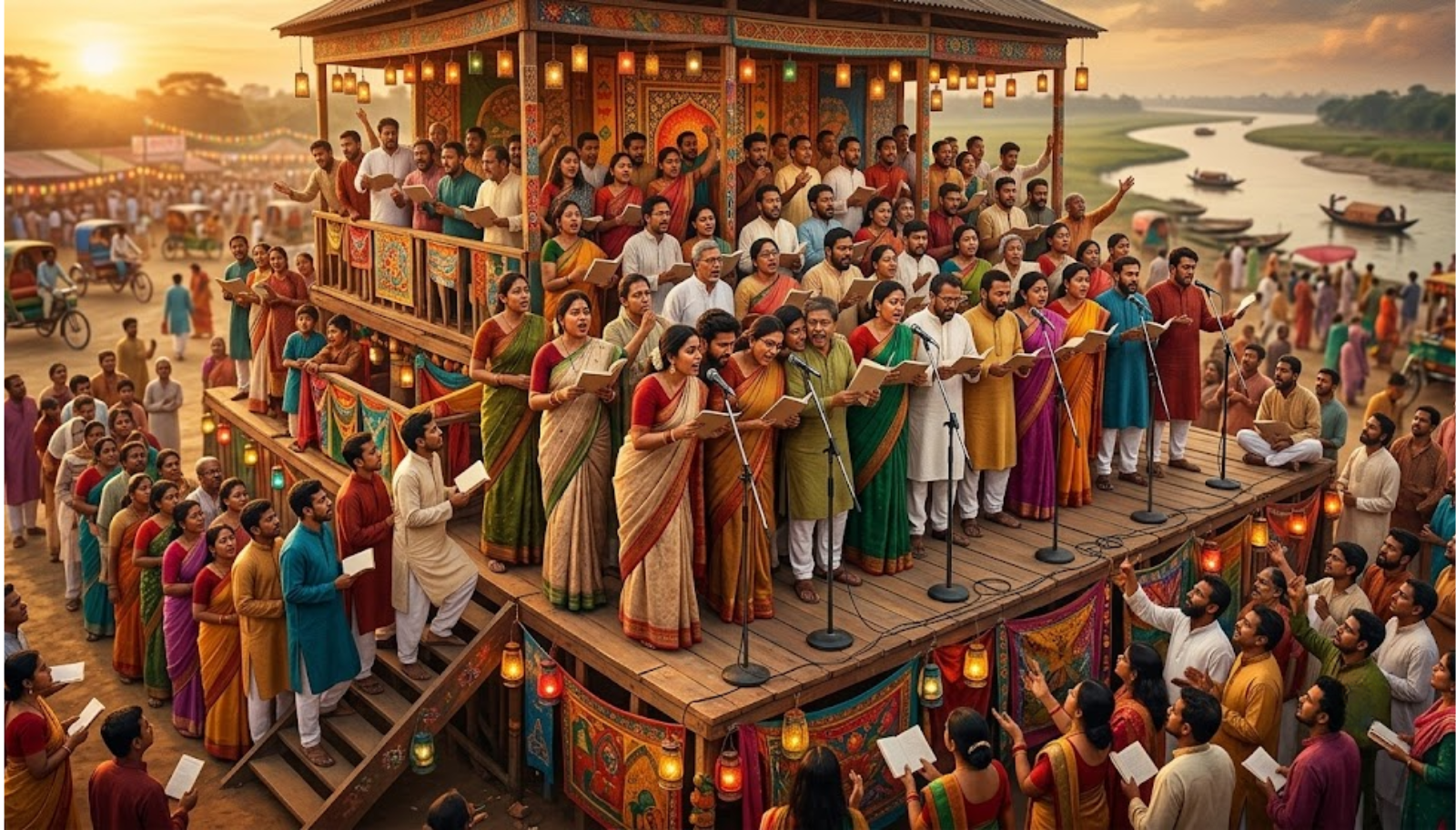
Walk through the Ekushey Book Fair in Dhaka, scroll through any Bangla Facebook page, or attend a cultural evening in Sylhet, Chattogram, or Rajshahi, and the evidence presents itself without invitation. Bangladesh is witnessing an unprecedented surge in the number of people who claim the title of poet.
Hundreds of books are published each year, many of them self-published, many of them inspired not by years of discipline, study, and emotional labour, but by a fleeting thought composed between one social media scroll and the next. Poetry, once a private and almost spiritual practice, has been reimagined as a form of personal branding. Own a smartphone, feel a passing sadness, and the title of ‘kabi’ is apparently yours to claim.
This phenomenon has its roots. The democratisation of digital publishing, the rise of literary Facebook groups with hundreds of thousands of followers, and the deep cultural prestige attached to the word “poet” in Bangladeshi society have together created an ecosystem where volume has replaced vision.
The result is a literary scene saturated with verse that rhymes without reason, laments without lived experience, and emotes without the discipline of form. The noble art of poetry, the art that once powered revolutions, mourned genocides, and carried an entire nation through its darkest hours, risks being buried beneath an avalanche of mediocrity.
The Sacred Tradition Being Diluted
To understand the weight of this moment, one must remember what poetry has meant to the people of Bangladesh. Bangla poetry has long been inseparable from resistance and liberation. The Bengal Famine of 1943, the Language Movement of 1952, the streets of Dhaka in the days before the Liberation War of 1971, the democratic uprisings of the 1980s: each of these defining moments was carried forward not only in history books but in verse. Poetry was a tool, prayer, and the keeper of collective memory, all at once. The poetic tradition drew its authority from that blood-soaked soil, and the giants who walked it earned their place through courage as much as craft.
The shadow of Rabindranath Tagore and Kazi Nazrul Islam has always loomed enormously over Bangla poetry, posing a creative challenge that every succeeding generation must confront honestly. The challenge for Bangladesh’s poets is not simply to write verse. It is to write verse worthy of that extraordinary inheritance. When every passing emotion is rushed into couplets and published before the ink of genuine feeling has dried, the tradition is not honoured. It is cheapened.
The Guardians of the Flame
Against this backdrop of poetic dilution, a generation of iconic poets has fought, and continues to fight, to preserve the dignity and depth of the form. Their work represents not merely literary achievement but a moral commitment to what poetry can and should be.
Nirmalendu Goon, born in 1945 and considered one of the most eminent figures of contemporary Bangladeshi poetry, emerged as a frontline poet in the 1960s, though his landmark debut collection Premangshur Rokto Chai (Blood for Premangshu) did not appear until 1970. Over the decades, Goon has produced approximately one hundred titles, forty-five collections of verse and fifty-five of prose, covering national crises, socio-economic ills, and the lives of ordinary people with a declamatory power that few poets in any language can match.
Awarded the Ekushey Padak in 2001 and subsequently honoured as the “Poet of Bangabandhu” for his extraordinary body of poems dedicated to the father of the Bangla nation, Goon remains a living testament to what decades of disciplined poetic engagement can produce. He is proof that genuine poetry must grow from the nation’s deepest soil, not from its shallowest trends.
Helal Hafiz, who passed away in December 2024, left behind a legacy of searing economy and emotional precision that continues to electrify readers. His iconic collection Je Jole Agun Jole (Where Fire Burns in Water), published in 1986, remains one of the bestselling poetry collections in the history of Bangladesh, a book that blended war imagery with love, rage with tenderness, in verses that have not aged a single day.
Hafiz was considered a true representative of his generation, marked by creative traits forged in an age of political turmoil and personal longing. His restraint, the willingness to write very little but to make every word count, is a lesson the crowded poetic marketplace desperately needs to absorb.
Mahadev Saha, born in 1944, stands as one of the defining voices of romantic poetry in the Bangla literary tradition. His verses draw from the wellsprings of solitude, love, yearning, the Liberation War, the rural landscape, and the cause of the poor and the secular. Honoured with the Bangla Academy Award in 1983, the Ekushey Padak in 2001, and the Independence Day Award in 2021, Saha has produced over one hundred and thirty books, a body of work that reflects a poet who did not merely react to life but spent a lifetime transforming it into art. He is a poet of mystery and muted ambiance, and his work teaches young writers that poetry does not need to be loud to be powerful.
Shamim Azad pursued a path equally remarkable for its breadth and its commitment. One of Bangladesh’s most prolific bilingual poets, she has published and performed across five decades as a storyteller, poet, journalist, and writer in Bangladesh and in London. In 2023, she was awarded the Bangla Academy Literary Award in the poetry category.
Her work navigates the spaces between two cultures without losing the essence of either, and her discipline as a craftsperson who writes in both Bangla and English has expanded the reach of Bangladeshi poetry to global audiences. Azad is a pioneer in the truest sense: someone who breaks new ground not by abandoning tradition but by carrying it with her.
What the Crowded Stage Must Learn
The fact that so many people wish to be poets is not cause for alarm. Every great literary tradition has begun somewhere in the ordinary hopes of ordinary people. The problem is not the number of voices. The problem is that so many of those voices are no longer listening to the great ones that came before, no longer studying them, no longer sitting long enough in their presence to understand what made them extraordinary.
Contemporary Bangladeshi poetry has changed considerably in recent decades, taking on new subjects, new themes, and new aesthetic styles. That evolution is natural and necessary. But new poets must understand the landscape they are entering, not simply assume that novelty alone is sufficient.
Young poets in Bangladesh must resist two temptations. The first is imitation without understanding: producing pale shadows of Nirmalendu Goon’s political thunder or Helal Hafiz’s emotional precision without having earned the perspective from which those voices emerged. The second is novelty without substance, chasing trends, digital aesthetics, and social media virality at the expense of the sustained imaginative labour that separates verses from poetry.
The path forward demands a return to the sources. Young poets must read Mahadev Saha not merely to admire his romantic imagery but to understand how he earns each metaphor through structural patience. They must absorb Shamim Azad’s bilingual courage and Helal Hafiz’s economy of emotion. They must sit with Nirmalendu Goon’s lifelong conviction that poetry is inseparable from the lives and struggles of the common people.
Poetry as a Viable Literary Form
The question of whether poetry remains a viable literary form in Bangladesh answers itself the moment one opens the right books. Bangla poetry holds associations with resistance, identity, and collective memory that no other literary form can quite replicate. The form is not in decline. It is in competition with its own diluted imitations.
The genuine article, when it appears, still stops readers in their tracks. It still circulates by word of mouth. It still sells out at the book fair.
Poetry works when it is serious. It works when its practitioners understand that a poem is not a status update, not a caption, not an outlet for unprocessed feeling. A poem is a made thing, an act of transformation, a gift of clarity to the reader who might otherwise drown in the noise of the world. Bangladesh’s greatest poets have always understood this. The task of today’s generation is to take that understanding and carry it forward with the same fierce determination that sharpened Helal Hafiz’s passion and deepened Nirmalendu Goon’s voice even in the face of every obstacle.
The stage may be crowded. But there is still room. There is always room for those who write not to be seen, but to illuminate.