
Farah Zahir,
Editor, Oniket Research Group
The purpose of this article is to examine the government’s newly announced plan to provide free and subsidised cataract surgery to roughly 10 lakh visually impaired people in Bangladesh, and to assess whether this initiative is built to deliver lasting change or whether it risks becoming a short-lived political gesture. The article looks beyond the surface appeal of the announcement (as discussed in another recent article in the bulletin) to ask harder questions about funding, capacity, and long-term sustainability.
In summary, this article argues that the programme’s short-term benefits are significant and largely undisputed. Restoring sight to 10 lakh people, most of them elderly and economically marginal, carries clear humanitarian and economic value, and the accompanying tax reduction on intraocular lenses and the expansion of school screening programmes add further weight to the initiative. However, the article also identifies structural weaknesses: cataract is a recurring, age-related condition rather than a one-time problem, and without permanent funding, adequate surgical capacity, and integration with the broader primary healthcare system, the programme risks fading once the current political moment passes.
As a suggestion, the article calls for the government to move beyond a one-off allocation and instead build a recurrent funding mechanism, transparent capacity planning across public facilities, private partners, and NGO-run camps, and a reliable supply chain for spectacles and lenses that outlasts the launch announcement. Only with this kind of institutional design, the article suggests, can the programme’s moral clarity be matched by practical, lasting outcomes.
The Plan
The government’s plan to provide free and subsidised cataract surgery to roughly 10 lakh visually impaired people is, at first glance, one of the more concrete health policy announcements to emerge from the current administration. State Minister for Health MA Muhit presented it as a priority initiative personally championed by the prime minister, framing it as both a domestic health intervention and a signal of Bangladesh’s growing leadership in global eye health governance. Still, the distance between the announcement’s promise and its capacity to deliver lasting change reveals a familiar pattern: a policy optimised for immediate visibility but insufficiently designed for the structural demands it will encounter.
Short-Term Benefits
The most immediate benefit of this programme is obvious and significant. Cataract blindness is among the most cost-effective conditions to treat in all of medicine: a single surgical intervention, typically lasting under thirty minutes, can restore functional vision to a person who would otherwise live in preventable disability. For 10 lakh people, many of them elderly, rural, and economically marginal, the restoration of sight translates directly into restored autonomy, reduced dependency on family members, and in many cases a return to productive activity. The economic calculus is unambiguous: treating cataract at scale yields returns that vastly exceed the cost of surgery.
The reduction of tax on intraocular lenses, announced alongside the programme, is a practical measure that lowers the unit cost of each procedure and makes the subsidised model more fiscally sustainable in the short run. It also signals a willingness to use trade policy as a health policy tool, a coherence that is often absent in Bangladesh’s otherwise fragmented governance landscape.
The planned expansion of eye screening and spectacles for schoolchildren, particularly in rural areas, extends the programme’s reach beyond surgical intervention into preventive care. If implemented, this could catch refractive errors and early-stage conditions before they progress, reducing the future burden on surgical services. The diplomatic dividend, including co-hosting the world’s first Global Summit on Eye Health with Antigua and having sponsored the first UN resolution on vision, further raises Bangladesh’s profile in international health governance, which may attract donor funding and technical partnerships that defray domestic costs.
Long-Term Challenges
The harder questions emerge when the programme is examined not as a one-time intervention but as a recurring commitment. Cataract is not a disease that can be eradicated; it is an age-related degenerative condition. The 10 lakh patients identified today will be replaced by a comparable or larger cohort within a decade as Bangladesh’s population ages. A programme designed to clear a backlog is structurally different from one designed to manage a continuous stream, and nothing in the current announcement indicates that this distinction has been factored into budgetary planning.
Without a permanent funding mechanism, as opposed to a one-off allocation, the programme risks restoring sight for a generation and then quietly expiring when the political moment passes. The question of surgical capacity is equally consequential. Performing 10 lakh cataract surgeries requires ophthalmic surgeons, trained nursing staff, functioning operating theatres, and reliable supply chains for lenses and consumables. Bangladesh’s public health system, particularly at the upazila and district hospital levels, already struggles with chronic understaffing and equipment shortages.
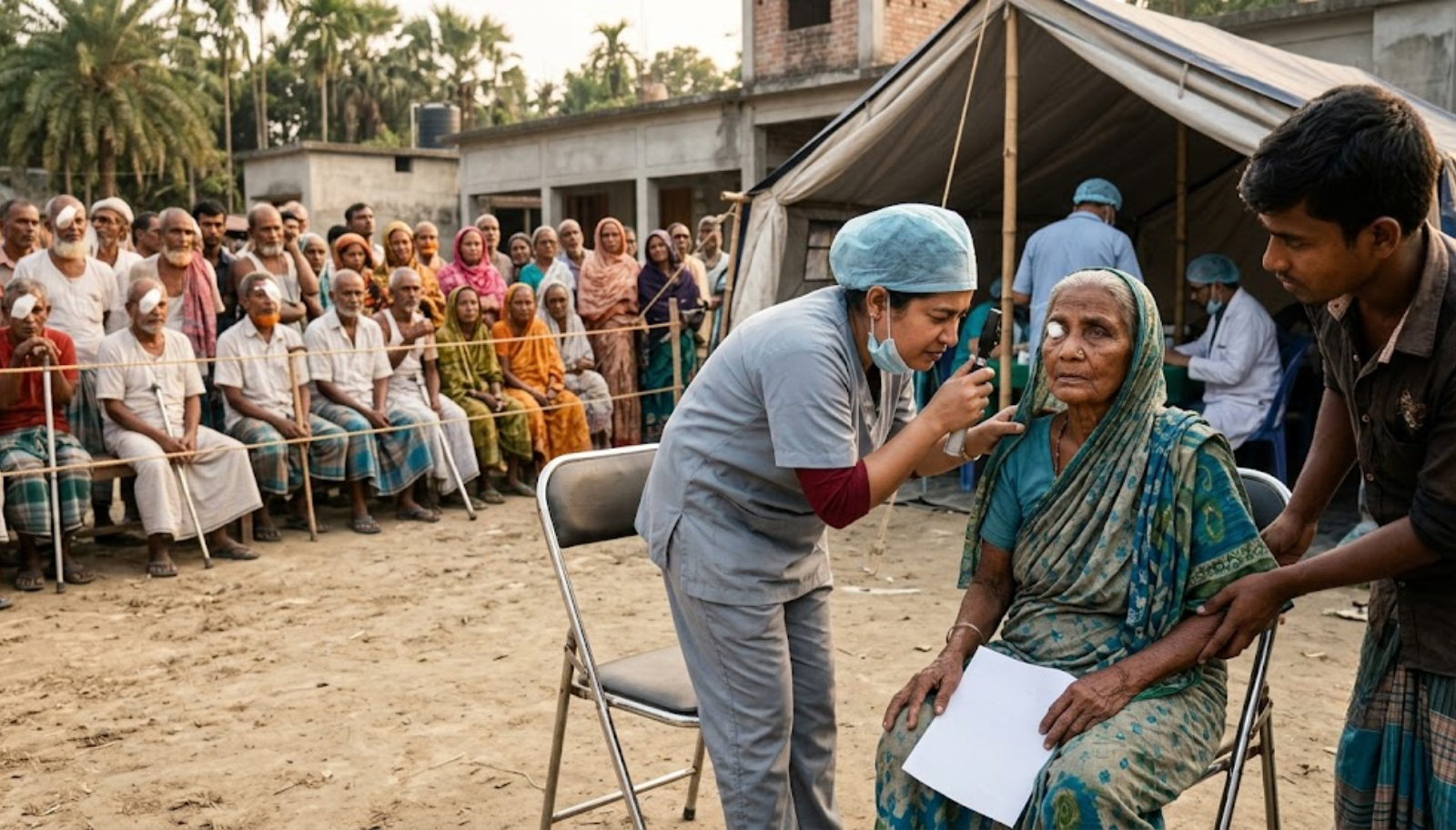
The announcement does not address how this surgical volume will be achieved institutionally, whether through public facilities, private partnerships, NGO-run surgical camps, or some combination of these. Each model carries different implications for quality control, equity of access, and cost. Surgical camps, for instance, can deliver volume but have a documented track record of higher complication rates and no mechanism for post-operative follow-up.
The screening component, while welcome, faces its own sustainability problem. Identifying refractive errors in schoolchildren is relatively straightforward; providing and replacing spectacles over years of a child’s development is not. A screening programme without a supply chain for corrective lenses and frames is a diagnostic exercise that produces no clinical outcome.
Finally, the programme’s relationship to Bangladesh’s broader health system architecture remains unaddressed. Vertical disease-specific programmes, whether for cataract, tuberculosis, or maternal health, have a well-documented tendency to create parallel structures that drain resources and attention from primary care. A cataract programme that builds dedicated surgical capacity without strengthening the district hospitals that should be providing it risks deepening the fragmentation it claims to remedy.
Expanding the Scope
Given the scale of visual impairment in Bangladesh, the government’s decision to target 10 lakh people should be treated as a starting point rather than a ceiling. The true number of people living with treatable cataract blindness is widely believed to exceed this figure, which means a large share of the affected population could remain outside the programme’s reach even if it is fully implemented. Covering more citizens will require the government to actively bring in the private sector and NGOs as formal partners rather than occasional contributors. Private hospitals and eye care chains already operate surgical infrastructure that could be mobilised through subsidised partnership models, easing the pressure on an already strained public system.
NGOs, many of which have decades of experience running rural eye camps and community outreach, bring the last-mile access and trust that government facilities often lack in remote areas. A structured collaboration, with clear standards for quality control and post-operative follow-up, would allow the programme to scale beyond its current target without compromising patient safety. If the government can pair its own funding and policy support with the operational reach of these partners, it stands a far better chance of reaching the full population in need, ensuring that the benefits of restored sight are not limited by an arbitrary numerical cap but extended to everyone who requires care.
Conclusion
The plan to restore sight to 10 lakh people is an initiative whose moral and practical case is beyond dispute. But moral clarity is not a substitute for institutional design. Without a recurrent funding model, transparent capacity planning, integration with primary care, and supply chains that outlast the launch announcement, this programme will restore vision today while leaving the conditions that produced the backlog entirely intact for tomorrow.
Reference: