
Arif Reshad
University of Essex, UK
Bangladesh’s arrival in the community of nuclear energy producing nations came in April 2026, when fuel loading began at the Rooppur Nuclear Power Plant, a genuinely historic turning point that made the country the 33rd in the world to generate electricity from atomic energy. Yet this milestone also throws into sharp relief how underdeveloped the country’s atomic research base remains. The distance between Bangladesh’s operational nuclear ambition and its underlying research capacity is still wide, and left unattended, that gap could become genuinely hazardous.
The Current Landscape of Atomic Research
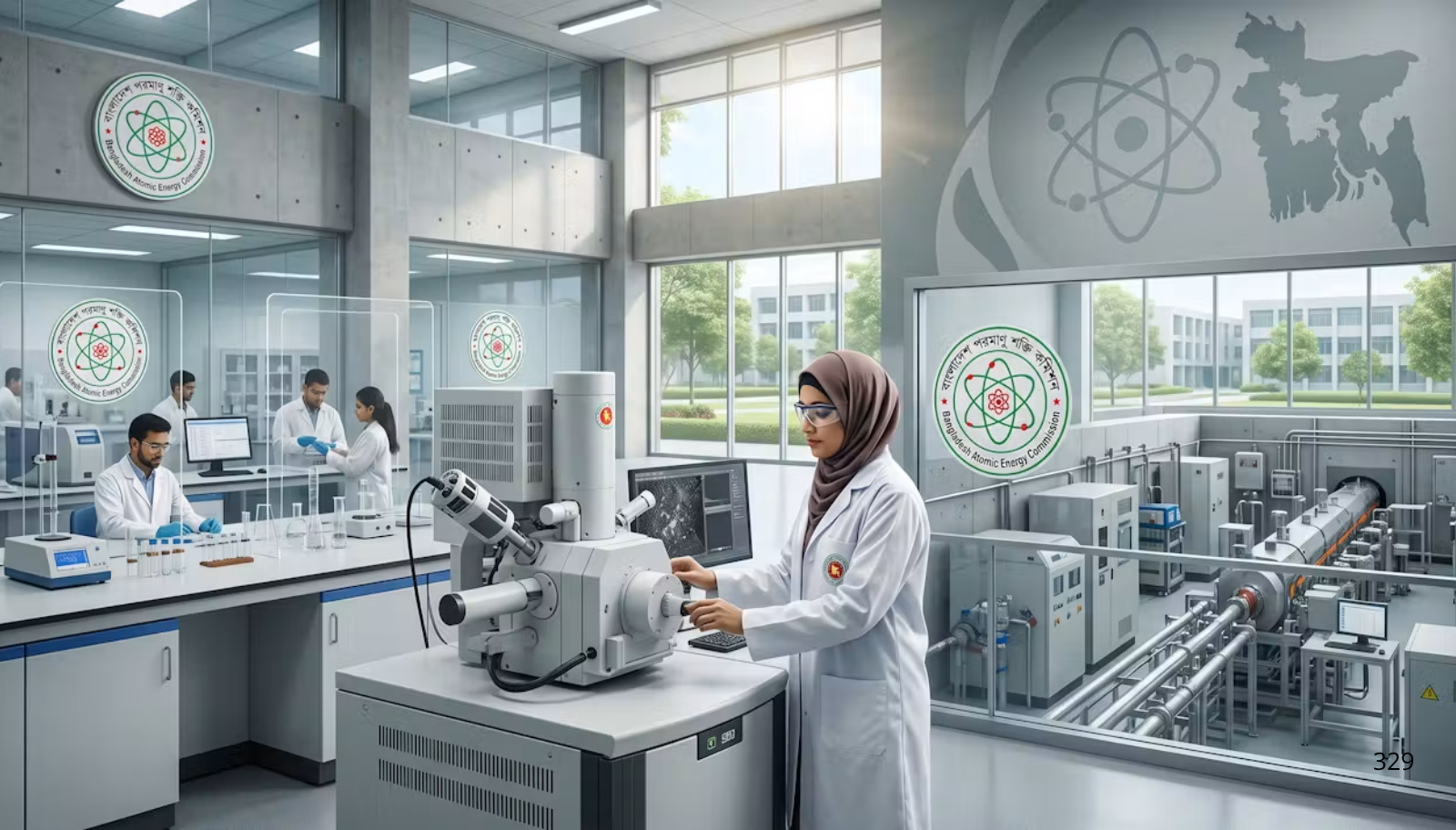
The Bangladesh Atomic Energy Commission, founded in 1973, remains the sole pillar of the country’s atomic research infrastructure, organised across physical sciences, biological sciences, and engineering. Its centrepiece is the 3 MW TRIGA Mark II research reactor at Savar, running since 1986 and used for neutron activation analysis, radiography, scattering experiments, and radioisotope production. The Korea Atomic Energy Research Institute upgraded it in 2024, extending its life, but one ageing reactor cannot support the range of inquiries a country now running a commercial nuclear plant requires.
Beyond the reactor, the Commission runs the Institute of Nuclear Medicine and Allied Sciences in Dhaka and regional centres offering radioisotope based diagnostics and therapy, the Institute of Nuclear Science and Technology at Savar, which handles analytical services and radiation processing including food irradiation and sterilisation, and the Bangladesh Institute of Nuclear Agriculture in Mymensingh, which applies radiation to crop development. These institutions hold genuine capability but operate largely in isolation from each other and from academia, with no shared communication channels, no coordinated national research agenda, and no systematic knowledge management linking the Commission, universities, regulators, and industry.
The academic pipeline is thin. The Military Institute of Science and Technology offers one of the country’s few nuclear science and engineering programmes, and Dhaka University teaches physics with some nuclear orientation, but doctoral level research in atomic physics, nuclear engineering, or radiation science remains scarce. The shortage goes beyond graduate numbers to a lack of experienced faculty, laboratories, and research funding able to attract and keep talent. A country commissioning a 2400-megawatt nuclear plant is producing only a trickle of specialists able to manage, regulate, or advance its nuclear enterprise.
Essential Steps the Government Must Take
A coherent path forward begins with the government drafting a national atomic research strategy that ties research priorities directly to the operational needs of the Rooppur plant, the requirements of the nuclear regulator, and the growing demand for medical, agricultural, and industrial isotopes. A strategy that fails to prioritize is little more than a wish list, so this document needs to identify the questions that only Bangladesh itself can answer how local construction materials behave under neutron irradiation, what radiological properties characterize the sediment and soil of the country’s rivers, and how low dose radiation exposure plays out epidemiologically in a tropical population over time.
Building on that foundation, the country needs to fund and build a second research reactor, one with a higher neutron flux than the current facility, capable of supporting not just isotope production but also materials testing, fuel qualification, and advanced neutron beam research. Relying on a single three-megawatt reactor to simultaneously meet medical isotope demand, training needs, and the materials research required for decades of safe power plant operation places an unrealistic burden on one piece of infrastructure.
None of this can succeed without deeper academic integration, and that integration has to become a structural feature of the education system rather than an occasional initiative. Establishing dedicated departments of nuclear science and engineering at a minimum of five public universities, with joint faculty appointments connecting them to the Atomic Energy Commission, would embed nuclear expertise into the country’s academic backbone. Curricula should be aligned with International Atomic Energy Agency standards while still incorporating problems and datasets specific to Bangladesh.
Public safety considerations point toward the creation of a national radiation monitoring network spanning every division, supported by real time data infrastructure and anchored by a centralized radiological emergency management center. Bangladesh currently lacks the capability to adequately monitor environmental radioactivity or respond to radiological incidents, a gap that becomes far more consequential for a country operating a nuclear power plant on a densely populated alluvial floodplain. Alongside this, an independent radioactive waste management authority should be established to oversee the entire lifecycle of spent fuel, low level waste, and decommissioning byproducts, since waste management cannot continue to function as an afterthought tacked onto the plant operator’s other responsibilities.
Finally, Bangladesh should broaden its international research partnerships well beyond the bilateral arrangements built around the Rooppur project. Systematic engagement with the IAEA, the atomic energy agencies of Korea and Japan, and European nuclear research consortia would allow Bangladeshi researchers to become genuine participants in multinational projects rather than remaining limited to bilateral technology transfer relationships. Nuclear knowledge functions as a global common, and Bangladesh stands to gain by positioning itself as a contributor to those commons rather than merely a recipient of it.