
Nilesh Haldar
Dhaka University
This article examines how slums in Bangladesh’s major metropolitan areas, such as Dhaka, Chattogram, Khulna, Rajshahi and Sylhet, affect the social welfare and social harmony of those cities. It looks at both the strains slums create and the contributions their residents make, and it suggests how policy can turn a source of division into a foundation for shared urban prosperity.
Why Slums Grow
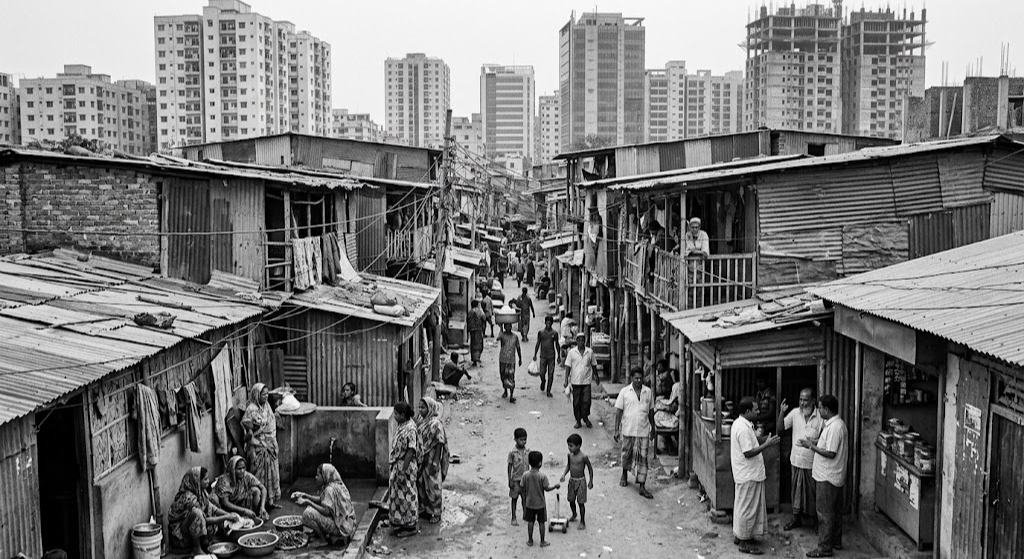
Slums are not an accident. They result from rural poverty, river erosion, floods and cyclones pushing families toward the cities in search of work, while formal housing stays out of reach for low-income households. Land and rents in metropolitan areas outpace what a rickshaw puller, garment worker or domestic helper can pay, so informal settlements rise on public land, railway lines, canal banks and low-lying areas. Millions now live this way, and their numbers keep growing.
Life in a slum is shaped by overcrowding and insecurity. Families share a single small room with limited safe water, sanitation and clean fuel. Open drains and waterlogging spread disease, and monsoon floods worsen it. Fires can destroy whole settlements within hours. Children’s schooling is interrupted by work and evictions, women face heightened risks of harassment and violence, and healthcare remains distant or costly.
These conditions reach beyond the settlements. Disease does not respect boundaries, and a polluted canal or an unvaccinated child becomes the whole city’s concern. Poor health reduces productivity, and poor education locks the next generation into the same cycle, placing a long-term burden on the economy and public services.
It would, however, be a mistake to portray slum residents only as a burden. They form the backbone of the metropolitan workforce. They sew the garments that drive exports, drive rickshaws and delivery vehicles, clean homes, staff shops and construction sites, and sell food and goods on the streets. Without them, the city would stall. Slums also hold strong informal networks of mutual support, where neighbors share food, lend small sums and watch over each other’s children. This social capital is a resource that policy should build on rather than dismantle.
Effects on Social Harmony
The relationship between slum dwellers and the wider city is often marked by distance and distrust. Residents may feel invisible, stigmatized as encroachers or blamed for crime and disorder, even though most are law abiding workers. Wealthier neighbors may regard settlements as eyesores and demand clearance. Repeated forced evictions, often carried out with little notice or alternative housing, deepen resentment and destroy livelihoods, pushing families into even more precarious places.
At the same time, real problems exist. Control of land and utilities in some settlements falls into the hands of local power brokers who extract rent and demand loyalty. Drug trade and petty crime can take root where policing is weak and legal protection is absent. Young people without schooling or work may be drawn into gangs. These realities fuel the cycle of stigma, and they show how neglect, not the character of residents, breeds insecurity. When a city treats part of its population as outsiders, trust erodes, and social cohesion suffers for everyone.
Building a Shared Urban Future
The more promising path is inclusion, and it begins with security of place. Families with secure tenure or long-term leases have reason to invest in their homes and build stable communities. Where relocation is unavoidable, it should be negotiated openly, sited near workplaces and paired with fair compensation, so moving does not mean losing a livelihood.
Security must go hand in hand with decent conditions. Safe water, sanitation, drainage, electricity, waste collection and street lighting should reach every settlement, repaying themselves through better health and productivity. Affordable rental housing near employment centers, including employer built and public private options, would ease the pressure toward informal settlement. Community clinics, schools, training centers and safe spaces for women and children would widen opportunity and weaken the pull of crime.
None of this lasts without a voice for residents. Community committees and transparent dealings with local governments would build trust and replace informal power brokers with accountable institutions. Investing in rural livelihoods and smaller towns would also ease distress migration, tackling the problem at its source rather than only at its destination.
Conclusion
Slums are a mirror held up to the city. They reveal the gaps in housing, services and opportunity, and they show the resilience of people who keep the metropolitans running despite those gaps.
A city that ignores or punishes its slums pays through disease, insecurity and division. A city that includes them gains healthier residents, a stronger workforce and a deeper sense of belonging. For Bangladesh’s metropolitans, social welfare and social harmony will rise or fall together, and the choice to invest in the dignity of slum communities is an investment in the whole city’s future.